Antisemitism is an abomination, unacceptable in any civilised society. Yet, as we look at the current state of our streets and the safety of our citizens, we must confront a jarring reality: the antisemitism which has surged through Australia is not an accidental by-product of global tensions. It is a political import, adopted by certain political parties, facilitated by the mismanagement of our borders and tolerated by a political class more concerned with electoral mathematics than enforcing the law and defunding extremists.
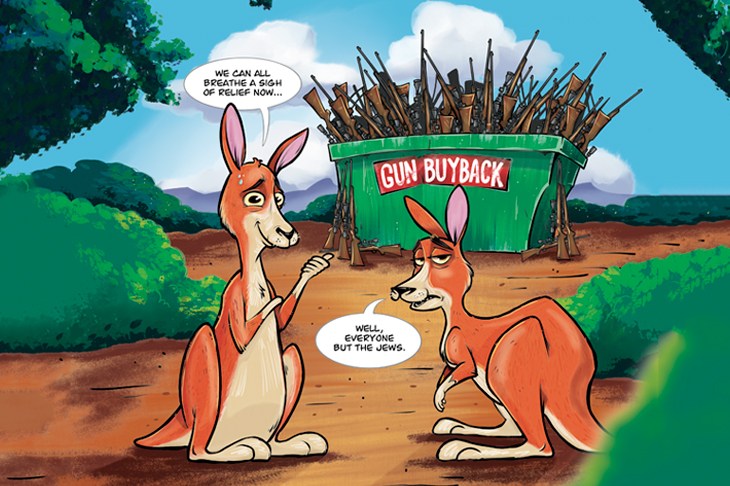
Now, as the Albanese federal government and the Minns NSW government (joined by the ACT) launch Australia’s largest gun buyback since 1996, we are witnessing political theatre at its most cynical. Billed as a response to the December 2025 Bondi Beach terror attack, this scheme creates the illusion of decisive action, masking the uncomfortable truth that both state and federal Labor governments have long tolerated a degree of antisemitism to win elections. As Labor eminence Barry Cohen famously declared in the Sydney Morning Herald on 22 October 2004, antisemitism is ‘rampant’ in the Labor party. As readers of this column may recall, it was in that very year that I saw and heard strong evidence which confirmed this. I have informed the royal commission of this
The surge of hate we see today is the result of what has been termed internationally as the ‘Red-Black Alliance’. Here, it is a marriage of convenience between Labor’s ruling hard-left faction and radical Islamists. The fear of losing western Sydney seats dictates policy. As was put to the caucus by a Labor minister when PM Gillard was being undermined over Palestinian status at the UN: ‘How can I possibly defend that policy from the steps of the Lakemba Mosque?’
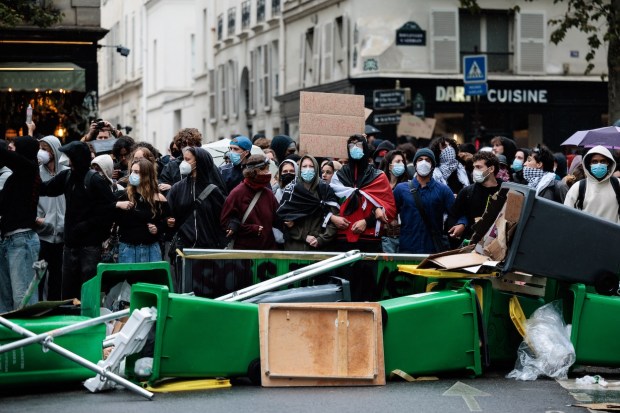
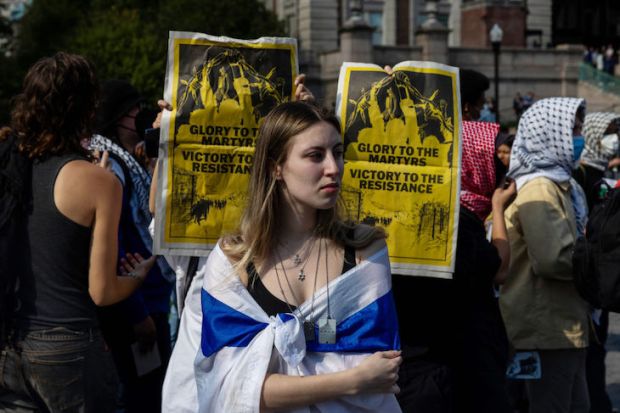
This calculation explains why, following the 7 October 2023 Hamas incursion, protesters from the Sydney Town Hall were chaperoned by the police to the Opera House forecourt. A riot ensued, yet the only person taken into custody was a Jewish man carrying an Israeli flag. It explains the police command spending months on a widely criticised investigation into whether the rioting mob shouted, as they clearly did, ‘Gas the Jews,’ rather than the unidiomatic ‘Where’s the Jews?’ – a desperate attempt to mask Labor’s deliberate inaction.
The contrast in government priorities was never more visible in recent years than at Bondi Beach. During the Covid-19 pandemic, Bondi was flooded with police to enforce the closure of the sand and later to view the photo ID of swimmers. Both were massive, pointless displays of force.
But when it came to the celebration of Hanukkah on 14 December 2025, the police high command refused to allocate even one armed officer, despite a recognised ‘high’ threat level. They offered only passing drop-in officers, despite the fact that private security were required to be unarmed. (They’d previously allocated half a platoon for the arrest of Alan Jones.) This was not merely a failure of policing; it was a symptom of an indecent official toleration—since at least 2004—of a degree of antisemitism as part of unofficial Labor government policy.
It was against this backdrop of a failure to apply the law, the funding of questionable organisations, and a refusal to protect the Jewish community that the Bondi terror attack occurred. The government’s response – a sweeping gun buyback targeting legal firearm owners – neatly distracts from the antisemitism Labor refuses to confront.
Leading in the polls, One Nation’s Pauline Hanson is an outstanding opponent of antisemitism. She has rightfully eviscerated Labor’s approach, cutting through the political spin to point out the obvious: ‘It wasn’t the guns, it was the people behind the guns that are responsible for the Bondi massacre.’
Pointing out that Australia already operates under some of the tightest gun licensing frameworks globally, she accused the Albanese and Minns governments of ‘crucifying those legal gun owners’ and demanding an end to attacks on law-abiding Australians. She rightly noted the absolute inadequacy of financial compensation for firearms handed down through generations, while squarely hitting the mark on the PM: he has never genuinely addressed the men who caused the massacre, nor the ideology that drove them.
This brings us to a broader, persistent institutional refusal to confront the reality of crime and extremism in this country. Just as the political class prefers to ignore the imported nature of rising antisemitism, they deny the cultural realities of organised crime. Historically, criminal syndicates in immigrant-receiving nations have frequently organised along cultural, familial, and ethnic lines – much like the American Mafia, which, while born from an initial migration wave, was sustained for generations by locally born descendants. Australia has seen similar patterns: an underworld that was predominantly Anglo-Celtic until the 1950s was later reshaped by post-war developments, from the emergence of the Calabrian ’Ndrangheta, the ‘Black Hand’, to the Vietnamese syndicates of the 1980s, and subsequently, the deeply entrenched Middle Eastern, extremely wealthy, and warring criminal networks of Sydney’s south-west.
Yet, rather than frankly acknowledging these cultural dynamics, our institutions increasingly prioritise political sensitivity over public candour. The disbandment of the NSW Police Middle Eastern Organised Crime Squad in 2020 was a classic example – a quiet concession to political lobbying designed to sanitise the public narrative and obscure uncomfortable truths.
When gun crime does occur in New South Wales, it is overwhelmingly driven by these hardened networks utilising a pool estimated by the Australian Criminal Intelligence Commission to consist of over 250,000 illicit, unregistered firearms in the black market. Penalising law-abiding, licensed firearm owners with a buyback does absolutely nothing to disarm these syndicates; it is merely another administrative sleight of hand to avoid confronting the real sources of crime.
If we are to arrest this decline, the current Royal Commission into Antisemitism must look beyond individuals and examine the political parties themselves, especially those who have clearly demonstrated a tolerance of antisemitism. We need a fundamental shift in how and to what extent governments enforce the criminal law, protect Jewish citizens, and fund antisemitic groups. Furthermore, we must address the root cause of imported hatred. We need stricter immigration controls, including recorded interviews to ensure immigrants genuinely wish to join our democracy, special care concerning those from lands where there is a long standing hatred of Jews, and often Christians, and a long and thorough Swiss-style probationary period for citizenship. Unless we take strong measures, active antisemitism will stain the reputation and indeed honour of Australia. Otherwise, the charge to our politicians to exercise executive and legislative powers for the ‘peace, order, and good government’ of Australia will remain a hollow phrase. This requires a political solution that places Australian laws and values above the calculated mathematics of winning the next election.
Got something to add? Join the discussion and comment below.
You might disagree with half of it, but you’ll enjoy reading all of it. Try your first month for free, then just $2 a week for the remainder of your first year.