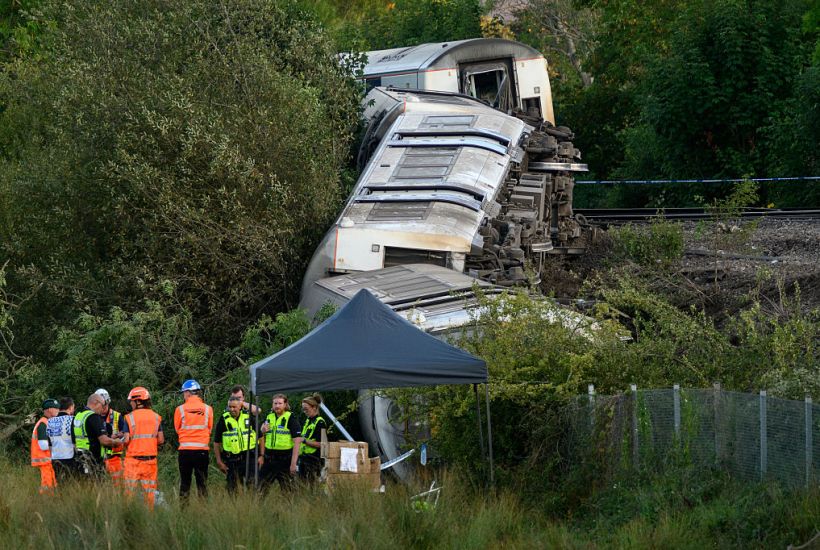
It’s been a bumpy ride for the railways in the past few weeks – quite literally for the passengers on the 14.24 train from Victoria to Eastbourne last Thursday, which derailed near Lewes, resulting in three carriages tumbling down an embankment. This was the latest in a series of incidents in recent weeks that have raised concerns about safety standards in an industry where any mishap immediately attracts huge attention from the media and the public.
The only fatality was on 19 June, when an East Midlands Railways service ran into another train near Bedford, apparently after passing a red signal. The driver was killed in the accident, which is still under investigation by the Rail Accident Investigation Branch.
Then, just under a week later, in an episode that has attracted little media attention, the warning signals at a level crossing near Preston that had recently been repaired failed to sound. As a result, the barriers had not been lowered and a train smashed into a car, in which the driver was killed and a child seriously injured. While most level-crossing accidents are the result of car-driver error, in this case the railway will be held responsible.
While the impact on the people directly involved in these incidents should not be forgotten, in terms of the history of the railways, they are relatively minor. The spectacular pictures of the stricken train near Lewes, with three carriages lying on their sides, would in the past have suggested that there had been multiple casualties. However, thanks to the enormous progress in the design of rail carriages, the coaches were able to withstand the impact and protect the passengers inside. A generation ago, there would not have been such a relatively happy ending.
This is part of the wider story of how the railways have responded to public concerns about safety on the tracks in recent years. A combination of innovative technology and a far greater emphasis on safety has transformed an industry in which lessons were consistently not being learned from successive disasters. For example, it took the 1999 Ladbroke Grove crash in which 31 people died for a basic safety procedure to be implemented that greatly reduced the number of signals being passed at danger – despite it having been available for decades. Today, the general expectation is that there will be no accidents at all across the system.
The improvement has been remarkable. From roughly 150 deaths in the 1970s and 55 in the 1990s, there have been only five fatalities since 2010, including that of the Bedford driver. This reduction, however, has raised fears that complacency has set in. The period included 13 years in which not a single death resulting from a rail accident was recorded (suicides and trespassers, around 275 a year, are not included in the statistics).
Nevertheless, there are concerns among the railway managers I speak to that this record may not be maintained. They are worried that the series of recent incidents that took place in quick succession are not just a blip but, rather, signs that complacency is creeping in. One manager asked, rhetorically: ‘When did you last hear a minister or an industry leader manager speak about safety?’
There is worry, too, that the catalyst may be the structural upheaval caused by the current reorganisation of the railways. The renationalisation and creation of Great British Railways are mostly recognised as a positive move, and it was in fact the Tories who began the process of bringing back together operations and infrastructure in 2018.
The fact that this is a more sensible way of running an industry that was fragmented by privatisation cannot obscure the reality that change can be a poor bed partner of safety. As old barriers tumble and new processes and working methods are established, managers and their staff can lose focus on the basic task of keeping the railway running safely. As one insider put it to me: ‘People become concerned about what role, if any, they will have in the new structure and take their eye off the ball in their day job.’
We have been here before. In the aftermath of privatisation there was a series of four major rail accidents – Southall, Ladbroke Grove, Hatfield and Potters Bar – whose cause could all be attributed to the changes that had taken place in the industry. Fortunately, the gaps in the system were plugged and the safety record immeasurably improved.
Railway managers were, in the past, haunted by recent disasters. But now, with nearly a quarter of a century without an accident that has caused more than a handful of deaths, that collective memory and the consequent attention to safety is being lost.
One industry insider pointed out to me the near-disaster near Wootton Bassett in March 2015. A charter train hauled by a steam engine with more than 500 passengers, mostly rail enthusiasts, and crew aboard passed a signal at danger that was protecting a major junction. The driver had deliberately disabled the warning system, thinking it was malfunctioning and the train came to rest on the junction where a 125 high speed train, carrying more than 200 passengers, had passed just 45 seconds previously. Remarkably, the driver was not jailed for his error but merely given a suspended sentence.
This near-miss should have a permanent place in the railway’s collective memory. The death toll from a 125 train hitting a steam locomotive amidships could well have made it one of the worst, if not the worst, rail accident ever seen within these shores, possibly beating the toll of around 225 at Quintinshill in Cumbria in 1915 when three trains collided. This example is merely to demonstrate that the railways are always just one piece of bad luck and one egregious error away from disaster.
There is still no need for panic. Some 20,000 trains operate safely every day. The car drive to the station remains by far the riskiest part of any journey, given that five people die on our roads every day. But each of these incidents should be a warning: complacency has no place on the railways.