‘Where does Allah put the disbelievers?’ Melbourne mum Rayann El Houli asked her infant son. ‘In the hellfire,’ he repeated after her.
‘Did you see how the mujahedin kill the Kuffar (infidels) with the knife? Look at me,’ she commanded, a jihadist mum in an Islamist version of Kath and Kim. ‘Look at me, how do they slaughter the apostate?’
El Houli travelled from suburban Melbourne to Syria in 2014 with her jihadi husband and is charged with entering or remaining in a declared conflict zone and becoming a member of the terrorist organisation Islamic State.
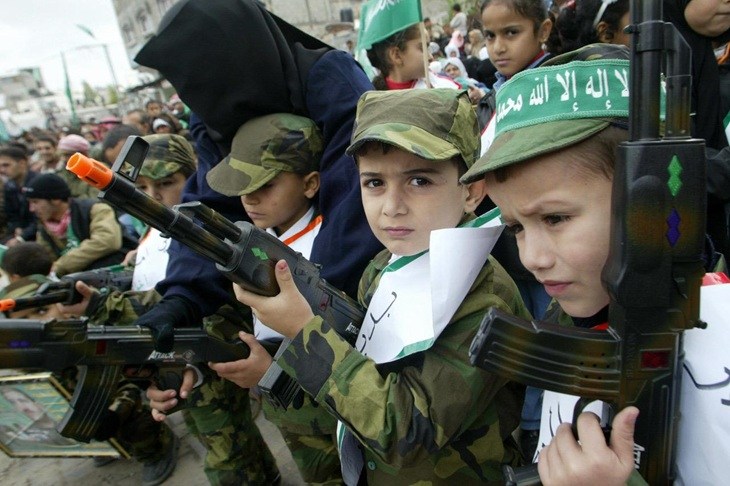
Watching Isis videos with her children was, according to the Crown prosecutor, part of a deliberate process of indoctrination; terror training rather than toilet training.
The maternal moments, captured in videos over a two-year period, showed her homeschooling her children in a house filled with weapons. They slept in a bed with an AK-47 propped up against the wall.
The videos were not screened in court because her lawyer claimed it would have distressed Ms El Houli. Even so, she teared up as the tender transcripts were read out.
Chief prosecutor Andrew Sprague said there was no evidence El Houli had renounced her beliefs. After the deaths of two of her three jihadist husbands, she remarried. On returning to Australia, she declined to participate in a Countering Violent Extremism program and only renounced violent jihad when she faced the prospect of being refused bail.
Her lawyer claims that since returning to Australia her focus has completely shifted toward her duties as a mother, yet it is through motherly love that El Houli arguably poses the greatest threat to her children, and through them, to the wider community.
Moreover, El Houli is related by marriage to convicted terrorist Nacer Abdul Benbrika, who served almost 20 years in prison for leading a cell preparing to commit an attack. Police allege that El Houli expressed the view in 2018 that Benbrika had been ‘persecuted’.
El Houli showed her face in court as a ‘matter of good faith’, having previously appeared in a burqa that covered her entirely. According to her lawyer, this was ‘quite a big deal’. Whether it did the trick or not, the magistrate said that although the evidence against Ms El Houli was strong, he would nonetheless grant her bail. With 13 Australians in Iraqi prisons seeking to return home, and the Albanese government doing nothing to stop them, we may soon find out whether courts will be as lenient when the alleged Isis supporters are men, including the notorious ‘Dr Jihad’.
El Houli’s trial is presumably the sort of case that Australia’s Special Envoy to Combat Islamophobia, Aftab Malik, had in mind when he called for the federal government to remove references in Commonwealth terrorism legislation to religious, ideological and political motivation, to avoid reinforcing the link between Islam and terrorism. Yet, it is hard to escape that link when jihadists dominate terrorist attacks around the world.
Malik’s report is light on substance but heavy on recommendations. There is no definition of Islamophobia, for example, but everyone from school kids to police and parliamentarians to the press is to be educated to prevent them from engaging in it.
As an acknowledgment of how hard it is to master the art of not being Islamophobic, politicians will have to undertake annual refresher courses.
To provide an incentive to comply, Malik wants stronger legal penalties for those who commit the nebulous offence.
The media, in particular, would face increased policing because, in the world according to Malik, it is their repeated reporting of the association between Islam and terrorism that has normalised negative stereotypes.
Malik’s solution is training to encourage more balanced reporting, but nowhere does Malik explain the difference between factual reporting of Islamist terrorism, legitimate criticism of Islamic doctrines, and anti-Muslim prejudice. Without that distinction, journalists can only guess whether their work will be condemned as Islamophobic.
Yet one only has to read Malik’s analysis of the war in Gaza to see that what he considers accurate and balanced looks more like biased and prejudiced. Yes, Malik condemns the terrorist slaughter of 7 October 2023, but Hamas is not even mentioned. From then on, his focus is exclusively on Palestinian suffering, which Malik blames entirely on the Israeli military. There is no acknowledgment that Israel faced a war of annihilation launched by Hamas, which took Israeli hostages, refused to provide underground shelter to its civilians, embedded military infrastructure in their midst and stole humanitarian aid.
More broadly, if Islamophobia is so hard to define that even a special envoy is defeated by the challenge, how can it form the basis for mandatory education across schools, universities, workplaces, and Parliament?
More to the point, why should Australians be asked to avoid the shape-shifting offence rather than requiring the members of Islamic organisations with Islamist tendencies to adhere, like all other Australians, to our liberal democratic norms?
Malik condemns violent extremism but offers no proposals for dealing with it (other than to ‘educate’ people, not to mention its connection to Islam). He has nothing to offer on shutting down hate preachers, ending foreign funding of extremists, combating online recruitment, or preventing extremism from taking root in mainstream Muslim communities. Where he does discuss counter-terrorism, the emphasis is on ensuring that laws do not stigmatise Muslims rather than protecting Australians, including Muslims, from Islamists.
Islamophobia is usually cast as the mirror image of antisemitism. It is not. Antisemitism traffics in age-old falsehoods about Jews (and, by extension, the Jewish state) to justify hatred, discrimination and persecution. Islamophobia is usually wielded as a stealth weapon against those who legitimately criticise Islamism or Islam.
It’s a relief that Albanese rejected Malik’s call to change terrorism laws, or to hold a commission of inquiry into ‘anti-Palestinian discrimination’. Nonetheless, the PM has agreed to establish an Islamophobia Education Taskforce to review the school curriculum – rooting out traces of Islamophobia and nurturing Islamophilia. He has also supported a new Islamic Australian research institute to promote the positive contribution of Islam to Australia as opposed to contributions such as no longer being able to fly with nail scissors in our hand luggage.
If combating Islamophobia means journalists, politicians and ordinary Australians can’t discuss terrorism without risking accusations of prejudice or worse, it has no place in a liberal democracy and the PM’s response to his envoy’s report will only strengthen support for One Nation.
Got something to add? Join the discussion and comment below.
You might disagree with half of it, but you’ll enjoy reading all of it. Try your first month for free, then just $2 a week for the remainder of your first year.