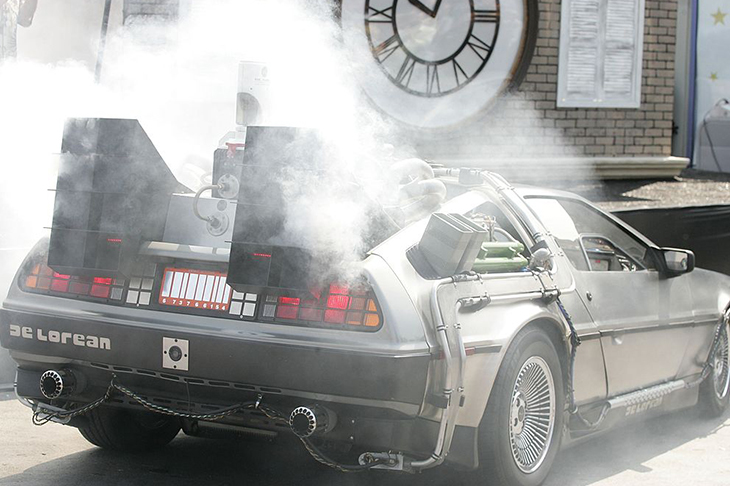
Here is a useful test of human endurance. You are trapped in a lift in Wellington for ten hours with a stranger. Would you plump for the person who insists on repeatedly announcing their preferred pronouns, a man who incessantly plays ‘amazing’ YouTube clips? Or an antinuclear bore? Choose carefully. The last is the worst, as the most recent American ambassador to New Zealand, Jared Novelly, is discovering. At his first media conference in Wellington, he joked about borrowing the DeLorean from Back to the Future and returning to the 1980s. A harmless line, until he reached for the dreaded N-word. ‘Perhaps I could fix this nuclear thing,’ Novelly said.
Poor guy. Poorer still if his attachés are sending him the less-than-ecstatic press clips about his desire ‘to work with New Zealand on that exact topic’.
The chief danger of New Zealand’s nuclear-free policy was never nuclear war. It’s the conversation around it. One careless mention of Anzus, and any room is transported to a broken-down lift – or perhaps an old Methodist church hall in 1986, the sort David Lange might have attended before he started the antinuke ball rolling. Someone finds a badge. Someone remembers a march. Someone says ‘Moruroa’ with feeling. Before long, the wine is untouched, the Americans have been blamed, and a man in sandals is explaining nuclear propulsion to the room. The antinuclear bore is not merely tiresome. He bores for New Zealand. Many of them, alas, are journalists of a certain vintage.
Every country has a subject on which its people become unbearable. The British have the war. Americans have you-know-who in the White House. Australians have sport, which, heartbreakingly, they do not always excel at. New Zealand has a nuclear-free policy.
And what a policy it is. It combines foreign affairs with moral hygiene, Pacific grievance with anti-American memory, and the comforting belief that a small country, if far enough away, can still figure as a kind of moral superpower.
The policy itself, which banned nuclear-capable vessels from entering New Zealand’s ports, was not entirely ridiculous. Well, not at first. Opposition to nuclear testing in the Pacific had its arguments. France was detonating devices at Moruroa. Then, in 1985, French agents blew up the Rainbow Warrior in Auckland Harbour and killed poor old Fernando Pereira. A protest cause morphed into a national sacrament. And why not? Nothing confirms a country in its virtue like being bombed by the French.
It wasn’t that New Zealand was wrong. The difficulty was that it so enjoyed being right. Here was a country in the 1980s with tens of millions of sheep – a few million of them living in the cities – and a defence force whose most lethal weapon was distance. It told Washington to shove its nuclear ships where the South Pacific sun doesn’t shine.
The United States, pursuing its policy of neither confirming nor denying what was on board, declined to be frisked by Wellington. The relationship froze. Anzus buckled.
By and large, the New Zealand establishment loved it. The Americans downgraded military and intelligence links. New Zealand upgraded its self-image.
The saint of the moment was David Lange, the country’s Bunteresque premier, who on a good day had the timing of a nightclub comic. His 1985 Oxford Union debate against Jerry Falwell, which was not one of those days, has since become holy secular writ in New Zealand.
During the debate, Lange told a toff interjector he could smell uranium on his breath – a terrible line, let’s be honest, but one that forty-one years on still does much journalistic service. The great Labour prime minister from Kiwiland, laying low the Pentagon, evangelical America and nuclear deterrence in one uranium-flecked breath.
Since then, nuclear-free New Zealand has become a national reflex. It sits beside the country’s vaunted, and factually suspect, clean, green image, along with being outdoorsy and egalitarian. Journalists have long been drilled on protocol, soliciting an approving opinion from any new celebrity arrival. (As a callow young reporter, I remember Talking Heads frontman David Byrne being asked about it at the airport. Byrne: ‘I just got off the plane.’)
The niggly part is geography. New Zealand’s antinuclear virtue, like its Covid policies a generation later, was always hugely subsidised by distance. It’s infinitely easier to be high-minded at the end of the world, especially when other countries still do the vulgar work of keeping sea lanes open and hostile powers at bay.
Mention this in New Zealand, however, as the new American ambassador now has, and you will be told you have not understood the moral clarity of the 1980s. Perhaps you haven’t. For many New Zealanders, the antinuclear struggle is the last uncomplicated national victory this side of Jacinda: after Vietnam, before neoliberalism; after ‘Piggy’ Muldoon, before housing unaffordability; before climate change turned moral purity into heat pumps.
That is the trouble with moral victories. Eventually they stop being argued and start being inherited. No government in Wellington would now repeal the nuclear-free law. That would be like abolishing pavlova, which New Zealand did not invent, or announcing that Sir Edmund Hillary was a tad over-praised.
The rest of the world moved on. China, as we have seen this past week with its military antics in the region, is not impressed. Russia couldn’t give a hoot about Dave Dobbyn’s protest songs. The US, once the bullying parent in the story, is now anxiously courted in other forums – Aukus, Five Eyes, and all the rest. Australia is buying nuclear-powered submarines, not nuclear-armed – a distinction that can spur the bore for another four hours.
‘We don’t like to be told what to do; that’s a good New Zealand-Kiwi characteristic,’ said former foreign minister Phil Goff in response to the new ambassador’s remarks, ‘and we won’t be told by any other country what to do.’
Which takes us back to the lift. The pronoun-signature enthusiast would be done by floor three. The YouTube clip person would need restraint once the battery hit 20 per cent, and an ugly fight could ensue if you forced the clod to switch it to Sky News Australia.
But the antinuclear bore endureth. He has range. He can get from Moruroa to Aukus without drawing breath, pausing only to correct your pronunciation of the word ‘newclear’. By hour nine, you will not want a rescue party. You’ll want Jared Novelly’s DeLorean.
Got something to add? Join the discussion and comment below.
You might disagree with half of it, but you’ll enjoy reading all of it. Try your first month for free, then just $2 a week for the remainder of your first year.