
What are the circumstances in which it is right to smash up a building? When might one justifiably destroy an artwork? And what are the conditions under which one might splinter someone’s spine with a sledgehammer?
Many on the left seem to have satisfied themselves on all these questions. But I wonder if they have even begun to reckon with the consequences.
One can only hope that those who urge on ‘direct action’ have no idea how slippery a slope they are on
Back in 2019 a group of activists from Extinction Rebellion took their views on fossil fuels to Belvedere Road in central London. There, at the site of the Shell building, they smashed windows, spray-painted walls and caused other criminal damage. At their subsequent trial at Southwark Crown Court, the judge instructed the jury that the accused had no defence in law. The jury acquitted them anyway, having apparently decided it is permissible to smash a building up if said building belongs to an oil and gas company.
As the years go on it becomes ever clearer that this country could have done with an energy policy which did not demonise oil and gas. But once it is decided that the headquarters of Shell, BP and any other energy company are fair game, you tilt the balance. Suddenly ‘activists’ become the provisional wing of the net-zero zealots and ‘direct action’ takes a step into acceptability.
Fast-forward a few years to March 2024 and it was a painting by the great Hungarian émigré artist Philip de Laszlo that was attacked. The portrait of Lord Arthur Balfour was hanging on a wall at Trinity College, Cambridge when an activist filmed themselves slashing it and spray-painting it red. So far as I can work out nobody has ever been charged with the attack.
De Laszlo was a Jewish-born painter, but it seems his painting was attacked because his subject was guilty of signing the ‘Balfour declaration’ in 1917, setting out the conditions under which the British government was willing to recognise the recreation of a Jewish state. Neither de Laszlo nor Balfour seem to have many defenders today – certainly not at Cambridge University. And so another precedent was set. If you would like to find an exquisite portrait of a person from the past whose actions you disagree with, then go ahead and destroy it if you like.
And so we come to the question of the sledgehammer. Some figures on the British left appear to have decided that people should be excused from smashing the spines of policewomen with sledgehammers. It is nearly two years now since a group of ‘activists’ – once again from Palestine Action – went into an arms company’s headquarters outside Bristol. Dressed in boilersuits and carrying sledgehammers, they started by smashing up computers; when the police arrived one of the activists took two swings at a female police officer, using a seven-pound sledgehammer, fracturing her spine.
In the days since some of those activists received sentences for their crimes, portions of the left have decided that the issue in question is whether or not the disabling of a female police officer was ‘intentional’ or not. Grievous bodily harm in itself seems not to be a particular problem for them. The question is ‘intent’ and the circumstances in which GBH is now permissible. As with the attack on the de Laszlo portrait the general justification seems to be ‘but genocide’.
As it happens the claim that there has been anything like a genocide in Gaza is a malevolent lie. What has been happening since 7 October 2023 has been a war – one which Hamas started. But the genocide lie – which started around 2005 – is pushed by people who then insist, as one left-wing British journalist put it this week: ‘You have a responsibility to do everything in your power to stop it.’ So the ‘stop the genocide’ lobby whip themselves up into a state of rage over a lie and then make excuses for each other when they start swinging sledgehammers. An action that used to be regarded as the place where political disagreement stopped and political violence began becomes tolerated.
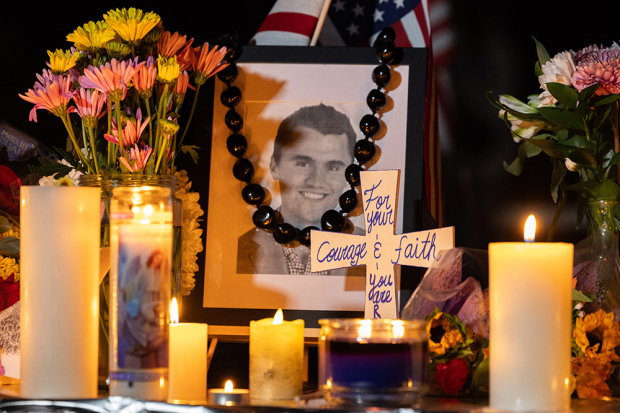
This not-so-subtle erosion of values mirrors something that has lately been happening in the US, where the murder of a healthcare executive on the streets of New York has been turned into a moral argument by the American left. Under what circumstances is it permissible to shoot a married father of two? In the same way there have been those who have decided that the words of someone like Charlie Kirk can best be responded to not with words but with bullets. A conservative activist was assaulted this week on the streets of Britain, doing something similar to Kirk, and we shall see how tolerated that is.
One can only hope that the people who urge on such ‘direct action’ have no idea of how slippery a slope they are on and that they have not worked out yet that political violence need not solely belong to one political side. In the US most weapons are held by people on the political right. It really wouldn’t be in the interests of the political left to embolden the idea of ‘direct action’.
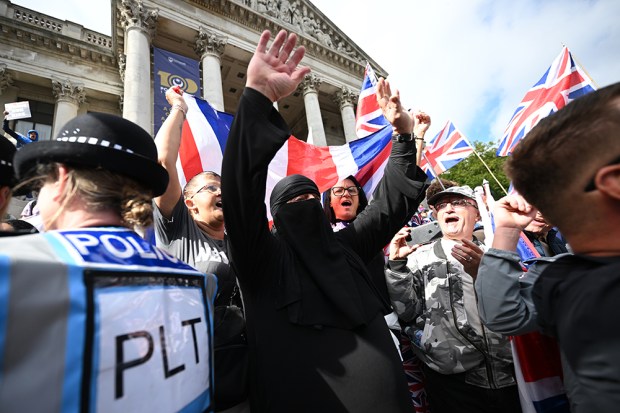
In the UK the stakes are – for now – measurably less severe. But they are there. If buildings can be smashed up for a ‘righteous cause’, works of art can be destroyed for historically illiterate ‘moral’ reasons and police can have their spines smashed for a good cause then I have news for the radicalising left. Which is that – as unrest from Southport to Belfast has shown – the violence might come from surprising places.
Many people think they have a moral cause. Many people are angry about many things. Some of their grievances are justified. Others are imaginary. But the debate does not stop when the sledgehammers come out. It simply becomes something different. For now, ‘direct action’ has been justified by only one political side. The radical left better hope that their opponents don’t notice if the rules of the game are changing.
Got something to add? Join the discussion and comment below.
You might disagree with half of it, but you’ll enjoy reading all of it. Try your first month for free, then just $2 a week for the remainder of your first year.