To begin at the beginning: the title. ‘Unbeatable, Unbearable’ is supposedly Winston Churchill’s opinion of Bernard Montgomery – that in defeat he was the first, and in victory the second. Gary Mead acknowledges that it is merely ‘attributed’ to Churchill. According to the late Richard Langworth, the unrivalled curator of Churchillian wit and wisdom, it and the rather more grandiloquent ‘In defeat, indomitable; in victory, insufferable’ are widely bruited about but are not in the Churchill canon.
Does it matter? We can be confident that the other major Allied figures of the second world war who dealt with Monty – Alanbrooke, Eisenhower and Ismay – would not have disagreed too much. But key is the word ‘victory’, which was in short supply in the early years of the war. One well-attested Churchill quote is: ‘Before Alamein we never had a victory. After Alamein we never had a defeat.’ In fact Churchill was more circumspect, presaging it with: ‘It may almost be said.’ The RAF, after all, had turned the strategic tide in the Battle of Britain; Richard O’Connor’s Western Desert Force had destroyed an Italian army of ten divisions in Cyrenaica; and the Royal Navy had put an effective end to German surface raiding in the North Atlantic.
‘An abusive childhood distorted all his future relationships and scarred him – and many others – for life’
Otherwise, it had been one disaster after another; and Alamein in October-November 1942 was Monty’s victory, for which Churchill allowed the church bells – silenced, ready to warn of invasion – to be rung in celebration. Montgomery’s viscountcy is ‘of Alamein’. He subsequently commanded during the invasion of Italy, and all Allied ground forces in north-west Europe from D-Day until the liberation of Paris; then all British, Canadian and Polish troops until VE Day. He governed the most important sector of western Germany after the surrender and became chief of the imperial general staff and then Nato’s first deputy supreme Allied commander (under Eisenhower again).
So what is Mead’s concern?
I was born shortly after the war, and early on drank deeply at the well of the Montgomery myth – the military hero. I grew up in the 1960s, when Montgomery was still highly esteemed by the British public; his name was synonymous with courage. Doubts about his sexuality or racial bigotry had not clouded his reputation. Then his shining image started shedding flakes, as his personal characteristics and values – his rudeness, his meanness, his vanity, his pettiness, his prejudices and his proclivities – became better known.
But of course there’s more to it than tarnish. There are the contradictions:
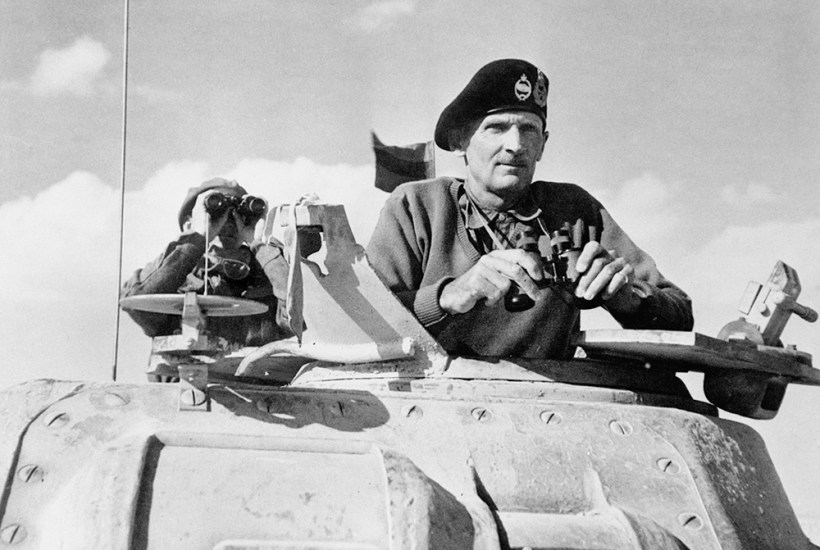
At around 5 feet 6 inches tall, weighing some ten stones, with a squeaky, high-pitched voice, an unmistakable speech impediment (pronouncing the letter ‘r’ as a ‘w’) and a chest measurement of just 34 inches, Montgomery was far from the conventional image of a strapping warrior. Yet this unprepossessing figure had by D-Day become the most publicly recognisable and (almost) universally adored British army officer since the Duke of Wellington. But how many people today could pin a name to that face?
Indeed, how many could even do the same for Wellington?
Mead relates how in 2011 the National Army Museum conducted a poll to ascertain who most deserved the title ‘Britain’s greatest general’. A field of 20 was whittled down to five: Oliver Cromwell, the Duke of Marl-borough, the Duke of Wellington, Douglas Haig and William Slim. Not Montgomery. But any poll placing Haig on a shortlist – or even a long one – ought at once to be discounted. (Haig, in fact, is the subject of Mead’s first biography, The Good Soldier. He does give himself trouble; but his career has been in journalism, specialising in trouble, beginning by reporting for the New Statesman on the rise of Solidarity and the imposition of martial law in Poland.)
Montgomery’s early life is chronicled briskly, with Mead concluding that he had ‘an abusive childhood. It distorted all his future relationships; poisoned his adulthood; scarred him – and many others – for life’. But he hedges rather by saying:
Montgomery might appear to be psychologically disordered, but efforts that have been made to diagnose him retrospectively are simplistically reductive, destined to be inadequate. Prone to extreme tactlessness and insufferable arrogance, he could also be kindly and generous-spirited.
But what about that word ‘proclivities’, quoted earlier? Mead cites Alun Chalfont’s biography, published in 1976, the year Montgomery died:
There was always something disturbingly equivocal about his attitude towards boys and young men. In their company he often seemed to display a heightened awareness and an almost febrile gaiety.
Field Marshal Sir Gerald Templer, who served under Montgomery in Germany after the war, was so incensed that he rebuked Chalfont on the steps of St George’s Chapel after the funeral. And Philip Hensher, in his Observer review of Nigel Hamilton’s 2001 biography, said that the evidence for Montgomery’s homosexuality was ‘pretty thin’.
This is, nonetheless, a serious, thorough and compelling book. There are a few mistakes, some trivial. Montgomery’s maternal grandfather, Frederic Farrar, was Dean of Canterbury, not Westminster. More substantial is the confusion about the appointment of Montgomery to command Eighth Army, which Mead says was ‘then called XIII Corps’. XIII Corps was in fact a constituent of Eighth Army, and its commander, ‘Strafer’ Gott, was Churchill’s first choice to replace Neil Ritchie as Eighth Army commander, whom Claude Auchinleck, commander-in-chief Middle East, had sidelined in June 1942, assuming temporary personal command. Gott was killed when his plane was shot down a few days before he was due to take over. Mead says that Alamein was Rommel’s to lose rather than Montgomery’s to win. In terms of material, perhaps. But as Napoleon is quoted as saying, the morale is to the material as three is to one, and Eighth Army’s morale was distinctly uncertain. After the war, Montgomery said that if Gott had not been killed we would have lost the Middle East. Crass, perhaps, but in his heart Gott might have agreed. He’d told Auchinleck that he didn’t feel up to the job; that he’d tried everything and it needed someone instead with new ideas.
His genius was to inspire a largely citizen army to take on and beat the battle-hardened Germans
Mead follows the fashionable convention of viewing Operation Market Garden (Arnhem) as Monty’s mistaken tactical alternative to clearing the Scheldt estuary. The argument was in fact a strategic one about the whole approach to invading Germany, one over which British and US chiefs of staff in London and Washington disagreed, not simply Montgomery and Eisenhower. Mead does concede, though, that US General Omar Bradley thought the operation ‘one of the most imaginative of the war’.
Of course Montgomery was a showman:
He recognised the importance and value of being a colourful character when most of his peers were run-of-the-mill and undistinguished… For Montgomery, there was no difference between being a showman and a leader.
His love of publicity became a disease, however – an addiction, according to Ismay, Churchill’s chief military assistant. He undoubtedly became a liability to both himself and Allied relations after the war.
Nevertheless, Mead recognises that Montgomery’s genius was his ability to inspire a largely citizen army, with limited experience of battle and often inferior weapons, to take on and beat the battle-hardened German army and SS. Who else, indeed, could have told them that D-Day was ‘a perfectly normal operation of war’ and been believed?
Got something to add? Join the discussion and comment below.
You might disagree with half of it, but you’ll enjoy reading all of it. Try your first month for free, then just $2 a week for the remainder of your first year.