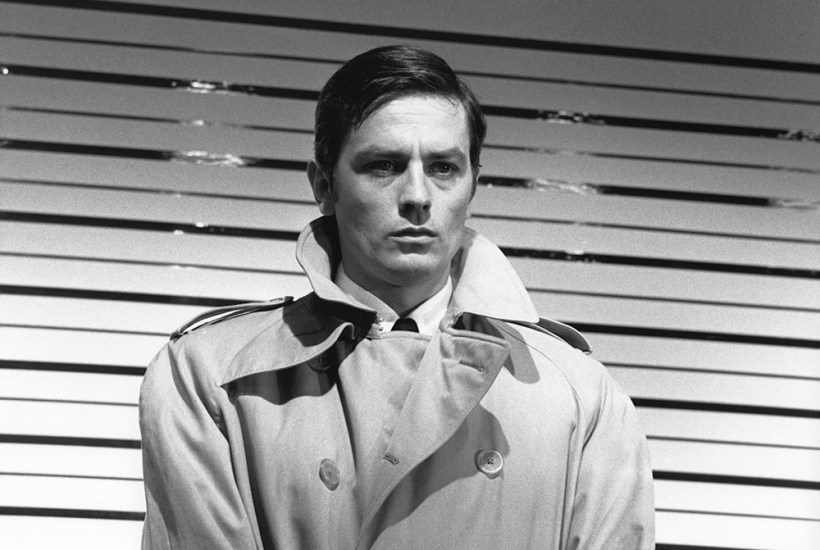
A photograph from the late 1960s shows a lavishly underdressed Marianne Faithfull sandwiched between Alain Delon, the most beautiful man in the world, and Mick Jagger, the second most beautiful man in the Rolling Stones. The gulf between these two indefatigable tombeurs is not merely sartorial. Delon wears a sharp suit, gun-metal grey, and a black tie. There are the makings of a master/servant dialogue here, for Jagger, far from mondaine, is gauche and scruffy with mismatched socks, no doubt counter-cultural. His picayune mis-demeanour, and his fitting up by bad apples in blue such as Pilcher of the Met, might have been a glitch, but it all turned out cosily parish-pump and, further, a great career move, assisted by William Rees-Mogg’s indignation. No one died in that Sussex cottage.
The English are, according to the rest of Europe, repressed, priggish and unarmed. They don’t have what it takes to excel in scandal: Jeremy Thorpe, John Stonehouse, John Profumo, Peter Mandelson’s pants. There is a whiff of Donald McGill about it – all Rinka, luncheon vouchers and Cynthia Payne. It is far removed from the enormities of Delon’s mafia-derived, smack-financed code of ‘honour’ in the milieu, or pègre, where respect, silence and loyalty are everything – until they’re not, when a grass is liable to end up on a waste tip with his severed genitals in his mouth (a signature of the FLN). That world was made public in the 1968 Markovic scandal, when a young Yugoslav man in Delon’s entourage was found murdered. The case remains unsolved.
It seemed that no one in France’s stellar echelons was uncompromised by the discovery of Markovic’s corpse
Survivors clung to the lower steps of the hierarchy, fulfilling a fate which did not match what they dreamed of in their native provinces. Desperation caused them to plunge to the murkiest depths, abasing themselves, betraying occasional acts of kindness and the benefactors to whom they were beholden. The patronage they received was provisional; they yearned for stability rather than having to run errands and heave suitcases whose contents they are ignorant of.
Beni oui-oui is a derogatory moniker, meaning ‘yes man’ or ‘gofer’. Given what befalls the two most prominent of this ilk in Edward Chisholm’s unsparing account of the Markovic Affair, it is a high-risk vocation which creates dependency-going-on-vassalage and the trap of cap-in-handreliance. These people are not, however, alone. Everyone, no matter how apparently powerful, is capable of suffering enforced subjugation in manacles they cannot necessarily see. It seemed there was no one in France’s stellar echelons who was uncompromised by the rotting corpse that proved to be that of Stevan Markovic, found by an itinerant worker in Paris’s south-western suburbs.
That was in October 1968. Even Ayatollah Khomeni would get in the frame, checking into a rented villa in nearby Neaulphe-le-Château some years later, when coverage of the affair showed no signs of abating. The French gutter press has an unquenchable appetite for faits divers, shared by thousands of readers. The case, for instance, of le petit Grégory, the four-year-old boy murdered in the Vosges in 1984, is even now treated as though it were current. There is always a new suspect or a new crank who has read the entrails. It is the boy’s great-aunt who is currently under investigation, again.
In this book, what Alain and Nathalie Delon, Georges and Claude Pompidou, Jean-Pierre Melville and dozens of other film people, politicians, policemen, spooks, journalists, former collaborators, party people and orgiasts have in common is an inchoate yearning to be people they are not. Delon wanted to be the mute hitman protagonist of what would become Melville’s (and Europe’s) greatest film, Le Samouraï. Indeed he announced: ‘I am Jef Costello.’ That was more than actorly bluster and histrionic identification. It was like a psychopathy. In his other films he performs; in Le Samouraï he simply is. He infects Chisholm’s book like a malign revenant. He was indulged by Melville, a pretend Texan, who drove around Paris in a Plymouth Fury wearing a stetson and aviator shades. Prime Minister Pompidou merely wanted to be president; while a hired horizontale, posing for lubricious polaroids, claimed to be his wife, Claude. Who was blackmailing whom? As for the murdered Markovic, Delon’s friend and bodyguard, he wanted to be Delon himself, in his black Ferrari 250 GT short-wheelbase California Spyder, fewer than 100 built – information that’s typically uncovered by assiduous research. Quite properly, Chisholm’s dogged method does not recognise such a thing as useless information. Everything is pertinent. All five archival tons of it.
He writes teasingly that the Ben Barka Affair had nothing to do with Markovic and then goes on to prove the contrary. Mehdi Ben Barka, the Moroccan dissident deemed dangerous by King Hassan II, was abducted in Paris on his orders in 1965 and murdered by moonlighting footsoldiers of the SDECE, France’s external intelligence agency. Its informal networks, predictably, relied on loyalty and silence rather than the law. The morally squalid president was of course party to this antinomian ‘architecture of power’, already demonstrated by the use of barbouzes in Algeria late in the war.
Charles de Gaulle – at treacherous arm’s length of course – had employed former collaborators and amnestied criminals to attack small shopkeepers and dirt farmers. The most powerful man in the country declared guerrilla war on Algeria’s petits gens, who believed they were French citizens. Would this man have been prepared to scupper Pompidou, his heir apparent, in a plot that went wrong? Markovic’s body might never have been discovered, and the industry that has developed would have been thwarted. There’s no doubt that it is an industry. Chisholm gives us 30 pages of index, bibliography and endnotes.
The cast might be trashy, but this is a serious, engaging, obliquely structured book and, according to the author, the first time the Markovic Affair as been written about so comprehensively in English. That seems likely. Much of the story is related in the voices of the participants – a neat ploy, well managed by a polished writer. Those fascinated by the political pickings from the jewelled sump of 60 years ago should also read La Sale Affaire Markovic by Jean-Pax Méfret, sometime political prisoner, singer, journalist and (still) militant for the tragically lost cause of Algeria, a resentful client state.
Got something to add? Join the discussion and comment below.
You might disagree with half of it, but you’ll enjoy reading all of it. Try your first month for free, then just $2 a week for the remainder of your first year.