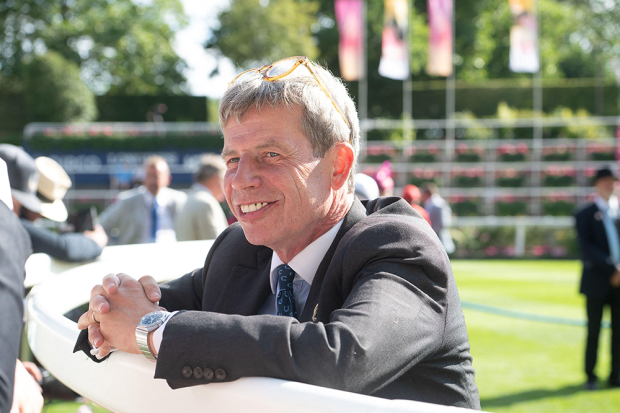
You meet an eclectic bunch of people in the horse-racing business. Yet it was at prep school 55 years ago that I first met Simon Marsh, who is the guiding light at Andrew and Madeleine Lloyd Webber’s Watership Down stud near Newbury.
‘Bog’, as we knew him, didn’t reappear after the summer holidays and word got to us that a garage door had fallen on his head. We were told to clear his locker. RIP Bog Marsh, we thought.
Many years later, someone called ‘Pie’ Marsh arrived in Lambourn. He looked and sounded like Bog and had a slight dent in his head, but apart from that he was very chipper.
It turned out that Bog had skulked off to Harrow where he’d scooped up two F-grades in his A-levels. There must have been difficulties with the third subject. And then he’d been packed off on a container ship to South America, before they’d had enough of him and moved him on to Australia.
‘Anyone will give you a job shovelling shit, but it gets more difficult if you want to progress’
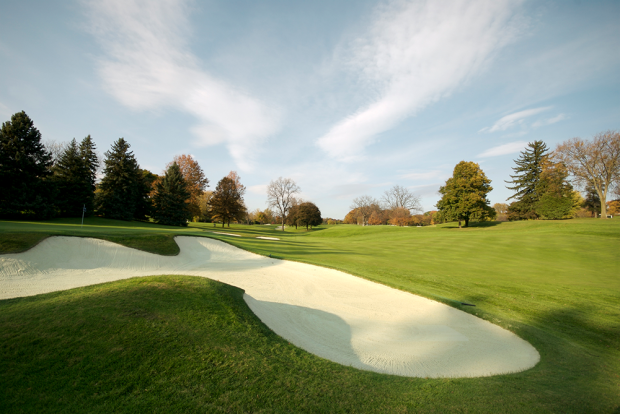
It was to discuss the rise and rise of Watership Down stud and Bog’s genius that we gathered at the Berkshire golf club; although I suspect Lady Lloyd-Webber might say ‘our genius’.
A couple of his fellow young thrusters of the Jockey Club joined us to talk mares and stallions as we hacked our way around the blue course. ‘Oh shit,’ Pie roared on the first tee box, as he carved his drive in the direction of Ascot racecourse. An elderly member in magnificent pink long socks on the nearby putting practice green had a coronary and was carted off. Pie’s language deteriorated thereafter.
We chewed over his early years as we wandered down the first fairway. ‘Anyone will give you a job shovelling shit, but it gets more difficult if you want to progress,’ he observed. And without any family connections in racing, he did a lot of shovelling.
‘Some of the most successful people I know didn’t have any family connections in racing. In England I don’t think it is necessarily a generational thing, unlike Ireland, where breeding cattle and horses is in their DNA.’
After years of working at the coal face of the industry – from the Niarchos family’s Normandy stud farm Haras de Fresnay-le-Buffard to Pacemaker magazine in London, where he sold advertising, Marsh struck out on his own and founded Myriad Communications. He didn’t learn that title at Harrow.
At the same time his old mucker Madeleine, who had done more than her fair share of shovelling herself, met Andrew Lloyd Webber, who didn’t want his bride breaking her neck riding around Badminton, so it was decided they’d buy a racehorse instead.
Dusty Miller was the first horse they bought, and it won its first race for them at the Cheltenham festival.
‘Was there a strategy from day one?’ I asked, as we looked for yet another of his balls in the heather. ‘Good God no. I didn’t have a clue what we were doing, really.’
But Marsh did have a plan. An ambitious one he devised with Madeleine. That piece of paper turned out to be the blueprint for one of the most inspired bloodstock operations founded in our lifetime.
‘They are perfectionists. And they do things properly,’ Marsh points out. The first big mare they tried to buy in America was Mariah’s Storm at the 1996 Keeneland November bloodstock sale. But they were outbid by John Magnier of Coolmore stud at $2.6 million.
‘Although we had a big budget, we put a value on everything and stopped when the bidding went past it,’ Marsh reflected. ‘It turned out to be a big miss,’ he added, staring down the fairway and shaking his head. ‘She was carrying Giant’s Causeway.’
The second major target they had identified was a mare called Darara, who was part of a 1994 clear-out from the Aga Khan’s stud. This time they had managed to outlast Magnier. Darara was the first big move for Watership Down stud, knocked down to them at 470,000 Irish guineas.
Everything went according to plan initially. They sold the colt foal [Kilimanjaro] she was carrying by Shirley Heights for 500,000 guineas. But soon three tense, barren years followed before she bred a glorious filly, Dar Re Mi. (It’s not hard to spot the ones Andrew names.) She was top class on the track, but it was her son, Too Darn Hot, who would get the accountants smacking their chops.
‘We couldn’t sell Too Darn Hot because he had an injury, so we had to race him. And then the offers started to come in for the grandson of Darara after he won the Dewhurst Stakes [in 2018] at Newmarket as a two-year-old.’
But Lady Lloyd-Webber wasn’t for selling until the end of his racing career, after which they sold a 50 per cent share in him to Sheikh Mohammed Al Maktoum for an undisclosed sum. Too Darn Hot now covers 100 mares a year in Australia, for 250,000 AUD a pop, and 140 mares in the UK, at £100,000 a cover. Those are the sort of numbers that never got punched into Marsh’s calculator at Harrow.
It was huge good fortune that their normal policy of selling the yearling colts to balance the books got scuppered. But they could have sold out at the end of Too Darn Hot’s two-year-old career, and yet they stuck with it. So it wasn’t all good luck.
As one of his fellow Jockey Club members observed with a wry smile on the 10th fairway: ‘If Pie fell out of an aeroplane at 50,000 feet, he’d land on a sun lounger,’
Although that luck didn’t appear on every hole he played at the Berkshire last week.
‘Fucking hell,’ he bellowed as he shanked his bunker shot on the 17th. The ladies on the adjacent hole looked up from their shots like meerkats. One of them was apparently the wife of the next chairman of Cheltenham. I hope she didn’t recognise us.
Got something to add? Join the discussion and comment below.
You might disagree with half of it, but you’ll enjoy reading all of it. Try your first month for free, then just $2 a week for the remainder of your first year.