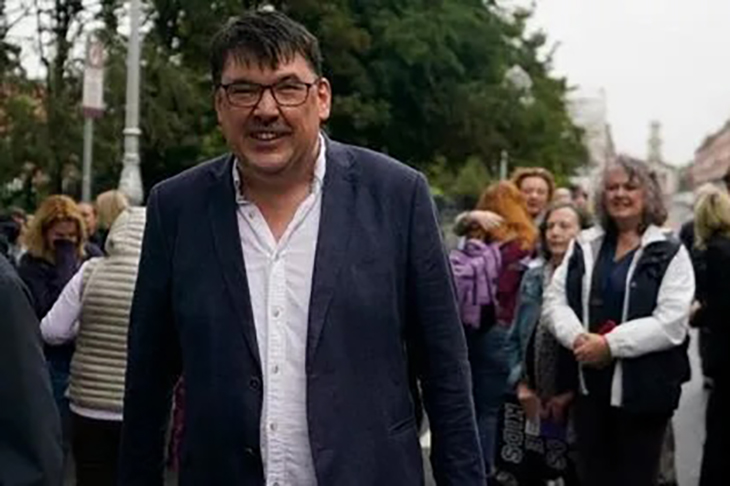
It is both a vindication of English justice and a cause of some embarrassment that the services of a High Court judge have been required to adjudicate on the cause of minor scuff marks on a mobile phone. Nevertheless, that is what Mrs Justice Tipples did yesterday and thereby delivered a genuine, if oblique, victory for Graham Linehan and the cause of free speech.
The Linehan saga has plainly frustrated Metropolitan Police Commissioner Sir Mark Rowley
Linehan was originally charged with harassment and criminal damage relating to the same transgender complainant, who had confronted Linehan and filmed him outside a public event in central London in October 2024. A year later in Westminster Magistrates’ Court Linehan was acquitted of harassment but convicted of damaging the complainant’s phone by grabbing and throwing it away.
The alleged offences were not truly speech crimes, except that the complainant by their own admission in court regarded the prosecution as a means to punish Linehan for his gender-critical beliefs. Worse still, when Linehan landed at Heathrow Airport from his home in Arizona to stand trial, he was arrested by five armed officers pursuant to a further complaint for historic ‘transphobic’ tweets.
The insanity of the arrest was immediately apparent even before it attracted the endorsement of Zack Polanski, who on that occasion expressed uncharacteristic enthusiasm for police coercion. The tweets investigation was later dropped without charge but quite naturally it intensified Linehan’s sense of besiegement at a time when the trial was still ongoing. (I represented Linehan following the Heathrow arrest but was not involved in the harassment-criminal damage trial)
Following his partial conviction, Linehan then exercised his right of appeal from the Magistrates’ Court to the Crown Court – an unqualified right which the Labour government is currently seeking to abolish. The appeal succeeded yesterday with Mrs Justice Tipples, sitting in the Crown Court alongside two lay magistrates, ruling that there was no reliable evidence of the phone having been damaged.
That Linehan should have prevailed on such a basic point supports his and other defendants’ repeated complaints that the police’s ethos of ‘belief’ – believing the accuser – has run amok.
In some areas of policing, such as sexual offending and trafficking, the ethos of belief is defensible in the initial stages of an investigation. The idea is that case-hardened officers should not quickly jump to negative conclusions if a complaint is patchy, and to reassure vulnerable, withdrawn victims that they are confiding in someone they can trust.
So long as a diligent investigation then follows before charge, no harm is done. But too often the police are disinclined to challenge complainants about obvious problems with their account. Carl Beech is perhaps the most notorious example in modern times but more commonplace faults are routinely overlooked until trial. Last month I dealt with a witness who had earlier described his assailant having an enormous and distinctive tattoo – the defendant had none – but was only asked about it for the first time in front of an unimpressed jury.
The ethos of belief applied to speech crimes has proved particularly disastrous because complainants tend to be highly motivated, influential and will kick up an enormous fuss if the State declines to resolve their political grievances by prosecuting their opponents.
For officers these cases, which usually involve minor criminal offences, are a source only of professional risk rather than reward if they decide to conduct a proper investigation. In Linehan’s case, officers were reportedly menaced with threats of professional misconduct reports by transgender activists. Officers can be somewhat forgiven if they prefer the quiet life, passing the buck to the Crown Prosecution Service who may or may not demonstrate firmer resolve to determine charges on the merits. Institutional incentives are as probable a cause of these woeful investigations and prosecutions as ‘woke’ dogma in the lanyard class.
In any event the era of woke as a social and bureaucratic phenomenon is said to be fading. The Linehan saga has plainly frustrated Metropolitan Police Commissioner Sir Mark Rowley who has said he ‘doesn’t believe officers should be policing toxic culture war debates’ and, among others, has called for a change in the law. A government-commissioned review into public order and hate crime legislation may strengthen speech protections at the margins, so long as it doesn’t imperil the shibboleth of social cohesion or risk ‘anti-Muslim hatred’. An incoming right-wing government after 2029 is likely to go further.
But inertia, buck-passing, confrontation-avoidance and sheer laziness cannot be legislated against. However robust the coming legal reform may be, speech crimes will effectively remain on the statute book so long as our institutions permit political disputes to be mediated through the criminal law.