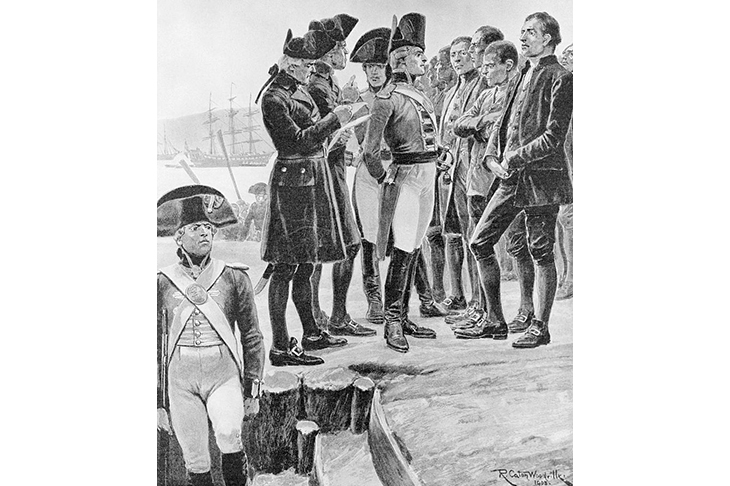
If you’d told a first-generation white Australian in 1788 Sydney Town he was lucky to live where he lived, he might have punched you. For quite a long time, colony life wasn’t a whole lot easier for free settlers than it was for convicts, not least because, even if you were important enough to have a few of those convicts at your beck and call, converting even one hectare of the scrubby wilderness that was New South Wales into life-supporting farmland was such hard yakka. So hard, indeed, that naming the place after a famously verdant corner of Britain may have struck First Fleeters as being as close as the notoriously dour James Cook ever came to cracking a joke. Even 150 years later, when Australia began to challenge India’s position as Empire MVP, few would have described her natural condition as providential and her inhabitants as fortunate.
The climate which would eventually nurture a surf and cricket culture was still more a curse than a blessing; the planting of crops and the raising of livestock still largely acts of faith, and the shearing of sheep – an activity which created as much of our early wealth as any other – was about the only form of labour which the Industrial Revolution hadn’t made easier. It was only when we began to get an idea of what lay beneath that inhospitable scrub that we got the whiff of serendipity. And it was hardly an epiphany. Coal was found in the Hunter Valley just thirty years after the founding of the colony, but its discovery wasn’t deemed good enough news for the escaped convicts who made it to be spared a flogging. And mining didn’t start to displace agriculture as our economic mainstay until the discovery, a century later, of substantial gold and iron deposits in other states.
Today, mining accounts for eight of our top ten exports (wool isn’t one of the other two) and while iron, coal and gold do most of the heavy lifting, we also provide many of the elements involved in the manufacture of the one thing which nobody on the planet can now live without, the smartphone. And even though our government continues to tilt at literal windmills and imbibe the moonshine of solar, other countries are relying increasingly on Australian uranium to boil their kettles and cool their offices. Unfairly blessed as we now know ourselves to be with mineral wealth, and with most of the grunt of mining now done by machines, it’s hardly surprising that we have severed our rural roots and become an almost entirely urban society which no longer feels the need to manufacture anything.
The self-imposed austerity of the Hawke, Keating and Howard years can now be seen as an aberration, and we have returned to the she’ll-be-right fiscal policies of Whitlam, Rudd and Gillard, with all our economic eggs still in one apparently bottomless basket. As long as those mines keep filling those trucks and as long as those trucks keep filling those ships, the revenues will keep rolling in, Medicare will creak on, and nobody will care greatly if we take the odd arvo off from the service industry or public sector jobs most of us now have to catch a wave or watch a Test.
Thanks in large part to the luck we didn’t make, we have become a nation of lotus-eaters with lanyards. Ironically, it took the leader of a country with absolutely no natural resources of its own – and no prospect of ever discovering them – to warn us about the danger of such complacency. What might be called The Great Australian Irony is that our dependence on our immense natural resources, and our consequent reluctance to manufacture, will one day make us incapable of competing with our naturally poorer, harder working neighbours.
The ‘White trash of Asia’ fate Lee Kuan Yew predicted was already looming when he died in 2015. But if he’d lived another twenty years he might have made another, equally disturbing prediction. Which is that at some other point in its not-too-distant future, Australia will find that buried along with its coal and iron and uranium, are the world’s biggest deposits of several minerals which aren’t quite such a blessing. Being amongst the world’s earliest and most enthusiastic adopters of solar, and having bought more panels per capita than any other nation, we have also consigned more of them to landfill than any other country.
Which means that the soil our ancestors worked so hard to grow food in already contains large quantities of the poisonous minerals those panels were made from. To quote last week’s Australian, ‘Australia faces a glut of old solar panels leaching polluting toxic chemicals with no viable reuse or recycling options available.’
But the most alarming aspect of this article is that its source was not the ranting of some Spectator-reading pessimist, but a report commissioned by the net zero-obsessed federal government’s Department of Climate Change and Energy.
Got something to add? Join the discussion and comment below.
You might disagree with half of it, but you’ll enjoy reading all of it. Try your first month for free, then just $2 a week for the remainder of your first year.