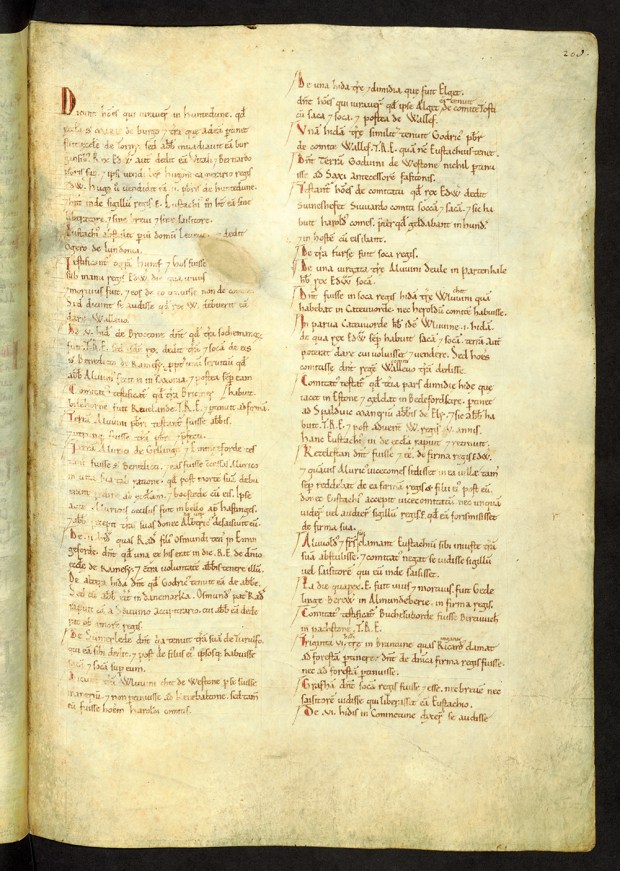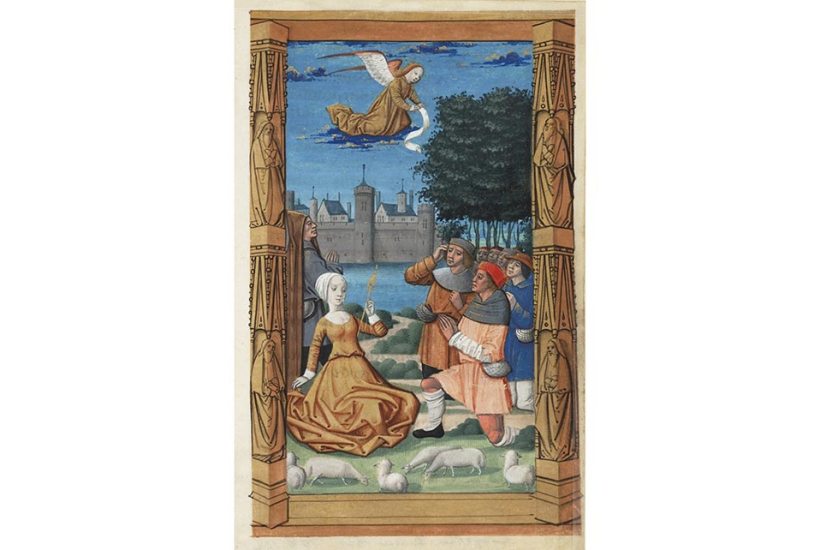
Christopher de Hamel is an outstanding salesman. At Sotheby’s, back in the 1990s, he brokered the sale of the 15th-century Sherborne Missal to the British Library for £15 million, a record-breaking sum. Over the past decade, his reputation as a salesman has fitted a much less conventional mould. In two dazzlingly illustrated books he has set out to sell to the ordinary reader the power and pleasure of medieval manuscripts.
His approach combines enthusiasm with scholarly precision and a conversational style that sits surprisingly easily with the fund of knowledge he has gradually accumulated. Conscious that most of us will never encounter these closely guarded treasures at first hand, de Hamel is more than happy to settle down in a library and turn the pages for us.
There is something sensual in his touch as he lingers over a manuscript’s weight, its smell and the patina of its great age. The edges of the vellum or parchment sometimes preserve the arcs of the animals’ necks and legs from which they were created as durable writing surfaces. An illumination’s blocks of colour can appear without warning ‘like a display of synchronised fireworks’. Its ornament of burnished gold has to be imagined lit by flickering candlelight.
De Hamel has previously introduced us to a dozen ‘remarkable manuscripts’, including the 8th-century Book of Kells at Trinity College, Dublin, with its disgruntled Virgin and unadorable Christ child, as well as to obsessive collectors such as the crackpot Victorian Sir Thomas Phillipps, a real ‘vellomaniac’, whose collection was so vast that it was still being catalogued a century after his death. Now, in The Migrants, we meet de Hamel himself.
The title is double-edged. First, it refers to the author’s own experience as a migrant. In 1955, the four-year-old Christopher, along with his parents and brothers, arrived in New Zealand on a steamship from England. His father, Francis, a doctor, had accepted a three-year contract to set up a mass X-ray programme in Christchurch. New Zealand, we are reminded, is the most distant country from Europe in any direction. It was also the last major country on Earth to be settled by humans – by Maori migrants from Polynesia in the 13th century and by Europeans in the 19th century.
The de Hamels didn’t find acclimatising to their new surroundings easy. But the fantasy of returning home finally receded when Francis accepted a permanent position as Medical Officer of Health in Dunedin on the South Island’s south-east coast. Christopher wouldn’t see England again until he studied at Oxford in the 1970s. Meanwhile, he describes himself as a boy trying to forget the dusty cabbage trees of his adopted land by staring into the blue skies and cool forests of the medieval France he found depicted in a Book of Hours in the town library.
For manuscripts too can be migrants from home. A key figure in de Hamel’s account is Sir George Grey, twice governor of New Zealand and elected its premier in 1877. Grey built himself a private paradise on Kawau Island. Here he created ‘a kind of acclimatisation depot’, introducing exotic birds, botanical specimens and other less welcome species such as the possum and wallaby. Grey also saw himself as enriching New Zealand, this far-flung outpost of the British Empire, with representative treasures of old Europe. At the time, it was deemed absurd that illuminated manuscripts should be sent on treacherous voyages overseas to a country that might not appreciate them. But Grey was farsighted enough to realise their value for future generations and by the end of the century his collection was available to view at the newly opened public library in Auckland.
The ‘vellomaniac’ Sir Thomas Phillipps’s vast collection was still being catalogued a century after his death
De Hamel is not perhaps a natural memoirist. Characters from his past tend to lie lifeless on the page, even his mentor A.H. Reed, who allowed him to borrow leaves from manuscripts at Dunedin to hang on his bedroom wall, satisfying the longing for a tangible past of a young boy cut off from his roots. The joy of this book are de Hamel’s true ‘intimate companions’, the manuscripts, and his ability to evoke the thrill and wonder he feels as he encounters them, whether it’s a 12th-century copy of Boethius he finds in Wellington, probably designed for Thomas Becket, or a Bible in Auckland, which he traces back to a Cistercian monastery in north-central Poland.
Roughly a million medieval manuscripts survive around the world today. As you accompany de Hamel on his investigations, spare a thought for the calligraphers and illustrators, mostly unknown, who created them. Occasionally you catch their voices in the marginalia. John Whas, the Benedictine who worked ‘intensely’ on the Sherborne Missal, complained that his body was ‘much wasted’ as a result. And we can surely all empathise with another monk who scribbled: ‘Now I’ve written the whole thing for Christ’s sake give me a drink.’
Got something to add? Join the discussion and comment below.
You might disagree with half of it, but you’ll enjoy reading all of it. Try your first month for free, then just $2 a week for the remainder of your first year.