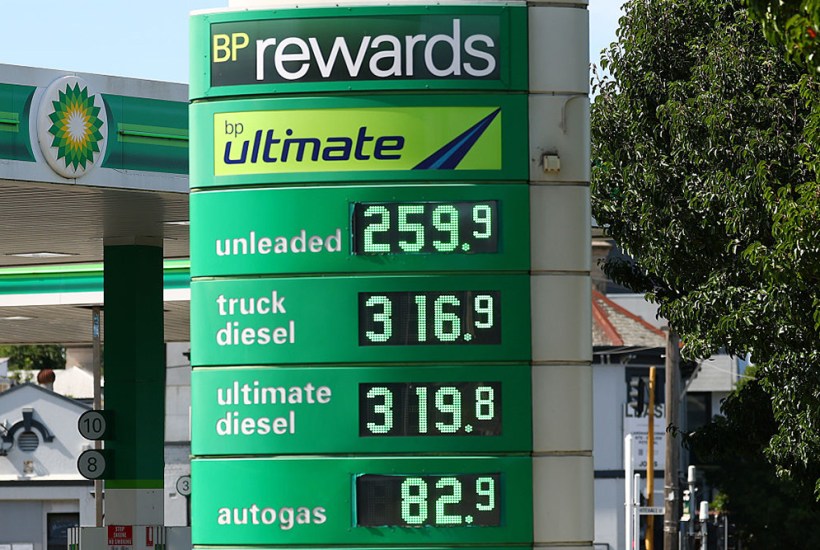
When a product becomes scarce, prices rise to ration demand. That is not a moral judgement. It is a mechanism, one of the most basic in economics. Yet time and again, politicians do the reverse of what the discipline demands. Australia is doing it again now.
The Labor government has just halved the fuel excise for three months in response to diesel shortages rippling through supply chains. It is politically attractive, superficially simple, and economically misguided.
Cutting the fuel excise during a supply shortage does not create more fuel. It does not bring forward shipments, expand refining capacity, or ease logistical bottlenecks. What it does is lower the retail price relative to the true scarcity of the resource, and that has predictable consequences: it encourages additional demand at precisely the moment when supply is constrained.
Higher prices during a shortage ensure that limited supply is directed toward its most valuable uses, whether they be freight, agriculture, or essential services. Distorting the price signal undermines this allocation. By reducing the price at the pump, the excise cut encourages motorists to use or hoard more fuel than they otherwise would.
Service stations run out sooner. Queues lengthen. Those with time and flexibility fill their tanks repeatedly, while those who rely on fuel for work find themselves unable to obtain it at any price. This is not speculation. It is standard shortage economics, and empty shelves are its signature.
There is a second effect that receives less attention. When prices rise, they signal scarcity not only to consumers but to suppliers. Higher domestic prices encourage conservation, substitution, and additional supply. Tankers are diverted, inventories are released, and marginal imports become economically viable. Rising prices are, in short, an invitation for more supply. Suppressing them through a tax cut cancels that invitation. It delays the adjustments needed to restore equilibrium and leaves the underlying shortage unaddressed.
The policy also carries a substantial fiscal cost. Halving the excise implies a large and immediate loss of revenue that must be financed through higher borrowing or cuts elsewhere. The distributional effects compound the problem.
Higher income households, which consume more fuel, receive the larger absolute benefit. Essential users such as freight operators gain only if fuel is actually available. So a policy that inflates demand without increasing supply risks leaving them worse off than before.
The deeper policy failure, however, is not in the demand management. It is in the supply side, and here the story becomes considerably more damning.
For all the commentary about the decline of Australia’s oil refining capacity, almost none of it acknowledges that this has corresponded with a collapse in domestic oil extraction. There is limited commercial logic in maintaining refineries when there is no domestic crude to refine. Yet the policy conversation treats refining as the problem in isolation, as if the feedstock question does not exist.
It does exist, and it has an answer. Australia is not a resource-poor country. As far back as 2013, the US Energy Information Administration published a detailed assessment of the nation’s shale oil potential. The numbers were striking. The six largest shale basins in Australia were estimated to hold 403 billion barrels of potential shale oil in place, with 17.5 billion barrels assessed as viable, technically recoverable resource. That is a figure sufficient to meet domestic requirements and generate a substantial export surplus. The resource is not the constraint.
The constraint is policy. Carbon targets, institutional hostility toward extractive industries, and a regulatory environment that treats hydrocarbons as a problem to be eliminated rather than a resource to be managed have made domestic extraction commercially and politically unviable.
Australia sits atop reserves that could meaningfully reduce its vulnerability to global supply disruptions, and it has chosen not to develop them. That choice has consequences, and those consequences are arriving now in the form of shortages, price spikes, and economic disruption.
The parallel with energy policy more broadly is instructive. Governments that have driven up electricity costs through the accelerated closure of reliable baseload generation have then attempted to offset the consequences through subsidies funded by borrowing. The scarcity is never resolved. It is merely masked, and the fiscal burden grows. Fuel policy is following the same path.
The German government, to its credit, has begun to say so aloud. The Minister for Economic Affairs and Energy recently observed, in the context of net zero commitments, that it is good to have a goal of sustainability but that if sustainability crashes your economy, the goals require readjustment. That is not a repudiation of environmental ambition. It is a recognition that policy must be grounded in physical and economic reality.
Australia has not yet reached that point of candour. Instead, it offers a temporary excise cut that deepens the immediate shortage, while leaving undisturbed the policy settings that created the structural vulnerability in the first place. The result is the worst of several worlds: higher demand competing for constrained supply, depleted public finances, no new production and no credible path to return to energy self-sufficiency.
There are better options than an excise cut. Targeted support for freight operators and essential industries can protect critical economic activity without distorting the price signal across the entire market. Priority allocation mechanisms can direct scarce supply to its most important uses. And a serious conversation about domestic resource development, including the shale basins identified more than a decade ago, is long overdue.
None of this is politically easy. Higher fuel prices are unpopular, and the pressure to act is real. But a measure that deepens a shortage while depleting public finances and reinforcing the conditions that caused the problem fails by any meaningful measure of policy effectiveness.
All Australians will pay for the unwillingness of successive governments to confront these trade-offs honestly. They will pay through higher costs, reduced economic activity, increased poverty and a geostrategic vulnerability that grows more serious with every year that domestic production remains off the table.
The excise cut offers the appearance of relief. The bill, as usual, comes later.
Got something to add? Join the discussion and comment below.
Peter Swan AO is professor of finance at the UNSW-Sydney Business School. Dimitri Burshtein is a Senior Director at Eminence Advisory.
You might disagree with half of it, but you’ll enjoy reading all of it. Try your first month for free, then just $2 a week for the remainder of your first year.