
This Middle East conflict ought to be much easier than the oil embargo which followed the Yom Kippur war of 1973. The Arabs came quite close to winning, whereas Iran has no chance. The embargo, imposed on all countries, including Britain, which had supported Israel in the war, was backed by almost all Arab states, few of which were fanatically Islamist, and by the Soviet Union. It lasted for six months. America depended on Saudi Arabia alone for 25 per cent of its oil (only a bit over 5 per cent of imports today). The price rose by 400 per cent. The economic disruption was massive. In 2026, by contrast, almost all Middle Eastern states detest Iran and want their oil to flow without let or hindrance. There is plenty of money and power in the world to reopen the Strait of Hormuz. So why the hesitation?
Part of it certainly derives, as President Trump complains, from European weakness. Here in Britain, retirees like General Sir Nick Carter and Lord Ricketts, the BBC’s favourite, say that Nato is a defensive alliance (true) and that this restricts it to the European/Atlantic theatre (false). Article 5 was only once invoked – after 9/11 – and was used to attack Afghanistan. Given that Iran has spent 47 years exercising its murderous intent against several Nato members (Britain holding third place in its global demonology), and that it now wants to block our oil, we would be acting in self-defence to hit back by re-securing the strait. Unfortunately, the Starmer/Hermer doctrine of self-defence is so narrow as to be, in effect, an invitation for an enemy to attack, like Labour’s ‘no first use’ policy on nuclear weapons in the 1980s.
Nevertheless, if you were prime minister, would you send the Royal Navy to the Gulf at Trump’s request? Perhaps not – partly because there is so little Royal Navy to send, but also because you could not honestly tell your armed forces or your electorate that Trump can be trusted. Might he happily encourage allies into places where he would not dare send Americans, or get bored with giving those allies air cover if different political imperatives captured his attention? Might he even take advantage of allied forces being in the Gulf to give Vladimir Putin another push towards victory in Ukraine? Besides, Trump is in such a poor position to call in favours. He is grumpy because, he says, America has repeatedly rescued and defended Europeans in the past and now we aren’t helping. True, but that is partly his fault. As President, he has been much ruder to his allies than to America’s traditional foes. Even if he is right about the threat in the High North, he was crazy to suggest – no, demand – that a Nato ally, Denmark, must give up Greenland and expect not to upset the whole alliance.
The current situation is like Suez in reverse. In 1956, Britain, France and Israel went in to prevent Egypt controlling the Suez Canal but did not take enough trouble to square things with the United States, which then pulled the plug. This time, America attacks Iran without bothering to secure European support and now has trouble with another key waterway. We were weaker then than America is now, but the resemblance is there. Nevertheless, any temptation we might feel to play an Eisenhower empire-toppling role should be resisted. We have friends in the Gulf whom we are not assisting properly and enemies in Tehran whom we have tried and failed to appease. Somehow, we have to help.
There is angst about replacing famous Britons on our banknotes with British birds and beasts. My own view is that our notes went downhill when they started representing any person other than the monarch, when they began, 60 years ago, to display Shakespeare. But there is an attractive precedent for the animal kingdom in our coinage. Until abolished in 1961, the farthing depicted a charming wren, ideal for the smallest unit of currency. Given inflation, a wren could make the same point on the new £5 note.
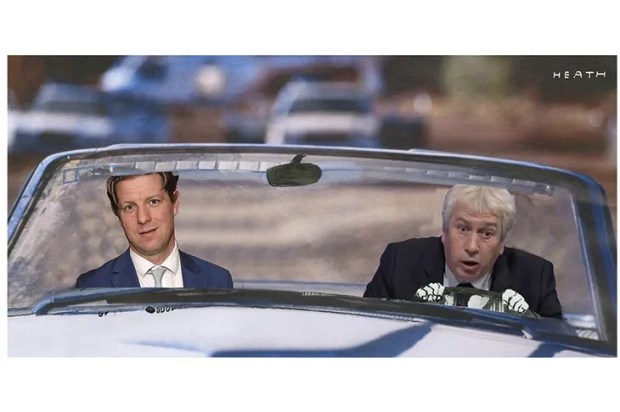
My inbox delivers an advertisement for a big sale next month – the entire contents of the Selsdon Park Hotel. Older readers will remember ‘Selsdon Man’ as the repulsive greed-head of the ‘ruthless, pushing society’ conjured up by Harold Wilson in the run-up to the 1970 general election which he failed to win for Labour. In January that year, Ted Heath, the Conservative leader, had used Selsdon Park for the only big conference of colleagues during his leadership which tried to revive interest in free markets. As prime minister, Heath later repudiated such ideas, leaving a gap which Margaret Thatcher more than filled. In those days, I imagine, the hotel was a gin-and-jag suburban paradise, serving beef Wellington and Black Forest gâteau and ‘boasting’ (hotels always ‘boasted’ then) an 18-hole golf course in its 200 acres. The zeitgeist moved on, however, and, in the spring of 2023, the place relaunched itself as Birch Selsdon and rewilded the golf course. This project collapsed after six months and the hotel lock, stock and barrel, with its rewilded acres, closed to the public, is for sale. The April auction offers the A-nrd/Sebastian Cox barely used furniture which infested all 181 bedrooms – furniture ‘designed and made with a nature-first perspective’. It includes ‘reception desks featuring a timber shakes finish’ and ‘sweeping booth seating cladded [sic] in rough sawn estate timber for the All-Day Dining room’. I like to think of the genial spirit of Selsdon Man, merry like the Ghost of Christmas Present, surveying the hotel’s ‘state-of-the-art wellness space, full-service co-working hub and creative studios’, and declaring with a hearty laugh: ‘You can’t buck the market.’
‘Cleaning firm cleans road signs’ says a headline in our local paper. I suppose that really is a story. If the next headline is ‘Council fills potholes’, no one will believe it.
Got something to add? Join the discussion and comment below.
You might disagree with half of it, but you’ll enjoy reading all of it. Try your first month for free, then just $2 a week for the remainder of your first year.