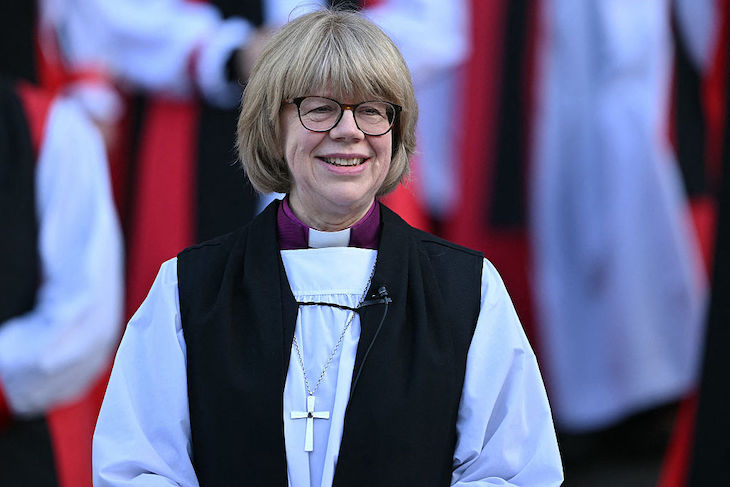
Is there anything much to say about Sarah Mullally, the Archbishop of Canterbury? It seems that she is a very nice, Christian lady. She used to be Britain’s top nurse. Um, she is a brilliant manager. She is good at washing people’s feet, both for practical and ceremonial purposes. She has an awesome work-ethic. She can show emotion: she cried when telling the Church of England’s Synod about the micro-aggressions that female clergy suffer. She seems to embody the Church’s official line on the gay issue: in favour of greater inclusion, but not wanting to change the doctrine of marriage.
Would the Church really risk antagonising the liberal majority, and prodding this dormant crisis into life?
To help me out I have just read a very brief biography by Tim Wyatt. It was like reading a long essay about the merits of vanilla ice-cream. What stuck with me? Mullally grew up in Surrey; her family wasn’t very religious; they enjoyed going on bike-rides together. Um. As a student she attended a conservative evangelical church. She then became more middle-of-the-road, but she has seemingly never commented on this shift. Indeed it is not clear that she has ever said anything much at all relating to theology – nothing that Wyatt thinks worth recording anyway. There is no mention of any theologian who has influenced her, not even C.S. Lewis. Her devotion to the Church is not in doubt, but does it have an intellectual side at all?
This mini-biography is part of a new book called Archbishop Sarah Mullally and Ten Urgent Challenges For the C of E; after Wyatt’s sketch ten other Anglicans share their thoughts. All the essays are friendly: all the writers are liberals, urging her to be bolder on this or that issue, from climate to trans.
The problem is in the title. ‘Ten urgent challenges’ is oxymoronic. It’s like a politician saying these are my ten priorities. The impression is that liberal Anglicanism is a buffet of interest groups.
The real problem facing the Church of England is that its liberals lack focus, and theological seriousness, and courage. The clearest evidence of this is that none of these essays addresses the fact that the Church is currently in a state of schism, over the ordination of women. It is mentioned in the biographical sketch, but only briefly; we hear that Mullally has bent over backwards to be nice to those who deny the validity of her orders, and that it costs her (in tears).
For those who don’t know, a small minority of the Church – less than fifteen per cent – rejects the ordination of women. When the Church decided to ordain women, over thirty years ago, they were allowed to stay, and form a semi-separate structure within the Church. The orthodoxy is that there is no harm in this: rather it is a remarkable example of internal diversity, from which the rest of the world can learn.
But there is harm in it. Obviously many female clergy feel demoralised by the fact that some of their colleagues can openly deny their authority. More generally, the Church as a whole is subtly demoralised.
In what way? The status quo is demoralising because it announces that the unity of this Church is not worth asserting. So what if the authority of the episcopate is diluted? We’re not the sort of Church that has a clear sense of purpose, so such a muddle feels rather appropriate. The toleration of division over women’s ordination is a sign of low self-esteem, a frail will to live.
This is a bigger issue even than the gay issue, because it concerns an actual structural division. The gay issue is about the Church’s slowness to bring a reform that the majority probably wants, but still has one buttock on the fence about, so in a sense the slowness is justified, though deeply painful for gay people. By the way, to be fair to this book, it contains a good clear essay on the gay issue by Charlie Baczyk-Bell.
And this issue might blow up surprisingly soon. London needs a new bishop, and there are rumours that a traditionalist candidate is being considered. Would the Church really risk antagonising the liberal majority, and prodding this dormant crisis into life? Let them try it. It will rouse the liberals at last, and put an end to this whole sorry saga.