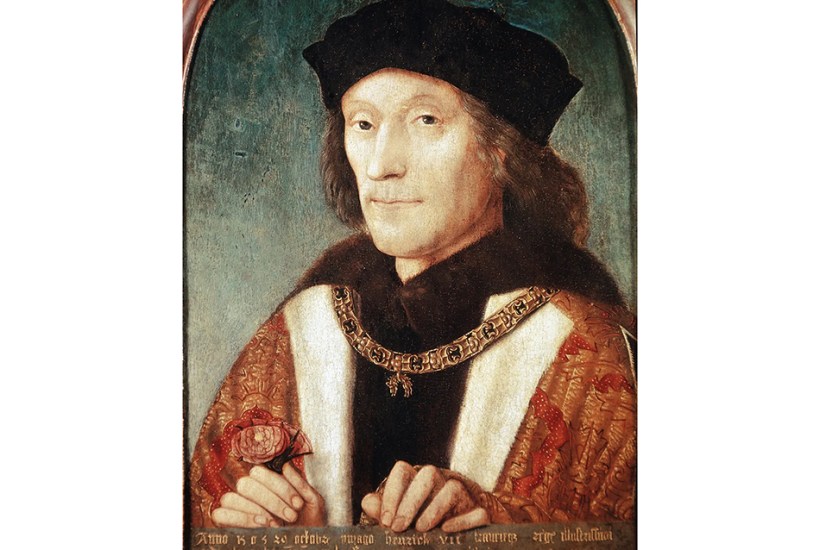
Have we ever had a more successful yet somehow forgettable king than Henry VII? A century ago, the Dictionary of National Biography could still hail him as the ‘Solomon of England’. But if he is remembered now it is almost solely for the dynasty he founded, with the domestic and international achievements of his own long and prudent reign largely ignored in the country’s bizarre obsession with the later Tudors.
There must have been an unusual mix of calculation and audacity to Henry’s character, because calculation alone could never have brought him to the throne. Over the first 30 years of his life, regime change had become the violent norm of English life; so when, in 1485, a minor Welsh earl with few supporters and no experience of either war or government returned from exile to seize Richard III’s crown, there can have been no reason to think that he would last any longer than his predecessor.
It was not, either, as though his royal claims on either side of his lineage were anything but tenuous. He had been born at Pembroke Castle in 1457, the only child of the 13-year-old Margaret Beaufort, the recently widowed great-granddaughter of the Lancastrian John of Gaunt and his mistress Katherine Swynford.
If that all sounds a little ‘sketchy’, as Sean Cunningham puts it, the story on the paternal side was a good deal less reputable. In 1455, Henry’s 12-year-old mother had been married off to Edmund Tudor, one of three sons of the impoverished Owen Tudor who had scandalously married Henry V’s widow – making Edmund, serendipitous and dangerous by turn, a half-brother of the ‘saintly, but mentally unstable’ Henry VI.
While they might not have been the strongest credentials for a claimant to the throne, by the 1480s the Lancastrian party was in no position to pick or choose. As a young child, Henry had been made a royal ward of the Yorkist Edward IV. But at the age of 14 he managed to escape to Brittany, where he might well have remained had the death of Edward and the murder of the young princes not split the Yorkist camp and given him his chance.
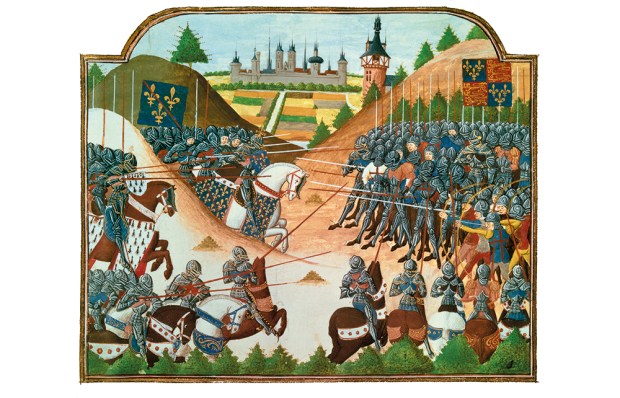
It was a chance that, against all the odds, he seized, though if the Battle of Bosworth – notoriously a battle decided as much by those who did not fight as those who did – taught Henry anything it was that beyond his immediate circle there was no one he could trust. ‘If the Stanleys, his relatives by marriage, were slow to show their hand until certain of winning,’ writes Cunningham, ‘then, Henry realised, no allegiance could be relied upon. Despite needing their support, he knew that he could only be secure on the throne if he could deny England’s powerful families the ability to directly influence his fate.’
The Battle of Bosworth taught Henry that there was no one beyond his immediate circle he could trust
It is this wearing struggle to bring the aristocracy to heel that lies at the heart of Cunningham’s lucid and always readable biography. Over the long, bloody years of civil war, the symbiotic bond of throne and land had been ruptured beyond repair, and not even Henry’s marriage to Margaret of York or the birth of an heir could stem the threats and rebellions that defined the early years of his reign.
If he could not woo over his enemies, however, he could muzzle them, and it is characteristic of Henry’s temperament and talents that he should turn to the law rather than the sword to cement his dynasty. He was ready to fight when a Perkin Warbeck or Lambert Simnel gave him no option, but from the earliest days of his reign he was exploiting every legal and financial resource open to him, binding dissidents by suspended fines, drawing in their supporters as guarantors, extending the scope and use of royal prerogatives, and – with increasing harshness as the friends of his exile gave way to a new breed of lawyer-henchmen – operating on and beyond the fringes of the law in a climate of greed, extortion, forfeitures, paid informers, bribes and arbitrary justice.
It is a story that Cunningham tells succinctly and well. We learn everything we need to know and nothing we don’t. There are almost none of the favourite stocking-fillers of Tudor biography – no sumptuary laws, no set-piece executions on Tower Hill – just the clear outlines of a crucial period of English history. ‘Justified Harshness?’ he calls his final chapter, and the question is answered with characteristic balance. ‘By all metrics of late medieval kingship, Henry had proved an exceptionally successful king,’ winning his battles, seeing off his challengers, controlling the state, securing his dynasty, providing England with a voice in European politics and – no given for medieval kings – finally dying in his bed.
Success, though, as Cunningham makes equally clear, had come at a heavy personal and national cost ‘Throughout his life,’ the Italian scholar Polydore Vergil wrote, ‘Henry was destined never to draw a peaceful breath’ – and that seems scarcely an exaggeration. By 1509, his health was shattered, his grip on affairs weakened and the trust of his subjects irredeemably lost. His wife was dead, as was his oldest son, Arthur.
It was a hard end to a hard life; and it would have been harder still if he could have seen what was to come. Within days of his death the chief architects of his financial oppression had been arrested for treason and the new king, the ‘dazzling’ 17-year old Henry VIII, had proclaimed a general pardon, with the promise of a new start, a new kind of reign and respect for the country’s laws. Whatever else lay obscurely hidden in the future, one thing was already certain: the popular image of the Tudors’ dynasty would not be forged in the likeness of the complex, pious man who had worn out his life and imperilled his soul to found it.
Got something to add? Join the discussion and comment below.
You might disagree with half of it, but you’ll enjoy reading all of it. Try your first month for free, then just $2 a week for the remainder of your first year.