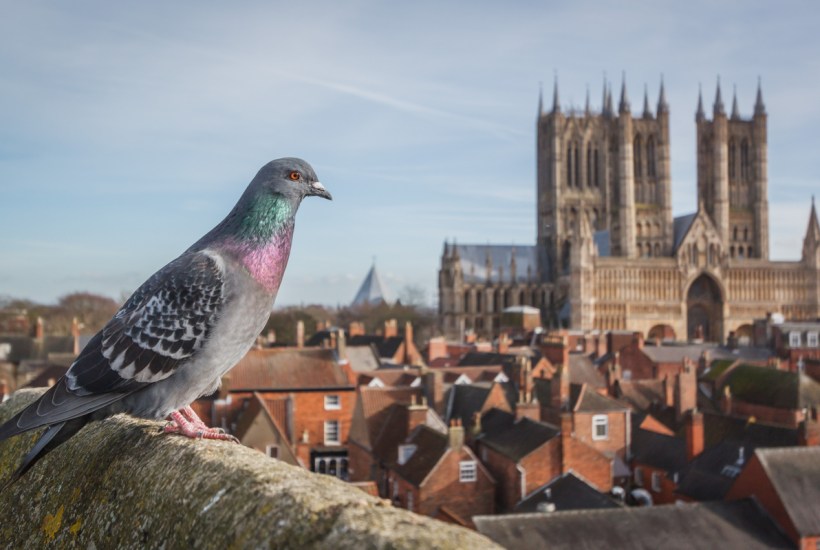
Norwich has known some beef in its time: from the Kett’s Rebellion against land enclosures in 1549, to the Great Blow during the English Civil War. Now there’s something new dividing the East Anglian city: pigeons. The ‘pooping menaces’ are pushing the council to ‘adopt extreme measures’, says the Guardian, The Times compared local scenes to those in Alfred Hitchcock’s The Birds, while the Daily Telegraph’s intrepid David Wilkes has donned his tin hat to report from the ‘front line of Norwich’s pigeon feeding war’.
A society that reserves its compassion for the exotic or photogenic reveals its shallowness. The test of our moral seriousness lies in how we treat the ordinary and inconvenient
Norwich City Council is trying to keep the pigeon population down at the main market and war memorial following complaints from stall holders and shoppers. It paid £4,000 for a falconer to patrol the market for four weeks but the idea was scrapped. A proposal to feed contraceptives to the birds was rejected because the technique isn’t licensed in the UK. Then there’s thee pro-pigeon flock, who are reportedly feeding the pigeons industrial amounts of bird feed to scupper any measures.
This isn’t the only pigeon war. There have been similar feathery fights in Rome, Venice, New York, Singapore and London. When Mumbai banned pigeon feeding there were clashes with police and a failed bid to form a political ‘Pigeon party’. In Manchester this week, a ‘bungled’ after-hours raids by pest control marksmen left nearly 100 birds dead or maimed in the city’s Victoria station.
How did we get here? Pigeons are now widely loathed as dirty and disease-addled, and dismissed as ‘rats with wings’. But they were once our friends. Domestic pigeons descended from the wild Rock dove and were selectively bred by humans for companionship, food, sport, message carrying and help in war. But after industrialisation, humans abandoned pigeons, which were forced to adapt and survive on the streets. Naturally, they bred and now we have large feral pigeon populations in our cities.
The heartbreaking truth is that they stay so close to us in urban environments because they’re not truly ‘wild’ and they still need us to survive. Pigeons aren’t really invaders at all: they’re a by-product of human urbanisation. Our cities’ tall buildings and their window ledges mimic their natural home of cliffs and caves, the uneaten food we dump is their feed. We engineered their proximity, then recoil at them.
As I wrote about seagulls on these pages last year, it’s ‘typical human arrogance to muck about with nature and then clutch our pearls when it turns out that there may be consequences’, and newspaper scare stories about dangerous or harmful animals ‘never consider the part that humanity plays in nature’s problems’.
The knowledge that it’s our fault doesn’t wave a magic wand over an undoubted problem in areas like Norwich market. All those flaps, feathers and faeces aren’t much good for a market where food is sold and then eaten al fresco. But the knowledge does suggest that, in all conscience, we have a responsibility toward animals we domesticated and displaced.
So what can be done? When cities splash large sums on culling, trapping, or poisoning pigeons there’s often little long-term benefit because of their rapid reproduction: a single pair of pigeons can produce up to 12 squabs every year. Killing them is a reactive and ineffective policy. A morally dubious one, too, because it punishes birds for our negligence.
Some suggest gradually reducing food over several months, which would slow their reproduction. Or we could simply learn to live with them better, building dovecotes to draw them away from specific areas and allowing local officials to try egg swapping: switching the birds’ real eggs for fake ones, to trick the birds into incubating them without laying new ones. These are solutions rooted less in vengeance than in stewardship.
It’s harder to muster sympathy for the plight of pigeons than it is, say, elephants, pandas or abandoned puppies. But a society that reserves its compassion for the exotic or photogenic reveals a certain shallowness. The test of our moral seriousness lies in how we treat the ordinary and inconvenient.
Pigeons are not the mindless vermin of caricature. Studies have found that they can recognise human faces and remember them, and that they display problem-solving abilities comparable to some primates. For instance, they can distinguish real words from made up ones. They mate for life and form strong, monogamous, and long-term bonds that often last until one partner dies. They share parenting duties.
There are two pigeons who rest on our garden fence most days and have a little kiss. In an increasingly sad and divided world their quiet devotion is a lovely sight. If 2,000 birds were landing in our garden I’d probably feel a bit less enamoured. But wherever pigeons mass, the first question should not be how we rid ourselves of them, but how we live with what we’ve created.