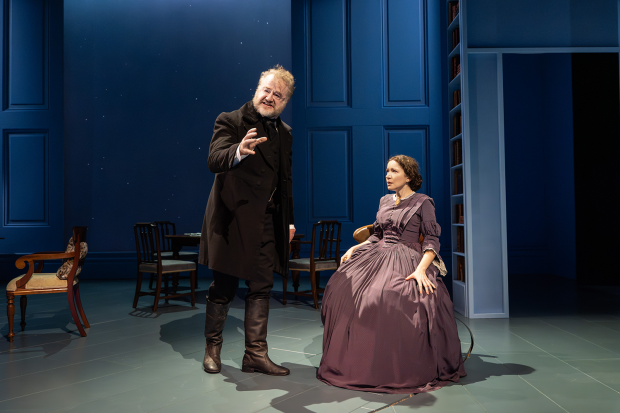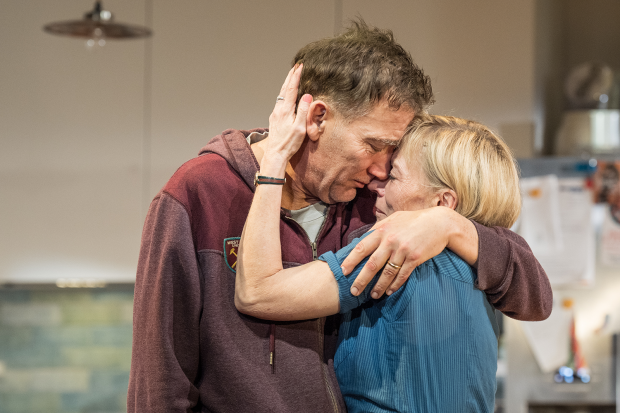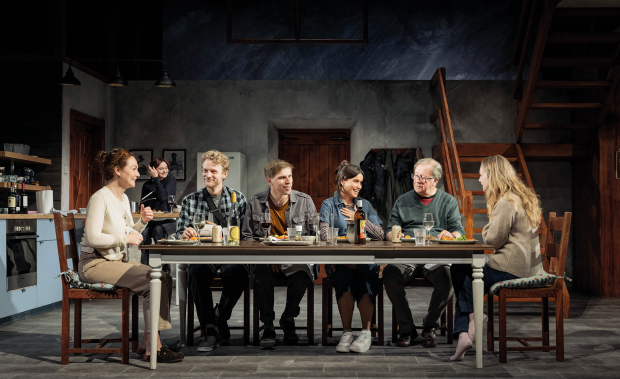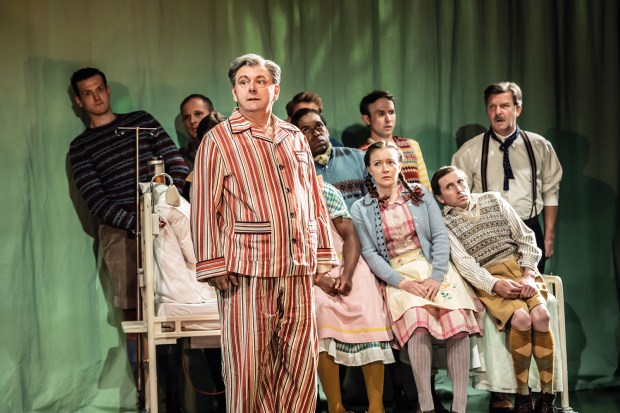
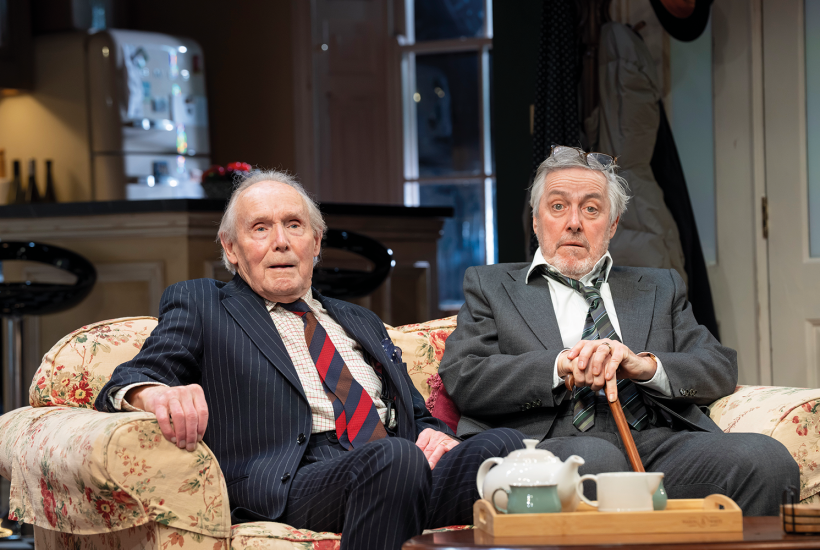
Jim Hacker is back in the West End. I’m Sorry, Prime Minister, written by Jonathan Lynn (who co-wrote the original TV series), brings us the former PM in semi-retirement as the Master of Hacker College, Oxford. Jim, now Lord Hacker, is facing a revolt by the students and the senior fellows who claim to have been offended by his high-table banter. He was overheard making positive comments about the British Raj and suggesting that the word ‘negro’ should not be expurgated from the work of James Baldwin. Both opinions are blasphemous according to the killjoy theocrats who govern our political discourse. Jim is ordered to quit his post but he refuses and the college authorities offer him a chilling compromise. He may continue as Master if he agrees to make no statements whatever, on any subject at all, even in private, without the prior approval of the college’s thought police. This repressive bargain develops into an amusing battle of wits when Jim telephones his old pal Sir Humphrey and enlists his help against the college.
The first act motors along beautifully but the second stalls over historical issues like Brexit
Griff Rhys Jones plays Jim as a rumpled Falstaffian folk hero, honking out his lines with schoolboy glee, shuffling around the stage in crumpled clothes and haywire hair, delivering pop-eyed grimaces of indignation at every new assault on his freedom. Rhys Jones’s rich, warm, turbo-charged performance is brilliantly complemented by Clive Francis as the dandyish, pinstriped technocrat who subtly mocks Jim’s blustering vanity. ‘You moved from the animals to the vegetables,’ he says as he congratulates him on his promotion to the Lords.
The first act motors along beautifully but the second stalls over historical issues like Brexit and austerity which raise little mirth. Jim’s young housekeeper, Sophie (Stephanie Levi-John), becomes the pivotal figure as she monitors the old boys’ conversation and scolds them for making remarks that threaten her narrow moral universe. Something strange is going on here. Jim and Sir Humphrey are masters of statecraft and yet they’re unable to defy Sophie’s authority or devise a plot that will overthrow her. They accept her edicts without a murmur.
Sophie’s backstory makes no sense. She holds a first in English literature, yet works as Jim’s maidservant on the minimum wage. And her character doesn’t develop or reach a dramatic conclusion. She’s not a real human being, of course, but a sanctimonious puppet who represents the spirit of destructive oneupmanship that dominates our universities. Never mind. Rhys Jones and Francis are on dazzling form as the ageing heavyweights dragged out of retirement for one last punch-up.
American Psycho is a musical based on Bret Easton Ellis’s 1991 novel. The lead character, Patrick Bateman (Arty Froushan), is a yuppie banker who has everything in the world except a sense of morality. He acts like an insecure teenage girl, pouting and swooning over brand names, and boasting nonstop about his designer shirts, his tailored suits and the five-star toiletries in his closet. Some of his purchases are strangely banal. He declares himself the proud owner of a Sony Walkman and a Toshiba TV set as if these cheap trinkets were rare luxuries available only to the moneyed elite.
At some point, and without warning, he develops a taste for committing murder in the middle of the night. He starts by killing a tramp and then moves on to female socialites and rival bankers. Who can save him? Perhaps his girlfriend, Evelyn (Emily Barber), a stylish, well-educated beauty who wants to marry him. But no. She’s exactly like Patrick: a loathsome, bed-hopping airhead without a shred of personality.
The characters are so revolting that you start to hope Patrick will execute more of them more quickly
He carries on slaying random New Yorkers, mostly vagrants and bimbos, but the authorities show little interest in his crime spree. A dozy old cop, Detective Kimball (Joseph Mydell), interrogates him at the bank for two minutes and then departs without realising that he’s just let the city’s most prolific serial killer slip through his fingers. And Patrick gains nothing from his nightly executions. He has no fun attacking his victims whose bodies he dismembers with an electric saw before concealing the parts in a special flat – ‘the meat locker,’ as he calls it – which he rents ‘anonymously’. Perhaps he means ‘pseudonymously’. He doesn’t even celebrate his ability to get away with mass murder. None of it means anything to him. Nor does he tell us why he commits his offences, because he doesn’t know himself.
The characters are so revolting that you start to hope Patrick will execute more of them more quickly. The choreography by Lynne Page looks as slick and sexy as a catwalk show but there’s no emotional content here. You might as well spend two hours watching a display of Morris dancing. The production’s defining motifs are blaring noises and flickering lights. If you hate screeching power tools, bring earplugs. And if you’re prone to epileptic fits, keep a blindfold handy too.
Got something to add? Join the discussion and comment below.
You might disagree with half of it, but you’ll enjoy reading all of it. Try your first month for free, then just $2 a week for the remainder of your first year.