I have just visited my ancestral birthplace of Bangladesh, where an election is due this month. What is unfolding carries implications for the balance of power across South Asia. In the vacuum left by a fallen regime, Islamist forces – organised, patient and transnational – are moving to claim the future of a country whose very founding was meant to reject religious theocracy.
In the wake of Australia’s worst terrorism incident in Bondi and a fractious immigration debate, developments in South Asia are of significance locally. The subcontinent has been the origin of a large proportion of our migrants, either through working visas or as international students. In protests linked to immigration in Victoria, Indians were singled out. They have made up the largest component of our migration intake, roughly a quarter in 2023-2024 according to Home Affairs. But the unease about Indians is likely to be a marker of unease about the broader South Asian intake.
In the modern porous flow of ideas, diaspora communities are often influenced by their countries of origin. In Bangladesh, I visited the major university there in the capital Dhaka. Nearly a century old, it has long been the engine room of political change. My mother studied there in the early-1970s, during the Pakistani civil war and the massacres that accompanied the birth of Bangladesh.
Across the main campus, lined with Mughal-inspired arches and banyan trees, a banner hung from a wall, scrawled in black marker on white cloth: ‘Down with colonialism. Support the Caliphate.’ Nearby, a mural showed a man cradling a bleeding body. Above it, the words ‘bloody July’ were painted in red. Bangladesh’s national story once revolved around resistance to Pakistan’s attempt to impose Urdu as a state language, to the idea that Muslim identity should eclipse all others. Australia was one of the first countries to officially recognise Bangladesh back in 1971.
Yet over the past year, that story has begun to unravel. The presence of women in public spaces is increasingly contested. Secular assumptions that once seemed settled are now openly challenged. And into the ideological void left by a collapsed state authority has stepped a more muscular, unapologetically Islamist politics.
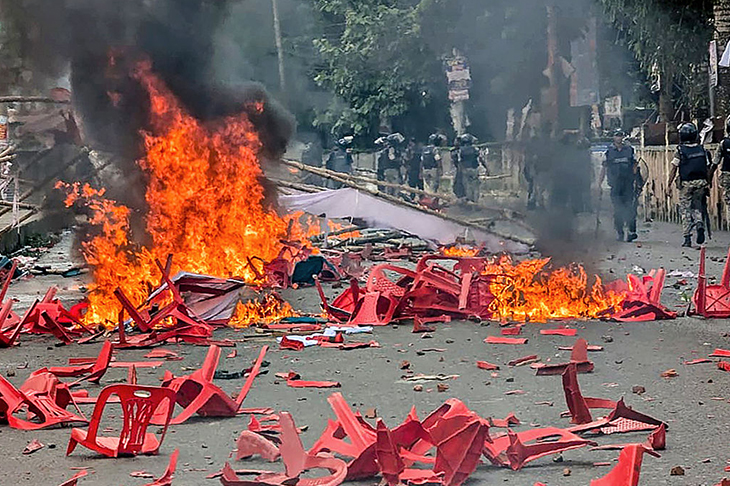
The rupture began in July 2024, when students protested employment quotas seen as favouring supporters of the ruling Awami League. What started as a grievance over patronage rapidly widened into a revolt against corruption, dynastic entitlement and the authoritarianism of former prime minister Sheikh Hasina’s long rule. As elsewhere in the developing world, social media provided the scaffolding for mass mobilisation.
The images that defined the uprising were harrowing. In a particularly inflammatory one police were seen discarding the unconscious body of a protester off their vehicle like he was bird poo. The student protester, Shaikh Ashabul Yamin, later died. Amnesty International verified the video. None of the twelve officers present offered medical assistance.
The uprising ended with Sheikh Hasina fleeing by military helicopter to India as her residence was ransacked. But her exit came at a terrible cost. Thousands of protesters were killed. Many bodies were never recovered. Bangladesh is now governed by a caretaker administration led by Nobel Peace Prize winner Muhammad Yunus, with elections scheduled for 12 February. The country is tense, uncertain, and dangerously open to capture. As in Sri Lanka and Nepal – both of which have seen student-led revolts topple corrupt elites – the immediate question is not why the protests happened, but what comes next.
In Bangladesh, the answer is increasingly unsettling. Islamist groups, long suppressed by Hasina’s security state, are emerging not as marginal actors but as credible claimants to power and moral authority. They are organised where liberal forces are fragmented. In 2025, student elections at Dhaka University were won for the first time by Jamaat-e-Islami, a party committed to governance under sharia law and hostile to the separation of religion and politics. India’s Congress MP Shashi Tharoor noted the result with unease, calling it ‘a worrying portent of things to come’. Jamaat has benefited from the discrediting of the major parties, both associated with corruption and dynasty.
The pattern is familiar. Digitally savvy youth movements can outmanoeuvre entrenched elites – but are often short-lived. The Arab Spring remains the cautionary tale: protest creates openings that better-organised forces exploit.
Across the developing world, a generation raised on smartphones, global connectivity and permanent crisis has taken to the streets. In Kenya, Gen Z forced the government to retreat on tax hikes. In Iran, young women continue to defy compulsory veiling. Protest has become the default language of a cohort that feels both hyper-connected and politically homeless. The energy is real. The outcomes are uncertain.
Bangladesh’s danger lies in who is best positioned to harvest that energy. Since the fall of Hasina, Islamist-adjacent violence has surged. In December, a Hindu garment worker, Dipu Chandra Das, was lynched and burned after being accused of insulting the Prophet Muhammad. His alleged crime was saying that all gods were equal. Videos showed mobs chanting religious slogans as they beat his half-naked, unconscious body. Three further Hindu deaths have followed in similar attacks. Women have been pushed to the front line. Vigilante groups now enforce dress codes in public.
Violence against women has intensified sharply. A journalist was raped in March. Ninety-six rape cases were reported nationwide in just the first two months of last year, according to local NGOs. A Human Rights Watch report warned of an ‘alarming surge’ in mob violence and intimidation driven in part by religious hardliners hostile to women’s and LGBTQ rights.
This represents a rapid reversal of recent progress. Under Hasina – repressive though her government was – Bangladesh achieved notable gains in female education, workforce participation and maternal health, outperforming even India on some indicators. Those gains are now under threat. Moral policing has revived debates about whether women should work at all. Jamaat-linked clerics argue employment should be permitted only with male approval. Job quotas for women have been scrapped.
Some analysts point to external influences: Gulf funding, Pakistani intelligence, jihadist networks. While hard evidence is elusive, the structural conditions are clear. Islamist organisations have long filled gaps left by a weak state, running schools, orphanages and disaster relief. As in Pakistan, a syncretic local Islam is giving way to a harder, Wahhabist strain.
Yet Bangladesh is ethnically homogeneous and founded on linguistic nationalism, not religious ideology. That is precisely why the current drift is so dangerous. A state born in rejection of theocratic politics is now at risk of being reshaped by it.
The implications extend far beyond. A destabilised, radicalising Bangladesh would unsettle India’s eastern flank, embolden extremists in Pakistan, and reverberate through South Asian diaspora communities in the West, including Australia. It would present us with a geopolitical and humanitarian catastrophe that could supercharge Islamism in the region.
Got something to add? Join the discussion and comment below.
You might disagree with half of it, but you’ll enjoy reading all of it. Try your first month for free, then just $2 a week for the remainder of your first year.