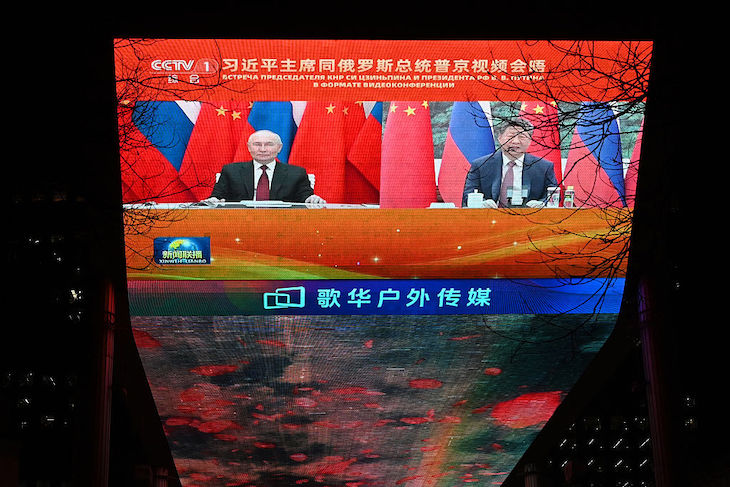
The lovefest between Xi Jinping and Vladimir Putin continued this week. A video call on Wednesday saw the Russian president cooing that, “for Russian-Chinese relations, it’s safe to say that any time of year is spring” and his Chinese counterpart telling his “old, dear friend” that their two countries needed a “grand plan” further to deepen ties between them. Of course, the realities are a little less harmonious.
Beijing is supplanting Moscow in regions where it once held sway
Russia’s need for energy sales, industrial machinery and dual-use equipment (in other words, things that are not weapons, but still of value in war, such as trucks and bandages) has made it increasingly dependent on its erstwhile “little brother.”
Last week, Russian Security Council secretary Sergei Shoigu visited China, where he and the Chinese Foreign Minister “synchronised their watches” in preparation for the leaders’ talks. The secretary’s job is powerfully but loosely-defined. Nonetheless, according to one member of Shoigu’s team, he is concerned that the relationship is getting too unbalanced: “he doesn’t want to go down in history as the man who sold Russia to Beijing.”
He has good reason. While Putin has been eager to tout the new connections between the two nations, this is less than meets the eye. When polled, Russians describe China as the country with which they feel they have the friendliest relations, but at the same time a substantial majority still wouldn’t want Chinese neighbours or in-laws.
Putin boasted that there were 56,000 Chinese students enrolled in Russian universities – but this pales in comparison with the 140,000+ in the UK. Likewise, street signs in central Moscow may be acquiring Chinese translations, but there are complaints that the influx of tourists benefits Chinese travel agencies more than local business. The former use their new-found market power to impose swingeing discounts on the latter.
This is a metaphor for the wider relationship. Mutual trade has essentially plateaued at around £150 billion a year, and the influx of Chinese consumer goods into Russia has not been an unqualified benefit. The West may offer Ukraine loans and aid, but China expects to be paid and uses Russia’s straightened circumstances to turn the screw – it gets gas, for example, at little more than cost price. Tighter Western sanctions only exacerbate this. Plans to increase gas supply through the Power of Siberia pipeline by 15 per cent will not make up for sales lost to Europe, for example.
It is also supplanting Moscow in regions where it once held sway. Russia used to consider itself the hegemon of Central Asia, thanks to its role as security guarantor and economic loadstar. Now, though, its forces have been drawn down and China is a much more credible business partner. Even Moscow’s long-standing role in Central Asia’s nuclear energy sector is in question. Russian conglomerate Rosatom has been contracted to build new power stations in both Kazakhstan and Uzbekistan, but the China National Nuclear Corporation is pitching itself as a cheaper, quicker alternative. Rosatom, which so long relied on a judicious mix of exclusivity and corruption, is now quietly grumbling that the Chinese are willing to cut their margins – and pay bigger bribes – to muscle them out of the way.
The result is something of a generational split within the Russian leadership. Putin appreciates the way that being seen as Xi’s closest ally gives him greater credibility abroad and undercuts Western claims to be “isolating” him. More to the point, he needs China so long as he is fighting his war in Ukraine. As far as he is concerned, this war is politically and historically existential for him. If he needs to swallow concessions to Beijing in order to win it, then so be it.
The next political generation down, though, is alarmed that by the time they are in power, they will be no more than the administrators of a Chinese dependency. They can hardly directly challenge a relationship that matters so much to the boss, but they have been making efforts to alert him to their concerns.
The Federal Security Service reports that Chinese espionage inside Russia has increased since 2022. The Union of Industrialists has highlighted cases of dumping, where Chinese goods are sold at artificially low prices to drive local competition out of business. Even one of Putin’s closest friends, Sergei Chemezov, head of the Rostec arms conglomerate, has called for a degree of protectionism to prevent the domestic car industry from being swamped. The Ministry of Economic Development has quietly approved a plan to massively increase the scale of domestic refining of rare earths, to reduce dependence on China. The Defence Ministry, while relying on Chinese kit and engaging in joint exercises, continues annually to update its contingency plans in case Beijing invades.
In the words of one ministerial adviser, “it’s a kind of survivalism. It’s about doing what we can, considering that we can’t do anything about how the Kremlin sees the relationship.”
Putin’s chief foreign policy adviser, Yuri Ushakov, described the leaders’ 85-minute conversation as “direct, confidential, warm, and friendly.” That may not reassure many members of Putin’s own elite.