’Tis bitter cold, and I am sick at heart. – Shakespeare, Hamlet
On the battlements of Denmark’s Elsinore, an arctic freeze has set in. ‘Sick at heart’ signals moral and political anxiety. Denmark is unsettled: the ghost has appeared, the state is threatened, and something is fundamentally wrong beneath the surface.
Shakespeare uses the cold to externalise inner dread and systemic disorder. It is ontological dread, exposure, realism, the stripping away of illusion. It is a time of ideological unease, decay within an order that outwardly persists. The court at Elsinore, like the European elites, sits abased amongst the debris of Liberalism. Like Abbots wandering in the ruins of a monastery. For the Greenland debacle is not about the concept of ‘independence’ – it is tantamount to recognising the shifting tectonic plates of the world order. Liberalism works in the world of ‘ought to be’, a paradisus in terris, ideologies of communism, insisting on the dawn, the sunrise, the redemption of the future. Ever since Thomas Mann’s The Magic Mountain, (Der Zauberberg), ironically set in the Alpine chill of Davos, Switzerland, the spectre of liberal spiritual exhaustion is near.
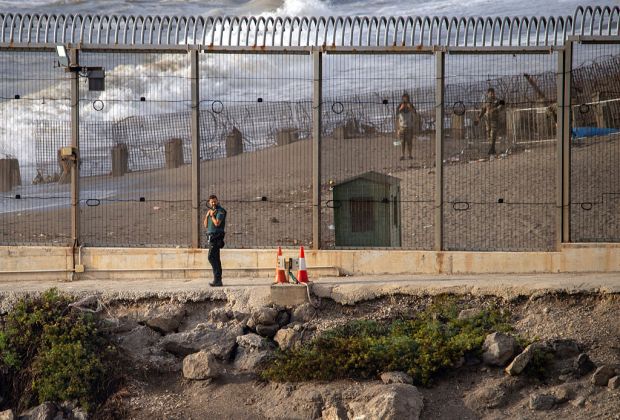
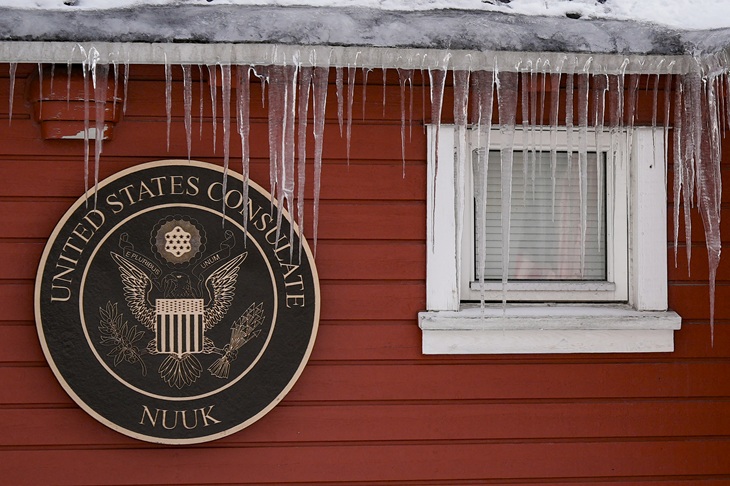
The Arctic has a way of clarifying things. That thief of frozen ships. The Wasteland. In a landscape stripped of colour, comfort, and illusion, what remains is exposure: to cold, to distance, to power. Greenland; vast, sparsely populated, strategically indispensable, has emerged as a geopolitical stress test for liberal internationalism.
In the white silence of the Arctic, liberalism’s language continues to circulate, but its authority does not. What Greenland reveals is not a temporary failure of liberal norms, but their terminal contradiction. Yet this process, this freezing of liberal normalcy began at Weimar, was confounded at Nuremberg. It was the juxtaposition of this messianic cult of right versus realism which set in the contradictions of International Law. It is the spectre of nature reclaiming its world and the thawing of liberal modes.
For decades, European political thought has spoken of an International Rules-Based Order as though it were a climate system: ambient, stabilising, and largely independent of force. Yet the Arctic does not obey incantation. It rewards proximity, logistics, and control. Greenland matters because nature and geography matters, because missile trajectories, shipping lanes, rare earth minerals, and military basing do not yield to International Courts. Liberalism wants to run the world from Davos, a mythical globalisation divorced from product and power. Confronted now with this frozen reality, it responds not with strategy but with pithy rhetoric. The result is paralysis in a blizzard.
Greenland’s strategic value is simple. Like the thawing ice of Liberalism, it sits astride Arctic sea routes that are opening as ice recedes. It anchors early-warning missile systems. It lies between North America and Eurasia like a glacial keystone. None of this is ideological. It is material. The island’s importance is not conferred by international law; it is imposed by the nomos of the Earth, by physics.
This is precisely the kind of fact liberal internationalism struggles to metabolise. Liberalism prefers a world in which disputes are juridified, mediated, and ultimately dissolved into process. But Greenland is not a dispute; it is a prize. As John Mearsheimer has argued, great powers do not merely seek security; they seek advantage. ‘Great powers,’ he writes, ‘are not content with the status quo; they seek to maximise their share of world power.’ Liberalism specifies The Arctic offers precisely such an opportunity.
Europe’s response, by contrast, has been timid and procedural. Statements are issued. Principles are reaffirmed. Sovereignty is invoked in the abstract. But no serious discussion follows about power projection, deterrence, or control. Liberalism continues to speak as though language itself were an insulation against the cold. As Shakespeare opined, these words are merely poor players.
Thomas Hobbes would not be surprised. For Hobbes, the defining feature of international politics is not cooperation but anarchy. The state of nature persists between states because there is no sovereign capable of enforcing law. ‘Covenants, without the sword,’ Hobbes famously observed, ‘are but words, and of no strength to secure a man at all.’ This was the ‘jus publicum Europaeum’, roughly from Westphalia 1648 to the first world war. There were a limited number of recognised European sovereigns and shared assumptions about war, territory, and authority. This was not international law in the modern universal sense. It was a regional legal order among roughly equal powers. The order of Europe worked because each state controlled its territory, wars occurred between states, not as moral crusades. Enemies were recognised as legitimate opponents, not criminals. The onset of a commercial imperialism in the 20th Century and its denouement in globalisation has ensured a chaotic period of missionary liberalism. The presumptions being visible in governance and development for example. This is not an argument against law, per se. It is an argument against mistaking law for power. Liberal internationalism repeatedly collapses the distinction, assuming that their legitimacy will constrain those whom it does not deter. In Greenland, this assumption looks less like optimism and more like denial.
The Arctic exposes this truth with glacial clarity. International law exists in the region, but its force depends entirely on the willingness of powerful states to enforce it. Where that willingness falters, the law freezes over. Europe’s invocation of norms without corresponding capacity is not moral high-mindedness; it is strategic abdication.
Carl Schmitt diagnosed this failure nearly a century ago. Liberalism, he argued, seeks to depoliticise conflict – to transform existential questions into moral, legal, or economic ones. Yet politics, at its core, is about decision-making. ‘The specific political distinction to which political actions and motives can be reduced,’ Schmitt wrote, ‘is that between friend and enemy.’
Greenland demands precisely such a distinction. Who will secure it? Who will project power from it? Who will decide its strategic orientation? Liberalism recoils from these questions, preferring instead to dissolve them into norms and statements. But refusal to decide is itself a decision – one that leaves the field open to actors less troubled by moral ambiguity. Schmitt warned that liberalism is ‘not a political doctrine but a critical and dissolving force’. In the Arctic, that dissolving tendency manifests as strategic drift. While others prepare for competition, Europe reassures itself with resolutions.
The phrase ‘Rules Based International Order’ functions today less as a description than as a talisman. It is invoked to ward off the recognition that the order it describes is neither universal nor self-sustaining. The rules persist where power enforces them. Elsewhere, they evaporate. Mearsheimer has been unsparing on this point. The liberal order, he argues, was always contingent on American primacy and European security dependence. ‘The liberal international order was doomed from the start,’ he writes, ‘because it rested on the false belief that states can escape the security competition that defines international politics.’
Greenland marks the outer limit of post-Liberalism. In the Arctic, there is no illusion of post-politics. The cold strips away the fantasy that mutual recognition alone can substitute for control. Europe’s continued attachment to liberal rhetoric in this context appears less principled than anachronistic. There is a reason cold features so prominently in political metaphor. Cold reveals weakness. It punishes complacency. It tests systems to destruction. Greenland, in this sense, is not merely a location but a condition an environment in which liberalism’s assumptions are no longer tenable.
This does not mean realism offers comfort. Realism offers clarity, not warmth. It reminds us that power abhors a vacuum, that geography endures, and that norms follow force rather than preceding it. As E.H. Carr once observed, ‘The utopian, in refusing to recognise power, condemns himself to political impotence.’ Greenland suggests Europe is flirting with precisely that fate.
In Hamlet, the line ‘‘tis bitter cold, and I am sick at heart’ captures not only physical discomfort but moral unease, a recognition that something is profoundly wrong. Greenland produces a similar effect. It confronts liberalism with a world it no longer knows how to describe, let alone shape. It is TS Eliot’s The Wasteland, Mann’s Magic Mountain. It is Ezra Pound locked up in his cage for wrong thinking. It is the Apogee of Liberalism, its denouement.
Brian Patrick Bolger. He has taught International Law and Political Philosophy at Universities in Europe. His articles have appeared in leading magazines such as The Spectator, The Salisbury Review etc and journals worldwide in the US, the UK, Italy, Canada, etc. His new book- ’Nowhere Fast: Democracy and Identity in the Twenty First Century’ is published now by Ethics International Press. He is an adviser to several Think Tanks and Corporates on Geopolitical Issues