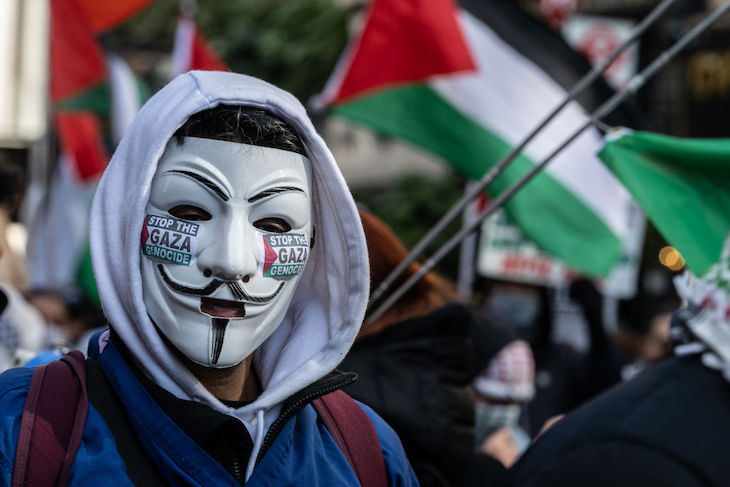
The news that Shahid Butt, a man convicted of terrorism who served five years for conspiring to bomb the British consulate in Yemen, is standing as a pro-Gaza candidate for Birmingham City Council has shocked many. Butt was jailed in 1999 as part of a terror plot linked to Abu Hamza, yet now seeks public office representing constituents in the Sparkhill ward. The spectacle of a man with a terror conviction campaigning on a platform of Palestinian solidarity while dismissing his past as youthful ‘mistakes’ has understandably provoked outrage.
From Birmingham to Gaza, the pattern is consistent: British institutions have developed a tolerance for terrorism and extremism
But if Butt wins his council seat, he will not be the first convicted terrorist to receive British taxpayer funding. The UK has been quietly bankrolling such individuals for years through its financial support to the Palestinian Authority – a system so perverse that it rewards terrorism with salary scales and career advancement based on the barbarity of the crimes committed.
The UK government’s approach to Palestinian Authority funding reveals the kind of bureaucratic sleight of hand that allows ministers to claim moral high ground while enabling the very practices they condemn. Direct UK budgetary support to the Palestinian Authority was stopped in 2021, but in case you thought this decision was a principled stand against the PA’s systematic glorification of violence or payments to convicted terrorists, the Foreign Office made sure explicitly to describe it as the result of a ‘general aid budget prioritisation exercise.’ Good to know.
Stranger still was the UK’s reaction after October 7, 2023, in the wake of the deadliest massacre of Jews since the Holocaust, to actually resume explicit financial support with a £10 million contribution channelled through a World Bank mechanism to support Palestinian Authority public sector salaries, alongside £5 million in ‘technical assistance.’ Ministers emphasise that UK funds do not directly pay for prisoners or militants, but this distinction rests on wilful economic obfuscation. Money is fungible. When external donors assume part of the PA’s wage bill for teachers or civil servants, they inevitably free up resources elsewhere in the budget: resources that can then be redirected toward the PA’s infamous ‘Pay-for-Slay’ policies.
The mechanics of these rewards are chilling in their precision. As detailed in recent analysis by the Jerusalem Centre for Security and Foreign Affairs, the Palestinian Authority operates salary scales that directly correlate terrorist payments with the duration of their prison sentence. Terrorists who serve five-six years receive department head positions equivalent to lieutenant rank. Those serving 20-25 years are appointed as assistant undersecretaries with brigadier general status. The most dedicated killers, those serving over 30 years, can aspire to ministerial positions with Major General military rankings.
The JCSFA points to the case of Ra’ad Sheikh as an example. Al-Sheikh participated in the brutal lynching of two Israeli reservists at a Ramallah police station in 2000, personally beating one victim with a four-pronged wheelbarrow in scenes of medieval savagery. During his 25-year imprisonment, the Palestinian Authority paid him over 1.4 million NIS (around £331,300). Upon his release in October 2025 as part of the blackmail deal to obtain the freedom of Israeli hostages kidnapped on October 7, Sheikh became eligible for Major General rank in the PA security forces. British taxpayers, through the UK’s resumed financial support, are now contributing to a system that has effectively made this convicted killer a shekel millionaire with senior military status.
The pattern extends to cases closer to home, as well. The now infamous case of Alaa Abd el-Fattah exemplifies how Britain grants its highest protections to those who despise everything it represents. Abd el-Fattah, who described Britons as ‘British dogs and monkeys’ and declared himself ‘a violent person who advocated the killing of all zionists including civilians,’ was granted British citizenship in December 2021 while imprisoned in Egypt. His return became a ‘top priority’ for Keir Starmer’s government, which expressed enthusiasm and delight at securing the freedom of a man who had previously celebrated the killing of American soldiers and openly advocated violence against civilians.
These cases form part of a broader institutional pattern that has corroded Britain’s moral foundations. The UK simultaneously accommodates illegal migrants in hotels at a cost of £2.1 billion annually – roughly £5.77 million per day – while conducting insufficient security screening of those it supports. High-profile cases like Deng Chol Majek, who murdered hotel worker Rhiannon Whyte, and Abdelrahmen Adnan Abouelela, who raped a woman in Hyde Park despite previous convictions in Egypt for membership of a bomb-making cell, demonstrate how the system combines ruinous public expenditure with security negligence.
The hard truth is that extremists must be deprived of support, not rewarded with it
The common thread is institutional tolerance for violence and extremism, whether dressed up as Palestinian resistance, personal desperation, or administrative convenience. Each case is treated as discrete, but together they reveal a state apparatus that has lost the capacity for moral distinction, and worse, actively rewards those who would destroy the values it should defend.
This tolerance becomes even more problematic when we examine what the Palestinian Authority actually represents. The organisation that receives renewed British funding operates educational systems that, according to independent analyses by groups like IMPACT-se, continue to include material glorifying terrorism, inciting hatred, and encouraging adversarial narratives embedded even in mathematics and language instruction. Palestinian Authority textbooks still contain violent and antisemitic content, portrayals that erase Israel, and celebrations of ‘martyrdom’ that normalise suicide attacks.
Even more absurdly, Palestinian Media Watch has revealed that the PA maintains entirely fictitious payrolls in Gaza, paying salaries to thousands of security forces members and civil employees who cannot work because Hamas controls the territory. This is the organisation that our ministers and civil servants describe as a partner for peace and reform. An entity that systematically rewards terrorism with career advancement, indoctrinates children with curricula of hatred, and maintains phantom payrolls funded by international donors is not a government in any meaningful sense. It is a terror-financing operation masquerading behind diplomatic recognition.
The fundamental problem is that terrorism cannot be defeated by terrorists, and neither can extremism be cured by extremists, whether they operate in Ramallah or Birmingham. The Palestinian Authority’s systematic celebration of violence, its financial incentivisation of murder, and its educational indoctrination of hatred make it structurally incapable of dismantling the very extremism it promotes and funds. Hamas will not disarm Hamas, but neither will an organisation that shares Hamas’s fundamental hostility to Jewish existence and celebrates the same ‘martyrs’ and ‘resistance operations.’ We need to stop pretending otherwise.
If Butt wins his council seat, he will not be the first convicted terrorist to receive British taxpayer funding
This principle applies with equal force to domestic policy. The notion that people convicted of terrorism can undergo meaningful transformation, or that the likes of Alaa Abd el-Fattah deserve state protection and resources, rests on the same dangerous delusion that has guided Britain’s Palestinian policy: the belief that support, accommodation, and financial incentives can somehow transmute hatred into moderation, even when the people in question are outspoken about their true beliefs.
The UK’s approach represents a catastrophic inversion of moral logic. Instead of treating terrorism and extremism with the cynicism, distrust, and caution they demand, British institutions have embraced a saccharine liberalism that sees taxpayer funds as therapeutic tools for ideological rehabilitation. We shower resources on those who would annihilate our values while expecting gratitude in return.
The hard truth is that extremists must be deprived of support, not rewarded with it. Where necessary, they must be forced to disarm, surrender, or leave. This is the real mark of moral and ethical robustness, not the wishful thinking that sees us splurge public money on every terrorist and extremist we can find, hoping against all evidence that financial incentives will somehow inspire their redemption.
From Birmingham to Gaza, the pattern is consistent: British institutions have developed a tolerance for terrorism and extremism that manifests in citizenship for extremists, electoral candidacies for convicted terrorists, and financial support for organisations that systematically reward mass murder. Each case is justified through narrow technicalities that ignore broader moral realities. The result is a system that simultaneously condemns terrorism in principle while funding it in practice – a contradiction that can only be sustained through wilful blindness to obvious truths.
The choice before Britain is stark: continue this descent into moral bankruptcy, or rediscover the capacity to distinguish between those who deserve our protection and those who seek our destruction. The current trajectory suggests the outcome is already decided.