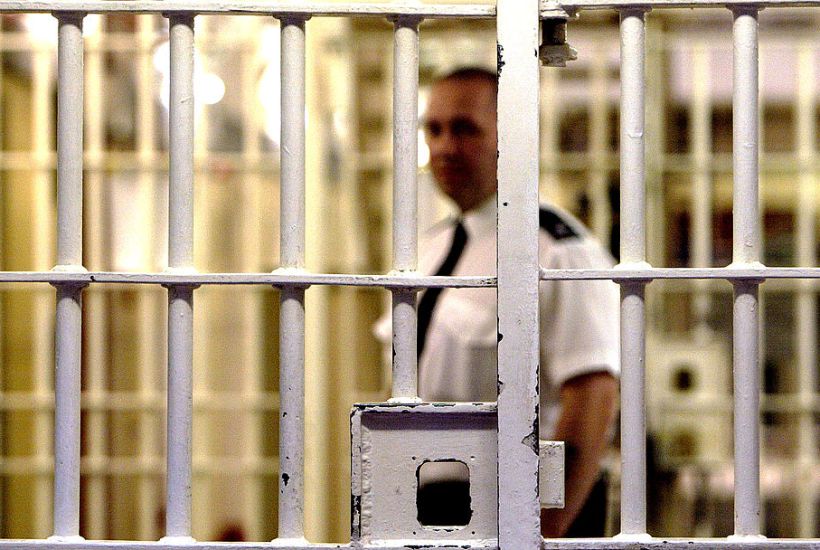
Ever since Labour was elected, every time there has been another disaster in our jails, or another set of terrible data, it has been briefed that ‘this government inherited prisons in crisis’. To be fair to the government, the Tories did leave our jails broken, overcrowded and crumbling, but this line has also been a useful shield for Labour, distracting from their own record. In this they have been helped by how long it takes for official reports and statistics to be published. There was always going to be a lag before Labour’s prison strategy could be judged.
Unfortunately for them, with today’s publication of a National Audit Office report on drugs and drones, we have learned that our prisons have become even worse since the general election. The Auditor General describes ‘substantial, increasing and rapidly changing threats’ from drugs in prisons, accompanied by a vast increase in drone sightings – a 750 per cent increase between 2019 and 2023, followed by another 43 per cent increase between 2023/24 and 2024/25. Meanwhile approximately half of prisoners in England and Wales are known to have a drug problem, and the number of prisoners saying it’s ‘easy’ to get hold of drugs in their jail has risen from 32 per cent to 39 per cent over the last year.
Drugs in prisons create violence, make rehabilitation even harder, and often cause further offending outside of jail. That they are so freely available is also a shocking indictment of our prisons.
An even more astonishing detail in the NAO report is that despite successive governments providing additional funding in order to secure our jails and reduce the flow of drugs, the prison service has not spent that extra money.
Between 2019/20 and 2021/22, the prison service was provided with a £100 million budget to invest in additional security measures. The largest allocation, £43 million, in this budget was for ‘physical security’, body scanners, metal detectors and drug detection units. The prison service only spent 74 per cent of that, a decision which is particularly shocking given the NAO report notes examples of ‘broken security equipment…not being repaired for many months’, and ‘of work to improve window security taking several years’.
Other unspent budget items included £7.11 million for counter-corruption activities, of which only 46 per cent was spent and £16.27 million for intelligence activities, of which only 56 per cent was spent. Indeed, the only part of the budget which was spent in full (and indeed, slightly exceeded) was for ‘other central costs’, that is to say central office staff responsible for ‘managing and evaluating the programme of work’.
Sir Geofrey Clifton-Brown, Chair of the Committee of Public Accounts said that:
‘HMPPS have not responded to rapidly evolving threats quickly enough and indicators such as increased drone sightings suggest the problem is widespread and worsening…given the scale of the challenge, it is worrying that HMPPS has significantly underspent on previous investment’.
Worrying, yes, but not surprising. Nothing could be more typical of this department, than being unable to replace broken body scanners, or repair broken windows, while managing to spend every penny available on civil servants at head office ‘evaluating’ these failed programmes.
Former prison governor Professor Ian Acheson, remarked that ‘huge underspends on budgets which would have tackled the awful violence directly associated with the drugs trade will have made it harder to recruit and retain staff and rehabilitate prisoners. But where there’s no accountability for these failings, there’s no hope for progress’.
Something has gone very wrong when the National Audit Office has to publish a recommendation that a department ‘should respond with more urgency to identified security weaknesses…including broken windows or inadequate window grills’. These basic matters of physical security should be managed by prison governors, and if they are failing then ‘Prison Group Directors’, the service’s regional managers, should act to remove those governors and fix gaping security holes as a matter of urgency.
In this context, Lord Timpson’s announcement that the prison service are, ‘investing £40 million to bolster security including anti-drone measures like reinforced windows and specialist netting’ is of little comfort as the money may not even be spent, let alone solve the torrent of drones carrying drugs and other contraband.
In a sense, Labour aren’t to blame. The civil servants running our prison service have been failing for a very long time, which is why we have a prison system that releases people by mistake, can’t repair windows or security scanners and in which half the population are drug addicts. In a just world many civil servants would face prosecution for misconduct in public office, such is the scale of their failure.
But Labour are in government. Whatever crisis they inherited, it’s their job to fix it. Lord Timpson has said the he knows ‘more must be done’. If he, and other ministers are serious they will move to replace prison service leaders with more competent staff from elsewhere. The current leadership are not fit for purpose.