Occasionally, the leader of a political party will be asked to name a favourite book. For years, this has produced a dispiriting response. Keir Starmer told an interviewer that he didn’t have a favourite novel or poem. On other occasions, he said that the comic Roy of the Rovers was his favourite book, and, more plausibly, two stories of helpless victimhood, The Trial and James Kelman’s unreadable A Disaffection. It might have seemed that the days were over, when Anthony Eden had been known to be passionately keen on Proust, Margaret Thatcher a great lover of English poetry, John Major an aficionado of Trollope (The Small House at Allington rightly singled out).
No focus group would ever have consented to a book as long, complicated, savage and ambiguous
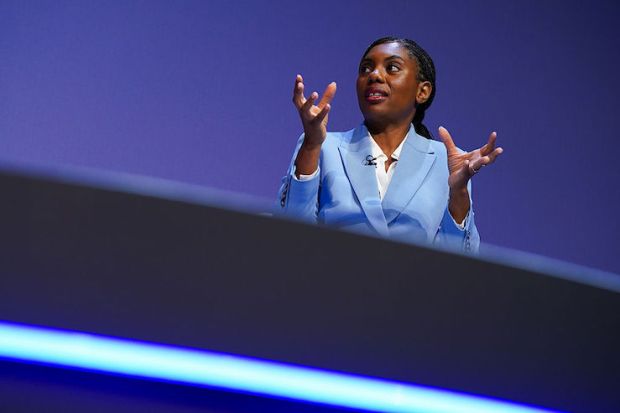
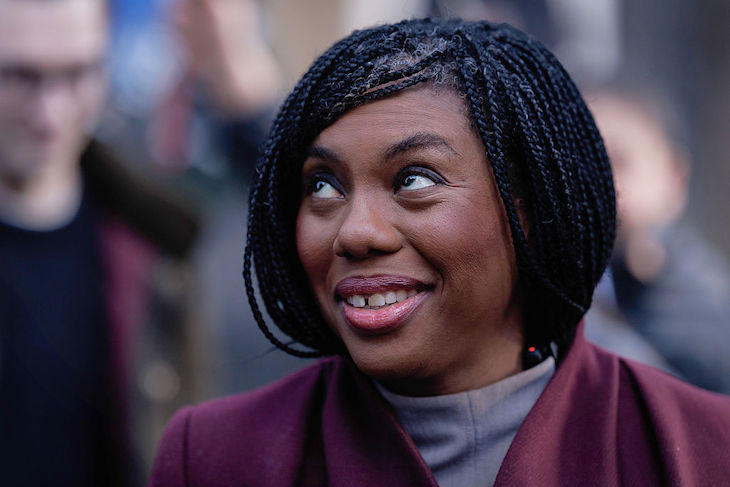
Last Sunday, Kemi Badenoch appeared on Desert Island Discs, and, asked for her choice of book to take with her, nominated Thackeray’s Vanity Fair. There seems absolutely no doubt that it’s her personal choice. No focus group would ever have consented to a book as long, complicated, savage and ambiguous. No spin doctor would have had the nerve to suggest it. No: it’s her choice. To coin a phrase, it felt for a moment as if the grown-ups might be back in the room.
Vanity Fair was first published in 1847-8, in serial numbers. Thackeray had some difficulty interesting a publisher, and Bradbury and Evans put off publication, doubtful of its success. It was noticed, but only started to sell well with the ninth number (of 19), about the Battle of Waterloo.
It’s a novel of astonishing power and appeal. There aren’t many English novelists who can do obsessive sexual passion as well as Thackeray, for a start. Thackeray loved the grand dramatic stroke, and some of the episodes concluded with a shattering surprise – George Osborne lying dead, or Becky being revealed to be married. Thackeray loved his readership, and was hugely interested in everything about the people he was describing. That’s a quality worth cherishing in anyone, novelist or politician.
I like to think that Vanity Fair appeals to Kemi Badenoch because its subject is what had always interested the novel, social mobility and individual transformations through sheer energy. Becky Sharp makes of herself what she will. In the end, amazingly, she becomes, of all things, a pillar of piety, and surfaces in passing in Thackeray’s later The Newcomes as ‘her who writes the hymns.’ People do change, after all, and their limits are usually imposed from outside. Her husband Rawdon says to her, early on, ‘By Jove, Beck, you’re fit to be Commander-in-Chief, or Archbishop of Canterbury,’ – the day for the first woman Archbishop has, finally come. (I doubt Sarah Mullally will be as invigorating as Becky would have been).
The novel wonderfully demonstrates what politicians ought to know, what the world looks like from other people’s points of view. We can easily understand what drives George Osborne, or Jos, or Amelia, or old Sedley, or Dobbin. The range of novelists’ understanding – not necessarily sympathy – ought to be wider than most. And so should that of politicians. Thackeray could effortlessly demonstrate this through his beautiful technique. Sometimes the novel ventures into the head of a very minor character, just so that we can see how beautiful Amelia was on her wedding day through the eyes of a junior ensign. Tolstoy, later, did exactly the same thing. If only politicians could try the same exercise of the imagination, we might get somewhere.
What makes Vanity Fair unusual among English novels is its grand sense of how individual lives are shaped by huge global forces. The possibilities of empire when Jos Sedley turns up, or this astonishing sentence; ‘So imprisoned and tortured was this gentle little heart, when in the month of March, Anno Domini 1815, Napoleon landed at Cannes, and Louis XVIII fled, and all Europe was in alarm, and the funds fell, and old John Sedley was ruined.’
That, too, ought to be squarely within politicians’ understanding. When they agree to something at a summit, or decide to make a change to business rates, the impact on individual lives may be catastrophic. Kemi Badenoch didn’t claim to be a heavy reader of fiction, but going on her taste, and her comments, she’s instinctively a good one. I can’t help thinking that a politician who loves Vanity Fair is more likely to understand and respect individual lives than one baffled by the imaginative exercise of reading a novel at all.