A great deal has been said about free speech in this country, and abroad, in the last few weeks.
The collective entity of human civilisation has been trying to decide if our religions, morals, political systems, and respective cultures can be harmonised in the melting pot of globalisation, or if nations will once again fracture. Perhaps, even, go to war.
Some of us will live in democracies. Others will be confined to dictatorships. And more, still, will be left picking up the pieces of broken nations.
The gift of social media, and particularly the contribution of Elon Musk via X, has been to show the peoples of the world that they do not have to live as slaves to an oppressive regime.
And that Supreme Leaders are the barbaric relic of a political era that must die.
Freedom and democracy exist. They are precious. And they can be achieved. No country is beyond reprieve if the people fight for their freedom.
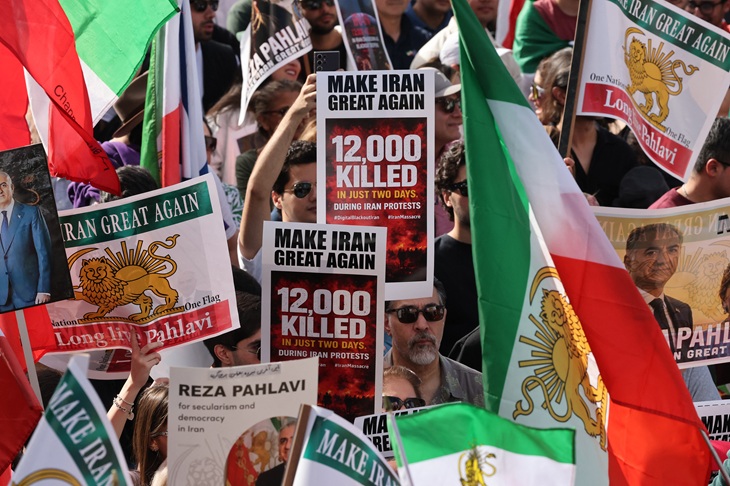
Iran is not trying to create liberty from scratch. They have a long and proud history. Millions taking to the streets, risking their lives, remember a time when they were free, or their parents do… The golden era of Iran under the former Shah still exists in the minds of living people.
Iranians know what their country can be, if only the depraved leaders of the Islamic Republic are removed. As the chief sponsor of global Islamic terror, it is in the interests of every nation to stand against the Supreme Leader and see him deposed and his men run out into the desert.
In response to cries for a revolution, and return of the Shah, the Islamic Republic has done what all dictatorships do under threat – they have turned to censorship.
CNN called it The Night Iran Went Dark.
The internet was shut off and the people of Iran were removed from the global conversation.
A woman living in Iran described it as ‘dystopian’.
A young man in the capital said: ‘There was a feeling that we were going to make a difference, that perhaps a revolution was actually going to happen.’
And then nothing. And then darkness.
From 8pm, the 92 million people of Iran had no access to the internet, no way to make phone calls for help, and were left on the streets in total darkness.
Following this darkness, and with a blindfold tied over the eyes of the world, the massacres began.
These were the worst killings in 47 years.
Without social media, the Islamic Republic revealed its true nature. Thousands of innocent people were slaughtered. Guards entered hospitals and shot injured patients in the head. Women. Children. Men. The elderly. Their blood covered the streets while security forces used green lasers to confuse those trying to flee.
Iranians have also been attacked economically, with the internet shutdown destroying the economy. The purpose was to turn businesses against protesters. And even worse, the government has been seizing the assets of those suspected of giving assistance to protesters. As an example, over 60 cafes have been seized along with the assets belonging to sports stars and celebrities to stop influencers from inspiring the crowds.
Tens of thousands of Iranians taken prisoner are now being tortured to extract confessions. Their homes are being raided. Children are being detained to torment their parents. Prisoners are denied lawyers. And young victims are hung in public streets.
What century does the Islamic Republic think it’s living in?
Now we hear that Iran is planning a permanent break from the global internet with only vetted individuals, the favourites of the regime, being allowed to access the digital realm.
They are making internet access a government privilege.
It is digital warfare.
Iran plans to copy China by trapping its citizens in a parallel digital universe shaped and curated by the Islamic Republic. A prison cell with invisible bars.
And shame on our Prime Minister, Anthony Albanese, for flirting with similar ideas of mass censorship, social media bans, and government gatekeeping on who can access the global conversation.
To the Australian Parliament I say, look at Iran, look at China, look at North Korea, heck, look at the European Union. We know where this leads.
Regimes control the internet to control power.
In 2012, the Islamic Republic founded the Supreme Council of Cyberspace to secure a government-controlled internet and the first thing they did was block Facebook, Twitter, and Google. Then, in the years that followed, businesses were enticed with benefits for moving themselves onto the government-controlled internet until finally the outside world could be shut off.
Unlike the steady collapse of the British Empire, where the United Nations used to gently encourage the Crown to facilitate breakaway elections where many countries peacefully voted for independence, or to remain with their monarchy, the United Nations is silent. It is not calling for democratic elections in Iran. It has no intention of putting pressure on the Islamic Republic to give people the right to choose their fate.
This is why Iran looks to America’s military power. Why those 92 million people held hostage by the Islamic Republic are asking Donald Trump for an intervention.
The global bureaucracies, which are meant to uphold standards of human rights and restrain political leaders, do not work against the worst offenders. Only social media succeeds in that role.
Iran’s Supreme Leader has blamed everyone except himself for the murder of tens of thousands. He is the one who gave the order. He is the one clinging to power. He is the one who keeps women as slaves and men as cogs in his terrorist machine. He keeps all the money. He enjoys all the freedom that should, rightfully, belong to the people of Iran.
We know that America must sign deals with Russia and possibly China before making a move against the regime in Iran. That is where President Trump is today and, although the people of Iran have been disappointed with America dragging its feet on this issue, the next week may be very different.
We know the Shah presumptive agrees, for he said: ‘There’s no other way to help unarmed people who are facing this level of brutality that the regime has exerted against them. The only chance is to see a cavalry that arrives. We can hold the fort up to a point, at some point we need to get that air cover, and that will change the balance in favour of the people.’
Today, it was reported that an American armada is heading to the Middle East.
To justify a military strike against the Islamic Republic, and return Iran to a constitutional monarchy with free and fair elections, social media is required to tally the crimes of the state. Leaders shake hands in back rooms all the time, but the roar of an online revolution makes freedom more likely because it is the one thing dictators fear.
Perhaps Donald Trump does not have to strike the Islamic Republic’s military assets. Maybe America need only take the servers offline. Cut the government’s internet off, as they did to the Iranian people. Use their prison against them.
Revolutions are no longer only fought with paper, posters, or people standing on street corners, speaking to crowds.
Those fighting oppression do not convert one person at a time.
Tyranny is not eroded solely in the physical world.
Revolutions begin when the terror of people’s lives spills into the digital world.
When their stories of hardship and wasted lives are told to millions. Instantaneously. Globally.
When the crimes of the Islamic Republic are shared with the whole world, not through the mainstream press, but directly from the people themselves.
Videos of murder. Photographs of body bags. A million people recording the devastation on their phones as an army of journalists. Their documentation of the revolution not only lives on as an historical record, it influences the outcome.
From the Caspian Sea to the Persian Gulf, the fires of dissent are burning.
A traumatised generation is determined to reclaim their nation.
And the internet? It is the guardian that holds monstrous regimes back from their worst crimes.
Flat White is written by Alexandra Marshall. If you would like to support her work, shout her a coffee over at donor-box.