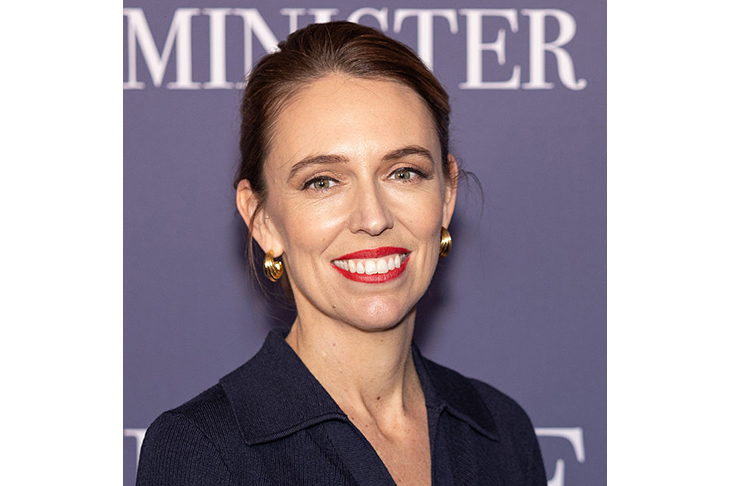
How very odd that former New Zealand prime minister Jacinda Ardern should have led the stampede exiting this year’s now-aborted Adelaide Writers’ Week, protesting the decision to drop Sydney writer Randa Abdel-Fattah, an outspoken critic of the ‘murderous Zionist regime’ who made several inflammatory social media posts in the wake of the Hamas-led attack against Israel on October 7, 2023, deemed by the organisers to be beyond the literary pale. The rest, as they say, is hysteria. Most of the guests promptly packed their bassoons and flounced out of the party. The entire event was canned shortly afterwards.
Among the first to leave was Ardern, the author of a recently published memoir and not a lot else. A Different Kind of Power is an apologia for the five-and-a-bit years she spent in office, but in sheer literary terms it’s rather thin. As one British reviewer unkindly (but accurately) put it, the work signalled her brand of political virtue ‘brightly enough to be seen from the moon’.
George Orwell once said that autobiography is ‘only to be trusted when it reveals something disgraceful’; by this measure at least, Ardern’s work was not a thumping success. But few would dispute her pulling power – or ubiquity. When it comes to an international kerfuffle, she dependably materialises like Forrest Gump. Even three years after stepping down, the former New Zealand prime minister with the toothy, telegenic smile undoubtedly remains the kind of political star literary gatherings like Adelaide need more than ever.
Despite record numbers of attendees at last year’s event in Adelaide, book festivals are not in good shape. Many would be in no shape were it not for taxpayers who are picking up much of the tab for what is fast becoming a dated literary relic. Part of the problem has to do with the now-weary Edinburgh literary festival format imported to the Antipodes in the 1970s and largely unchanged since.
Festival attendees and (gulp) speakers know the cobwebby routine all too well. Authors get interviewed by fellow authors. Authors retell their most shop-worn anecdotes. Authors answer throat-clearing queries from audience members, including at least one at every session agonisingly prefaced by ‘I have a comment and question’ that relates to absolutely nothing the author has been speaking about, and which in any just world would see the questioner bound and trussed and thrown out of a fast-moving train.
Last, authors wearily sign a smattering of copies of their latest work, before driving off like Snoopy into the dark and stormy night.
The demographics hint at wider problems: too many clusters of grey hair. A preponderance of high-tone accents. People with too much disposable time and income on their hands, and, especially, far too few young people. Not to mention younger writers. At 46, Randa Abdel-Fattah is no spring chicken, but she’s a slip of a lass compared with the average lit’ry speaker these days.
The rise of digital media is another part of the issue. So is the proliferation of alternative platforms for literary engagement. Mostly, though, the perception is that traditional festivals are either too out of touch with contemporary concerns or too in touch with one particular contemporary concern, which is the curious obsession with all things Jewish to the exclusion of virtually anything else currently happening around the world.
The growing consensus seems to be that, on their current trajectory, many of these events are simply becoming ever more insular, catering to shrinking audiences and wheezy establishment types.
As if all this isn’t bad enough, festival organisers have the additional issue of authors rebelling against sponsors with links to perceived environmental despoilers or politically unpopular investment portfolios. And woe betide the board that thinks of reining in the likes of an Abdel-Fattah or, worse, rescinding an invitation.
Ardern, who had been scheduled to speak about her memoir with the ABC’s Sarah Ferguson before pulling out at the admittedly cack-handed treatment Abdel-Fattah received, has her own curious record in this department.
As prime minister, she aggressively pursued her own version of ‘hate-speech’ reforms that, had they been enacted, would have greatly expanded the power of the state to prosecute people for far milder provocations than those trafficked by Abdel-Fattah.
Ardern’s Christchurch Call, established in the aftermath of the horrific mass-murder of 51 Muslims in New Zealand in 2019, proposed harsh penalties for those who incite or ‘normalise’ discrimination. It would have broadened the definition of ‘hate’ to include offending religious sensibilities or using words that could bring others into political disrepute.
Whatever one thought of Ardern’s proposals, they hardly marked her as a Jeffersonian champion of unfettered free speech.
As New Zealand’s Free Speech Union argued, Ardern’s approach – like that of leaders elsewhere in the region in the aftermath of similar tragedies – focused on cracking down on what some people in general were saying rather than doing anything specifically helpful. At best, her proposals simply homed in on ‘base collective references’, as the union said, rather than the obvious remedy of using existing laws to root out potentially dangerous criminals. While Ardern often spoke about the importance of kindness in public discourse, her own government’s legislative agenda suggested a willingness to curtail certain forms of expression in the cause of some unspecified social harmony. One could debate all this, of course, but the place to do it would have been somewhere like Adelaide.
Got something to add? Join the discussion and comment below.
David Cohen is the author of Jacinda: The Untold Stories (Centrist Publishing).
You might disagree with half of it, but you’ll enjoy reading all of it. Try your first month for free, then just $2 a week for the remainder of your first year.