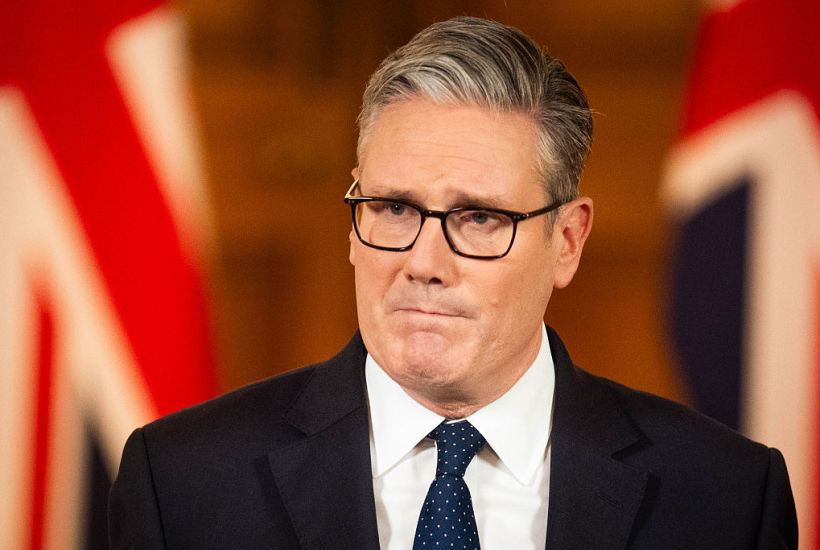
For all his problems, Keir Starmer has never been a victim of high expectations. When he entered Downing Street in 2024, voters did not throng the streets as they did for Tony Blair in 1997. There was little talk of new dawns. Britain was too battered by Brexit and its aftermath, and by a series of dismayingly inadequate Tory prime ministers, to feel optimistic about its next leader.
Starmer’s reversals stem from a staggering lack of forethought about how to run the country he had just spent three years campaigning to govern
Then there was the leader himself, a man almost incapable of inspiring warmth or excitement. Voters accepted him as the least bad option. But there was also a sense that he was solid, dependable and competent. And after Boris Johnson and Liz Truss, these qualities had acquired a charisma of their own. Starmer might be short on ideas and personality but he could do the job. He was serious
That was, broadly speaking, my assumption too. And yet, having settled in for a government of reassuring mediocrity, I’ve been amazed at how far beneath that level he and it have operated. In September 2020 Starmer criticised Johnson for making 12 U-turns. ‘To correct one error, even two, might make sense’, he said. But 12? ‘The only conclusion is serial incompetence’. A fair point, but what are we up to now with Labour? Add ID cards, business rates, and jury trials to an already long list and Starmer has now exceeded that number.
Johnson at least had the excuse of an unprecedented and fast-moving global crisis. Starmer’s reversals stem from a staggering lack of forethought about how to run the country he had just spent three years campaigning to govern. The modus operandi of his government has been panicked ad hoc. The three most recent U-turns reversed polices that were not in the Labour manifesto. They were cooked up in office, thrown against the wall, and are now slithering down it.
Having presented himself as the last man standing between Britain and populism, Starmer has instead been the making of Nigel Farage, who, without having to change very much at all, suddenly looks like a plausible prime minister.
I used to think that Starmer was a tortoise: a frustratingly slow learner who nevertheless got there in the end. I no longer believe that. There is no sign that he is learning on the job and no self-awareness. Insofar as he recognises that things are not going splendidly, it’s the fault of other people – his cabinet, his MPs, the civil service, the media.
Amazingly, there are still people out there, a few of them with newspaper columns, who don’t seem to have updated their view of him. They see Starmer as a fundamentally serious man who struggles to ‘tell his story’. They assume that behind his disturbingly blank façade there is a weighty statesman who secretly agrees with them about everything. But what if behind the façade there is nothing at all?
In the Financial Times, Camilla Cavendish has urged Starmer to ‘move fast and break at least a few things’, by which she means his own party’s shibboleths. For all his faults, Cavendish says, Starmer is a prime minister who isn’t obsessed with soundbites and really cares about public sector reform.
I’m sorry, which Starmer is this? Is it the Starmer who has allowed his education secretary to roll back the most successful cross-party reform programme of the last 20 years? Is it the Starmer who let his Health Secretary kick social care reform into the long grass? Or maybe it’s the Starmer who whined about a declinist civil service while appointing a notoriously conservative official to head it, and embarking on a radical programme of complete inaction. As for his supposed distaste for soundbites – really? Are we sure it isn’t just that his soundbites are unmemorable? He certainly likes to repeat that Labour has ‘fixed the foundations’ which would be laughable if it weren’t so depressing.
The idea that Starmer is a serious man unsuited to an age of raw populism is remarkably persistent. Tom Baldwin, Starmer’s amanuensis, blames the voters for Starmer’s deep unpopularity. He says that Britain may be becoming ungovernable. ‘Something is going on with the electorate.’
I don’t know, maybe the electorate is smarter than Baldwin thinks, or at least not as stupid as he imagines. Perhaps they can see that this is a Prime Minister who merely cosplays at seriousness; who changes his mind on everything because he didn’t know his own mind in the first place; who introduces a momentous change to the law on terminal care because a celebrity told him to; who makes a hard-hitting speech on immigration and then says he didn’t know what he was saying; who drops everything to call a press conference about a Netflix drama; who allows his Chancellor to hint at breaking a central campaign pledge and then take the hint back; who declares right before his party conference that ID cards will be the centrepiece of his reform programme before erasing all mentions of it from his speech.
Starmer has been called a colourless technocrat, but this is hard on technocrats, who can at least claim technical expertise. One of the salient characteristics of this Prime Minister has been an almost complete lack of knowledge or interest in domestic policy – in solving knotty problems of economics or infrastructure or service delivery. He isn’t the antidote to populism so much as a dismal populist – Boris Johnson without the sense of humour. He is constantly grabbing at policies or themes he thinks (or his advisers think) might win him votes, but lacks any instinct for what voters want, admire, or like. Fatally, he doesn’t even know what he wants. Robert Caro, the great biographer of Lyndon Johnson, says that power doesn’t always corrupt, but it always reveals. After 18 months in office, Starmer has been revealed as a void.