‘We continue to grapple as a species,’ writes Carl Morris, ‘with a knotty philosophical divide between anthropocentric and biocentric approaches to the natural world. Our bodies are both transcendent – seemingly beyond nature and capable of rationalised enhancement – but also immanent – that is within nature and therefore subject to the same frailties and limitations.’ What is he addressing? Space travel? Diving to the bottom of the Mariana Trench without oxygen? Not quite. He is talking about the process of human locomotion. He is talking about running.
Stay with me. Books about running can be as dull as a ten-mile road race in the Illinois flatlands, and I say that as a keen fell runner. This book isn’t. The stall-setting, a bad habit in academic writing, doesn’t reappear and doesn’t stand for the rest of the book, which is a deep dive not into a trench but into what Morris calls MUT. He claims this as a standard abbreviation for Mountain Ultra Trail, though I’ve never heard of it.
Humans have not always run for fun. Nor have they traversed epic distances by foot just because they wanted to. Morris takes us at a steady pace through the growth of off-road ultra running, from its beginnings in the charming phase of pedestrianism in the 19th century, when people like Weston the Walkist were famous for their walking feats. In 1866, wagered $10,000 that he could not do it, Edward Payson Weston walked 1,200 miles from Portland, Maine to Chicago in 29 days, where he was ‘escorted to the Sherman House Hotel by 50 police officers and a 30-piece marching band’.
Meanwhile, in England, George Littlewood set the six-day walking record of 531 miles, one that still stands, ending it with a foot worn down to the bone. But my favourite walkist is Grandma Gatewood. Emma Gatewood, the 66-year old survivor of a brutally violent marriage, decided to walk the entire Appalachian Trail, a route that had taken nearly 20 years of planning by various hiking clubs and finally opened in 1937. She failed on her first attempt, getting frequently lost. On her second, in 1955, she didn’t prepare much better, having only a shower curtain against the rain, sleeping on leaves at night and eating mostly berries. But she did it and became famous; and suddenly walking your cares away on epic trails became normal. Normal, but not easy. It is never easy, as Morris says: ‘In a complex world where outcome and our societal contributions can be elusive, it is an activity that combines simplicity with difficulty: move – keep moving – finish.’
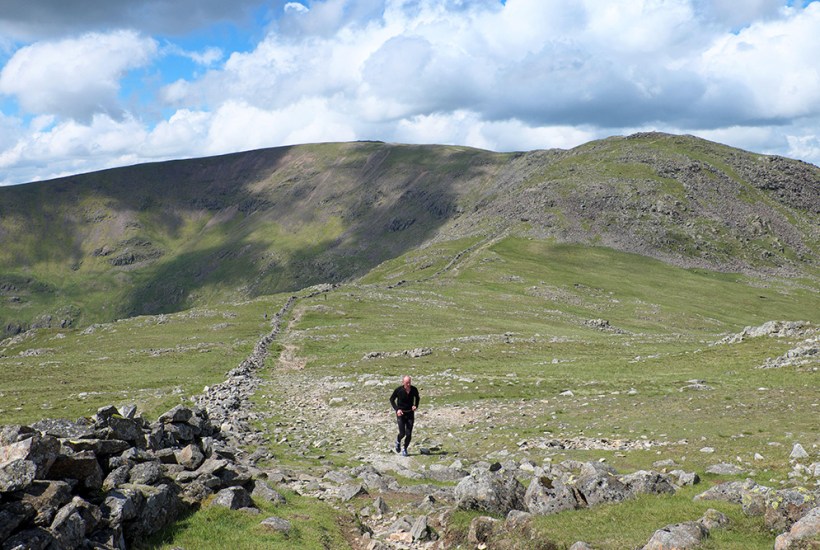
Morris’s focus is definitely on ultra running and mostly on the US side of things. That’s where ultra running grew fastest. In 1972 there were only six ultra-distance events in the United States, and ten years later there were 209. The US has produced magnificent runners, such as Courtney Dauwalter and Dean Karnazes. In Britain, we have contributed Bob Graham, a ‘powerfully built, modest, kindly’ hotelier in Keswick, who set off in June 1932 to run 42 Lakeland mountains, a distance of 66 miles, in less than 24 hours. Although he and his pacer relied on fruit pastilles and water at first, they succeeded in 23 hours 39 minutes, and the Bob Graham Round is still the most famous round that fell runners aspire to complete.
Ultra running may have started as a man’s sport – early athletics and walking clubs kept women out because they were considered too delicate – but Morris gives starring roles to many magnificent women, too. There is the unnamed Tarahumura woman who won a race covering about 77 miles around ‘an oblong mountain’ in Mexico in 1867, having given birth ten days earlier. And there is my particular hero, Jasmin Paris, who won the Spine Race outright in 2019 (we have to say ‘outright’, because otherwise it’s not clear she beat all the men) while expressing milk for her 14-month-old daughter.
As for why people choose to run improbable distances up and around mountain ranges and across endless fells, you will find plenty of reasons in Dirtbag Dreams. If you are someone who responds to a person running a long distance with ‘you’re mad’, this book may change your single-track mind, since the enterprise actually increases sanity and serenity. Morris has delivered a satisfying account of how we got to where we are now, where it is almost normal to run for days, for fun. At the finish line, though, there is no better reason for why I or anyone else chooses to run 42 miles overnight, or 268 miles along the Pennine Way, or many miles around the French Alps than: ‘Why not?’
Got something to add? Join the discussion and comment below.
You might disagree with half of it, but you’ll enjoy reading all of it. Try your first month for free, then just $2 a week for the remainder of your first year.