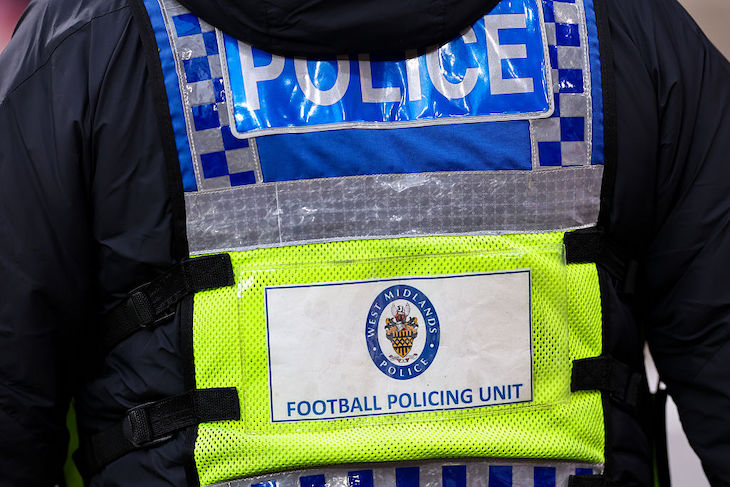
Each new revelation that has followed the banning of Israeli football fans from Birmingham shows that West Midlands Police is rotten to the core. As more evidence emerges, the case that the force responsible for policing our second city has been captured by sectional interests becomes stronger.
The association between the police and Green Lane mosque is one which the mosque is keen to promote
The most recent information released into the public domain shows just how deeply ingrained that infiltration has become – and how it goes to the very top.
In 2022, when the force’s current chief constable, Craig Guildford, was recruited, the then chief executive of the controversial Green Lane mosque in Birmingham, Kamran Hussain, sat on one of the selection panels which interviewed prospective candidates.
This is a mosque which has subsequently become no stranger to the articulation of highly-controversial views. In December 2025, the mosque livestreamed a sermon where an imam said husbands had a right to impose ‘physical discipline [as] a last resort on the condition that it doesn’t cause pain, injury, fear or humiliation’ on their wives. In 2024, the then chief executive of the mosque, Abdul Haqq Baker appeared to cast doubt on the number of victims in the 7 October 2023 terrorist attacks. In 2023, the mosque had £2.2 million of government funding suspended after footage was uncovered of a preacher linked to the Green Lane mosque and community centre arguing that ‘homosexuality is not permissible’. None of this is a recent turn of events: as far back as 2007, a Channel 4 Dispatches investigation found that teachers and preachers were promoting extremist ideas at the mosque.
The association between the police and Green Lane mosque is one which the mosque is keen to promote. Both West Midlands Police and the West Midlands Police and Crime Commissioner are listed as ‘partners’ in the mosque’s 2024 annual report. In their 2021 annual report, they refer to the assistant chief constable attending their annual Gala Dinner. It has now been revealed through a Freedom of Information request that the local Police and Crime Commissioner, Labour’s Simon Foster, has documented how well the mosque is known to his office, how he has ‘attended Green Lane mosque and community centre on various occasions’ and that he has previously confirmed he is ‘happy to provide a general letter of support for the purpose of Green Lane mosque and community centre funding applications’.
Can any other faiths or community groups claim such strong partnerships with the police? Why is this faith ‘community’ – particularly those within it who have connections to those who espouse extremist views – seemingly prioritised above all others?
The recruitment of the chief constable is one of the many responsibilities of the Police and Crime Commissioner. What due diligence do he or his office undertake when it is decided which ‘community leaders’ to involve in their activities? As part of this process there were also panels representing staff members – which of the force’s so-called ‘staff networks’ were involved? Are any specific groupings regularly prioritised over others?
The recruitment exercise is just one example of how embedded sectional interests have managed to become within West Midlands Police. During the riots of 2024 a senior officer, in an interview with Sky News, defended the force’s failure to deal with an armed mob after consulting with ‘community leaders’, because the community would apparently police ‘within themselves’.
Can any other faiths or community groups claim such strong partnerships with the police?
Central to the problem here is the lack of transparency when it comes to the various policing structures and their dealings with ‘stakeholder’ groups. Involved in this case alone were: the Home Office, the National Police Chiefs Council, the UK Football Policing Unit, the National Police Coordination Centre and the Ministry of Housing, Communities and Local Government.
This week Sir Andy Cooke, His Majesty’s Chief Inspector of Constabulary, will report to the Home Secretary on West Midlands Police’s handling of the affair. With Sir Andy’s five-year term coming come to an end in March 2026, this will be one of his final pieces of work before departing. Returning the force to the ‘special measures’ oversight regime will be the minimum requirement given everything we have seen so far.
The ball will then fall squarely to the Home Secretary, Shabana Mahmood MP. While the immediate question will be what to do with the chief constable – and for the avoidance of doubt his position is entirely untenable – the equally important question is how to rebuild a force which has been allowed to be so evidently captured by vested interests.
In this case, the government should pass emergency legislation to place powers of oversight for West Midlands Police into the hands of the Home Secretary – as was the case for London’s Metropolitan Police prior to 2000 – for a time limited period. Having decided to abolish Police and Crime Commissioners, the government’s current plan is for existing PCCs to complete their terms of office with their powers passing to the mayoralty where one exists in May 2028. Here, that cannot be allowed to happen when it is partly local politics that has permitted sectional interests to have such considerable influence.
Beyond West Midlands Police, this is an episode which has called into question how local accountability in policing can ever be effective when there is a risk that police forces and the relevant local mechanisms of oversight can so easily be influenced or captured. In the coming weeks, the government will publish its White Paper on Police Reform. Ministers’ most essential task will be to ensure that – contrary to what we have seen in Birmingham – we can once again have faith that our police forces really do act ‘without fear or favour’.