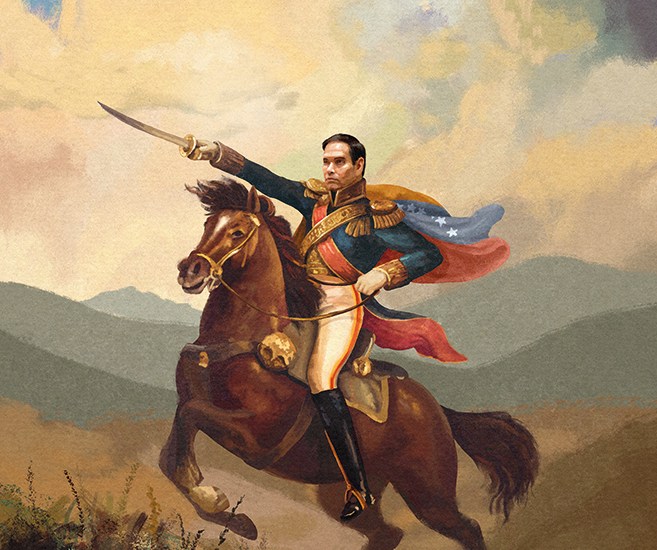
It required an incredible amount of sophistication to achieve the desired result in Caracas: a dictator detained and transported alive. The mission had been planned and mapped out for months, worked and reworked at the behest of the Commander-in-Chief. No American casualties would be tolerated. Special Forces had been circling and at the ready for weeks.
The helicopters were easy targets, so a vital part of the mission was to eliminate Nicolás Maduro’s ground- to-air response beforehand and claim total air superiority. There must have been any number of worries that such a risky mission could go wrong, yet mere hours before it started, Marco Rubio was calmly sitting at a table in Mar-a-Lago where he was captured singing along to Pitbull and throwing up his hands at the chorus of “Fireball” in a celebratory mood. There he is, the American Secretary of State: constantly memeable, always on his phone.
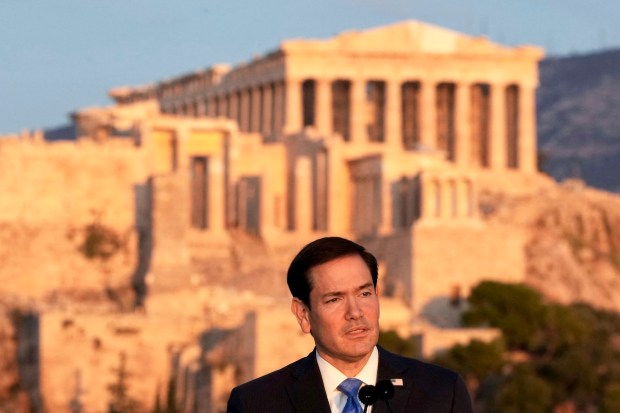
Rubio is now the best version of himself; the laid-back Gen Xer of the cabinet, cool under pressure
Rubio had an incredible journey to this moment of victory. Once he was ridiculed for his heel boots and robotic debate-stage talking points. He was the ordained inheritor of neoconservative dreams. He posed with Nikki Haley, Trey Gowdy and Tim Scott in South Carolina, the last establishment gasp before the reality of the 2016 cycle set in.
But Rubio has remade himself into something new and interesting. His rakish wit and a come-at-me on-camera attitude renders him immune to the jabs of talk-show critics. Rubio is now the best version of himself; the laid-back Gen Xer of the cabinet, cool and composed under pressure and with an occasional knowing wink to his audience. This is a guy who officially does not give an F. And, as Secretary of State, that is a very powerful thing.
Rubio’s origin story was always an oddity: he was a dyed-in-the-wool social conservative, a Mike Huckabee supporter in 2008, who latched on to the energy of the 2010 Tea Party to seize a Senate seat. TIME magazine hailed him as the “savior” of the Republican party, the establishment-friendly Hispanic face of a newly anointed nationalist movement tied to tricorne hats and pocket Constitutions. As a presidential candidate six years later, he attempted to bring everyone in for the win, running a campaign that seemed more tuned to a general election than a primary. But things didn’t go as planned. At a rally in Hialeah, a Cuban-heavy Miami-Dade neighborhood, he stayed late onstage to take questions from Fox News’s Megyn Kelly as supporters provided a cheering backdrop – only for the interview to conclude too late for people to vote at the nearby polling booth. That became the moment people remembered.
But Marco learned valuable lessons from the debacle. There was a brief moment where it seemed he might quit the Senate, or potentially take a break from politics entirely – but upon his return, he stood out as a politician who had learned from the defects of the Paul Ryan-led Club for Growth and was more open to moderation. He became an increasingly loyal Trump supporter, advocating for his national security policy without hesitation and putting the best spin on choices made by the Commander-in-Chief.
The new role did not go unnoticed by the President – and when the campaign to return reached the point of vice-presidential consideration, Rubio was at the top of the list. He turned out to be second only to J.D. Vance, driven in part by the fact that Trump was running as a citizen of the state of Florida, and Rubio’s inclusion would’ve spurred election ballot lawsuits and legal hassles undesirable for an effort that already employed a surfeit of lawyers.
But it was well known among those close to the campaign that Rubio was the preferred candidate of Susie Wiles, now White House Chief of Staff, and that many close to Trump believed him to be a more capable and compelling VP than Vance, who just seemed to double down on Trump’s strong appeal in Appalachia.
In retrospect, Rubio may have dodged a bullet. His role as Secretary of State has expanded dramatically and now includes the office of National Security Advisor and a host of other duties. “The Oakland Raiders have announced Marco Rubio as their new head coach” is now a ubiquitous joke: the “Secretary of Everything” has more jobs than he can count. And how is he doing at those jobs? Very well, apparently. “The thing is that I don’t know what J.D. Vance is doing, and maybe Marco is doing too much, but Marco seems to know what he’s doing – and I’m not sure J.D. does?” a Washington Republican consultant tells me. The view seems widely shared: Rubio may have bitten off a lot in this second Trump term, but he’s handling it well, whereas Vance seems to struggle with things as basic as answering awkward questions about his wife’s religion. Rubio, for what it’s worth, is married to a Miami Dolphins cheerleader. Forget the international statesmanship, he’s still a Florida man deep down.
The tension between Vance and Rubio is the talk of Washington, and already there are people taking sides. Some close to Vance maintain that his elevation is assured, a foregone conclusion, and that an endorsement from Trump will make it an uneventful 2028 primary. Others – some Rubio supporters, but more who have the knowledge born of prior contests – maintain things will get messy and difficult.
The tension between Vance and Rubio is the talk of Washington – and already there are people taking sides
Vance’s squad has openly intimated that he has no intention of participating in presidential debates. Those close to Ted Cruz have something to say about that. As for Vance himself, he clearly understands the potential threat of his incipient rivalry with Rubio. After lightheartedly offering to reward the Vanity Fair photographers with a $1,000 for having made Marco look bad – and short – Vance gave an interview to Fox News in which he entertained a hypothetical. “If an opportunity is presented that would make Marco Rubio look good, be great for the administration, and wouldn’t really involve me, at least publicly, what do I do?” Vance said. “If I’m optimizing for 2028, I try to kill the opportunity. If I’m optimizing for the country, for the administration, and to be a good human being, we do it.”
So was that what Vance was doing when he ceded the scene to Rubio at Mar-a-Lago, with the Secretary of State at President Trump’s shoulder and ever-present in the aftermath of the Maduro raid? It can’t be viewed as a wise choice. “Is he in witness protection? Would he have done what Trump did?” one Republican tells me. “Is he waiting for it all to go wrong and then say… ‘if only Rubio hadn’t given Trump bad advice’?” Vance has since given an interview on Fox News in which he parroted the tough talk of the administration on Latin America. But there is a definite perception that at any controversial juncture, the VP can remove himself from the situation, deliberately distancing himself from the choices of the Commander-in-Chief.
The assumption on Capitol Hill is that, though he’ll pay lip service to the agenda, Vance didn’t support the Venezuela move, just like he didn’t support the Iran move, and just like he hasn’t supported any of the President’s more hawkish tendencies in his second term. The decision to choose distance is made with an eye on 2028, surely, but it also makes him seem ungrateful: a reluctant defender of the man who elevated him to a heartbeat from the presidency after winning only one election in a deep-red state.
When Rubio did his full-blast media tour defending the Maduro capture, he repeatedly made reference to the fact that he’d been working on Venezuela-related policy for 15 years. The implication was not lost on DC Republican politicos. “Marco was working on figuring out South America when J.D. Vance was writing for FrumForum under one of his many different names,” one Republican Hill staffer told me. “This is a ‘get your fucking shinebox’ line if I’ve ever heard one.” Perhaps that isn’t Rubio’s intent. Maybe he just wants to focus on the demands of his numerous current jobs, and really will, as previously intimated, offer a demure response when Vance launches his inevitable 2028 campaign. But what if Rubio himself better embodies the spirit of MAGA than Vance? What if his South Florida persona solves the drip-drip-drip loss of Hispanic support that was so critical to Trump’s 2024 win? What if the Donroe Doctrine is something Rubio can more readily defend than Vance, who seems constantly risk averse?
Could it be that after all the failures on right and left, we see a Gen Xer mount a meaningful campaign after all? These are all vital questions still waiting to be answered.