Each Supreme Court term typically includes at least one explosive case that inflames political passions and captures the public imagination.
When the court overturned Roe v. Wade in 2022, or when it greatly broadened presidential immunity, as it did last year in Trump v. the United States, or when it ruled against race-based college admissions in 2023, it reaffirmed its centrality and reminded voters that it mattered.
As it happens, very few Americans can name the chief justice of the Supreme Court of the United States (surveys show it is consistently under 16 percent), but most know instinctively the high court’s opinions deeply impact governance, politics and culture.
Before the justices conclude for the summer, they will rule on a section of the Voting Rights Act that states have used to craft congressional districts giving minority candidates an edge. During oral arguments, the court’s conservative majority seemed to be leaning toward striking that provision, a move that could cost Democrats a dozen or more seats in the south.
That case, and a host of other hotly contested issues before the court, including President Trump’s deployment of National Guard troops to Chicago, his imposition of tariffs on foreign competitors and his ban on birthright citizenship, have the potential to play a pivotal role in next year’s congressional elections.
With Republicans clinging to a thin, single digit majority in the House, any one of these issues might prove decisive.
But in the current Supreme Court term, context might be even more important than any individual case. Underlying the litigation battles playing out at the court is a full-blown power struggle. In case after case, the final question isn’t so much about the fate of individual litigants but rather the balance of power between the high court, the executive branch and Congress.
Such conflict is a perennial feature of Constitutional jurisprudence and dates to the founding. But seldom has this tug of war been attended by such ferocity.
The high court, with its conservative majority, has generally been supportive of the Trump agenda. Not so the lower courts in the federal system. Since Trump’s inauguration in January, federal district court judges have issued more than 150 injunctions barring the administration from enacting a wide range of policies on immigration, to government staff cuts and birthright citizenship, an unprecedented number.
Robert Reinstein, the former Dean of Temple University law school and an expert on the high court, said lower courts are in “revolt” against Trump administration policies and have been unusually combative in trying to constrain the administration. That in turn has prompted the administration to turn to the court’s so-called shadow docket for emergency orders, allowing it to move forward with its policies, at least on a temporary basis.
Traditionally, use of the shadow docket has been rare, confined to death penalty cases and other emergency matters. But the numbers have surged during Trump’s second term. According to Georgetown University law professor Stephen Vladeck, the number of emergency orders sought by the Trump administration after 20 weeks in office matched the total sought during the full four years of the Biden administration. During the 16 years of the Obama and Bush administrations, there was a total of just eight shadow docket applications.
Use of the shadow docket has raised hackles because cases typically are decided without oral arguments, briefing or textual support. Nor is it typical for the court to issue much in the way of an explanation when it makes a decision. Thus, there is relatively speaking, little in the way of a record or transparency.
But this complaint is overblown. The orders are temporary, reflecting the urgent nature of the issues being decided, and the matters are typically sent back to the trial court for further proceedings.
That is what happened in the birthright citizenship case. The court did not decide the case on its merits and ordered the district court that heard the case originally to reexamine the matter. It did take the opportunity, however, to restrict trial court judges’ ability to impose nationwide orders. The practice had infuriated Trump administration partisans, who accused lower court judges of abusing their judicial authority to thwart the president’s agenda. Now the court has agreed to hear oral arguments on the central question in the case – whether being born in the U.S. guarantees citizenship.
One of the ironies in this ongoing conflict between Trump and the lower courts is that while the administration has been hit with an avalanche of injunctions barring it from implementing policy, it also has won the vast majority of appeals that it has pursued on the shadow docket, 20 -3 according to one tabulation. The underlying dynamic is one of trial courts manning the barricades, as they see it, and the Supreme Court, with its conservative majority, backing up the administration.
That there has been a surge in the number of shadow docket cases is a byproduct of the country’s ideological divide and the Trump administration’s aggressive agenda.
He clearly seems intent on pushing the envelope. In matters such as sending the National Guard to Portland and Chicago to assist in deportation sweeps and in his claim that he has the authority to impose tariffs on foreign products without congressional approval, among many other initiatives, Trump inarguably has pushed the boundaries of what is permissible under statute and the Constitution.
But in the long and contentious power struggle between the Supreme Court, the executive branch and Congress, this is actually nothing new.
Chief Justice John Marshall famously laid down the gauntlet in Marbury v. Madison in 1803, where he declared for the first time that “It is emphatically the province and duty of the Judicial Department to say what the law is.”
William Marbury had sued the government under the newly elected president Thomas Jefferson to secure a judicial appointment he had been promised under the previous administration of John Adams. The official paper granting him the position hadn’t been delivered on time, and Jefferson, seeking to make his own nominations, declined to move the appointment forward.
Marshall wrote for the court that Marbury’s appointment had been improperly denied but that the statute under which he sued to obtain the position did not grant the Supreme Court authority to address the matter. With one stroke of the pen, Marshall managed to upbraid Jefferson for improperly denying Marbury’s appointment, while asserting the court’s position as final arbiter of what the law intends.
Through the years, the principle of judicial independence established in Marbury v. Madison has been periodically tested and in pivotal moments it has been upheld, notably when President Harry Truman attempted to seize U.S. steel mills in 1952 as part of the Korean War effort, and in Brown v. Board of Education, when the court overturned public school segregation
And so it is that this very institutional history makes predictions based on the ideological leanings of Supreme Court members a precarious undertaking. Partisans on the right and the left like nothing more than to castigate the court for acting out of political motives, prompting calls for term limits and increasing the number of justices, a so called court packing strategy.
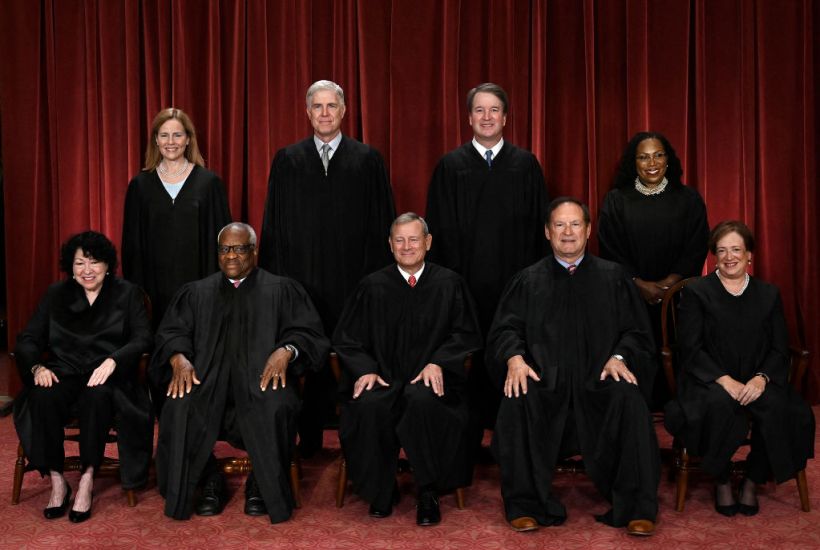
In this court, it is surely the case that its six-member conservative majority is consistently more supportive of the Trump administration. And its three liberals, Elena Kagan, Sonia Sotomayor and Ketanji Brown Jackson, are usually in opposition.
This was clearly in play when the court heard oral arguments in Louisiana v. Callais, challenging the legitimacy of section 2 of the Voting Rights Act. The law was enacted in the 1960s to counter discriminatory election practices and has been used to create racially gerrymandered congressional districts to ensure higher numbers of minorities in Congress.
During the hearing, it soon became clear that the court’s conservative justices were skeptical that such racially engineered districts were needed any longer, a view certainly in keeping with conservative orthodoxy. If section 2 were overturned, a dozen or more black majority districts in the House could be eliminated, all of them represented by Democrats.
But such ideologically aligned results are hardly a fait accompli.
When Justice Neil Gorsuch, during oral arguments in Learning Resources, Inc. v. Trump, grilled solicitor general John Sauer on the administration’s claim that the International Economic Emergency Powers Act grants the president broad authority to impose tariffs, without ever once mentioning the word, he seemed to be drawing a line.
The implication was that grants of congressional authority are not open ended and when the president asserts such a right, it had better be clearly spelled out in the law.
In other words, ideology too has its limits in the world of constitutional law. Jurists may tend in certain directions when it comes to political questions. But Supreme Court justices, both conservative and liberal, also protect institutional prerogatives and agency, and the simple assertion of that independence is often as important as what the facts and the law might say.