Anne-Louise Sarks’ production of that dazzling dramatic opera Carmen at Melbourne’s Regent was sometimes lit like a Christmas tree, sometimes shrouded in darkness, but it was animated by the dramatic vivacity and virtuosity of Danielle de Niese. The performance was an extraordinary coup of theatrical intensity and it proved that the head of the Melbourne Theatre Company can do opera and can keep an audience on the edge of their seats.
Much Ado About Nothing in a production by Mark Wilson made you wonder how a major theatre company could come out with such a confused and cumbersome production despite a competent Beatrice in Alison Bell and an impressive Benedick in Fayssal Bazzi.
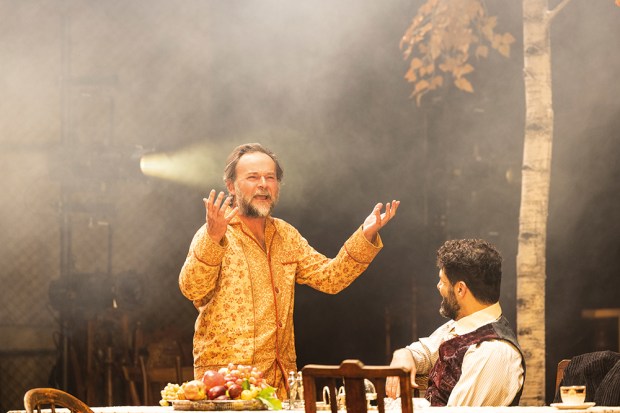
The production is full of light as if it emanated from some Queensland of the mind and Anna Cordingley has referenced Sam Newman’s blue house so that we’re confronted by an angled glass box with white plastic outdoor furniture. And the cast – apart from the leads – is an extraordinary mismatch of misaligned multi-tasking.
That distinguished actor with the funny voice, Julie Forsyth, has to play the idiot policeman Dogberry who misunderstands the meaning of the simplest words. This is fine but she is also plays Ursula and the Friar and is deemed to be a member of the ensemble so that her serious lines get jumbled up with the comical ones.
This reaches the point of casting idiocy when Miela Anich has to play not only Hero – the sweet girl betrothed to the juvenile lead Claudio – but Borachio the villain who contrives to betray her for the evil Don John, the bastard. Chanella Macri plays this evil eminence with a degree of lowering immensity but then has to double as Margaret, the misleading girl at the window. Even Claudio himself, played attractively by Remy Heremaia, is absorbed into the ensemble when he dons a beanie.
It is little wonder that John Shearman as the Prince is also associated with the collective. It doesn’t help that his early scene with Beatrice where he says, ‘Will you have me lady?’ is played with a wholly inappropriate histrionic hysteria where it is manifestly written to evoke a bemused whimsy and easy flirtatiousness.
It’s worth remembering that a lot of Much Ado is written in prose. Listen to Beatrice: ‘No; but to the gate; and there will the Devil meet me, like an old cuckold, with horns on his head, and say, “Get you to heaven, Beatrice, get you to heaven; here’s no place for you maids.” So deliver I up my apes, and away to Saint Peter for the heavens: he shows me where the bachelors sit, and there live we as merry as the day is long.’
The language that delineates the ‘merry war’ between Beatrice and Benedick represents the zenith of Shakespeare’s command of one kind of urbane, wise-cracking comedy which is – if we can jump a few centuries – the closest he ever came to the crisp typology of Shaw. Benedick is in fact a kind of Henry Higgins before the letter and Beatrice is an Eliza who can stand up to him. Everyone acknowledges that they would drive each other mad if they married but everyone is also aware of the latent attraction which is how the good characters trick them into acquiescing into a love neither of them thought would ever be requited.
Beatrice is arguably the greatest of all comic roles for an actress. When she’s told she was born in a happy hour she says that no, her mother cried and she also says she can see a church by daylight.
Much Ado About Nothing is the greatest romantic comedy ever written because it presents these two emotional sole traders catapulted into an overt state of besotted love by the good tricksters. But then there is the counterplot where the scheming liars hurl Claudio and the Prince into a state where they repudiate poor Hero.
The competence of Alison Bell brings home the great one-liners with a degree of precision but not transfixingly. On the other hand, Fayssal Bazzi gets as close as circumstances allow to being if not a first-rate Benedick then at least as close to one as the parameters of this perversely hare-brained production can allow.
But this is a Much Ado which shows no comprehension of how to situate this magnificent rom-com. In the latter part of the action we get Claudio and the Prince in full sartorial military dress but the effect of this beglamoured glory is dislocated by the setting so that all this princely full dress parading is done in front of the house where it is meant to take place in a church.
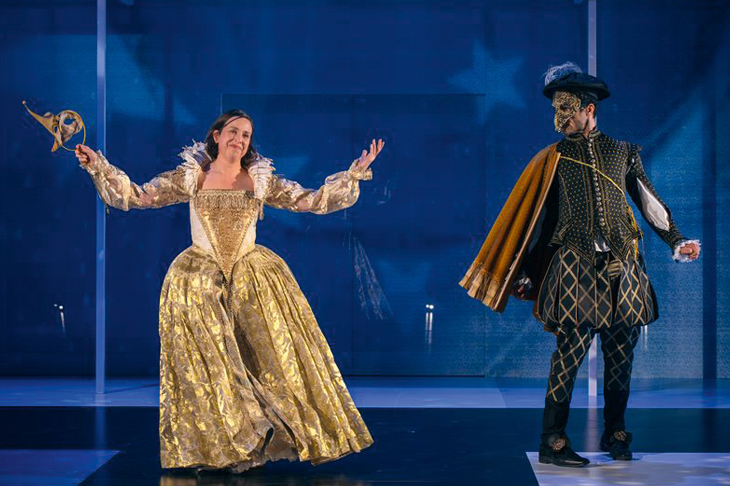
Karine Larché’s costumes are a moveable feast without any rhyme or reason: we go from modern casual to camp Elizabethan sway and swagger to the full regalia of military formal. Some of it splashes on the eye with visual glory but none of it makes sense and it’s all done to the accompaniment of Julie Forsyth wacko and Julie Forsyth grave.
Nor did it help that the crucial turning-point scene was accompanied by great shrieks of amusement from the first-night audience, whether through bafflement or cumulative delight it’s hard to say.
BENEDICK: ‘Come, bid me do anything for thee.’ BEATRICE: ‘Kill Claudio.’ BENEDICK: ‘Ha! not for the wide world.’ BEATRICE: ‘You kill me to deny it. Farewell …’ BEATRICE: ‘… O! that I were a man. What! bear her in hand until they come to take hands, and then, with public accusation, uncovered slander, unmitigated rancour, – O God, that I were a man! I would eat his heart in the market-place …’ BENEDICK: ‘Think you in your soul the Count Claudio hath wronged Hero?’ BEATRICE: ‘Yea, as sure is I have a thought or a soul.’ BENEDICK: ‘Enough! I am engaged, I will challenge him.’
It is one of the greatest scenes in the whole of Shakespeare. This is, alas, not a production that gives nearly enough sense of that. Someone who taught me used to say the play was all about ‘noting’ i.e. noticing or perceiving.
You don’t have to be across the etymological argument to see how much this production fails to notice about this extraordinary play. There is no argument for doing Much Ado with only eight actors and mixing them up so randomly and with such a lack of feeling.
Got something to add? Join the discussion and comment below.
You might disagree with half of it, but you’ll enjoy reading all of it. Try your first month for free, then just $2 a week for the remainder of your first year.