There’s no doubt that most any conversation centred around the state of journalism will draw significant criticism or negativity at what is perceived as a general decline in standards, trustworthiness, and reliability.
You are likely to hear something along the lines of: ‘Mainstream media is all propaganda’, ‘the media are all biased’, ‘they don’t report on what’s really happening’.
For the most part, the recognition is astute and accurate, though what is driving the perception says more about the nature of our society and the ways in which we consume our news in the 21st Century than it specifically says about the media broadly. There is more fault to be shared around, more complexity to the puzzle and perhaps, a little more perspective required.
What a view like this fails to accept is the part the consumer plays in the shaping of the content.
Consumers have a responsibility to do the work to ensure we aren’t either blindly accepting everything that’s put in front of us, or rejecting reality on the grounds of inherent biases.
I’ve identified roughly seven issues with the media landscape and have briefly outlined the concerns in the hope we can begin a conversation and shed light on the many competing priorities and societal failures doing harm to a fundamental cornerstone of democracy: a free and fair press.
Problem #1: Lack of Experienced Journalists
This is the obvious one. There is a dearth of the kinds of journalists of the past who spent decades honing and refining their craft; who saw the role not simply as a job, or a means to an end, but a career.
In print journalism, there remains a larger subset of the old guard than in other media forms. They continue to offer true insights and commentary through a career informed by the sum of many experiences, of the memory and wisdom of mistakes made, and the former realities that laid the groundwork of our present problems.
Perhaps it’s the form itself that lends itself to more thoughtful and coherent prosecutions of ideas, and because it is the older of the modern forms.
Alternatively, the majority of the reporters that we see on our screens – of news producers in newsrooms and digital teams – are engines powered by a mass of young adults, often freshly graduated from university, churning out content for pennies on the dollar, working shifts for 24-hour news companies until they inevitably burn out, or they move on at a rate of 12-18 months, as is particularly common among under 25s across Australia.
This is not unique to journalism but rather is part of the changing employment landscape in all sectors. Certainly, as a result of technological advances and shifts in socio-cultural values, there rarely exists the kinds of principled individuals whose sole commitment was to their craft and its honing over years and years; cutting their teeth out in the bush, before returning to ‘the big smoke’ with stories, experience, wisdom, rich networks, respect, and a refined journalistic voice. Many often took internships and cadetships – unpaid – where they were able to ingratiate themselves with the industry and its giants; learning the ropes and beginning the process of developing the tools one would require some day when seeking full-time employment. That individual usually gained the inside track over hopefuls through networks and on-hand experience, which made the sacrifice worth it.
Problem #2: Poor Calibre of Training (Critical Thinking and Dispassionate Reporting)
We do not lay the blame entirely at the feet of new hopefuls in the industry.
There has been a general shift in the way humans consume media and in the way humans present media. Some of this is a result of technological change and some the result of enhanced marketing and consumer practices.
Due to this, investment in the crafting and development of the next generation of journalists has all but disappeared. When we consider that investing in individuals whose longevity in the role is not guaranteed, and that delivering media online rewards volume, we become less inclined to see the value in developing and training journalists to be more than typer-monkeys churning out content en masse and rather valuable voices and truth-seekers who disseminate facts through meticulous and painstaking research and query; who hold authority to account and inform communities of current affairs they should care about.
The media purports this is still its charge, but I think we are all a bit cynical of that assertion. The expectation of journalists among the public (at least in principle) is that journalists should be trained with a deep sense of critical and analytical thinking skills with a commitment to dispassionate reporting that presents the facts without swaying its audience and is void of bias as much as it can be avoided.
This is somewhat wishful thinking, knowing that whilst people say they desire ‘no frills’ news, it is the tantalising tabloid journalism that still – according to the data – is what gets the most traction and engagement on social media platforms. As for the lack of bias, whilst there are those journalists who cannot help but manifest their vitriolic positions with little to no self-restraint, I dare say that the vast majority are not so much biased factional operatives as they are poorly trained unskilled fools.
Problem #3: The Business Model shift (clicks over quality)
Social and technological shifts have totally changed the way in which media is consumed, and, with it, the nature of the news media business model.
As we shifted onto online platforms as the primary means by which we consume our media, news outlets have found themselves in a global marketplace which values high volumes of content utilising algorithms to target and promote product through pithy, engaging content. Reliability and truthfulness become secondary considerations to post reach and user interaction. News has been reduced to 15-second summaries with which the masses must ‘inform’ themselves through in order to construct a vapid position on a serious issue to engage with inconsequential bots online who peddle outrage.
We all feel the pressure to take a position on breaking news, learn the talking points being fed to us and parroting them to anyone who will hear it to show the world just how engaged and informed we are, despite everyone simultaneously screaming into a void about an issue we can’t even verify is true. Salacious and speedy shorts. You don’t want the truth, and the media won’t give it to you. We receive what we demand. Unfortunately, much of what we claim to believe and stand for is contradicted by our actions and appetites.
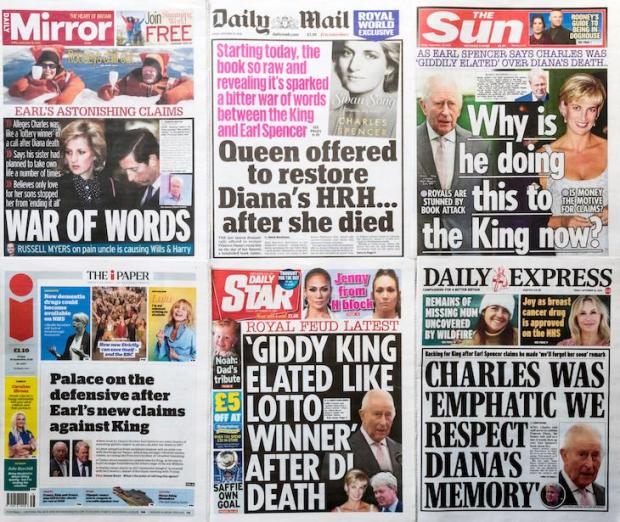
So often I hear people complain about the Royals, for example, and how irrelevant news reports about them are, yet as a former worker in the media, I can tell you that they were often the stories that gained the most traction online.
Problem #4: The Digital Age
This digital age has deeply affected the method and the means of media dissemination and consumption. In many ways, the advent of social media platforms has been a ‘great leveller’ in disrupting the monopolies of monolithic corporations, but in turn, has now replaced them with gargantuan monopolies of their own invention.
What I mean when I say ‘great leveller’ is that platforms became a contested space between individuals and independent ‘news’ accounts on one side, and the legacy media on the other, who sought to utilise the platform for its own commercial gain.
The problem is that consumers can’t help but view that which is presented to them on the same platform, as equal. A great media masthead with hundreds of staff and networks disseminating information are forced to share the common digital spaces with ‘Super News Dude 93’.
This is clearly problematic, as it means where news was once reserved for credible, verified sources, there now exists the means for inaccurate, lazy, or blatantly false reporting.
That reporting could be simply ill-informed at best, but at worst, it could be a weapon for foreign entities to engage in misinformation and proxy digital warfare.
In some ways the disruption has called out the callous and complacent legacy media for its abuses of authority, but it seems at a great cost to the fabric of free and democratic Western societies where ill-informed masses, foreign actors, greedy corporates, and opportunistic politicians utilise a pervasive technology to advance their individual objectives to the detriment of us all.
Problem #5: The community relationship & perception of media
The digital equilibrium of service providers and opinion providers, compounded by the growing polarisation of society due to algorithmic echo chambers, has seen a slow erosion in trust for legacy media. Cases have been exhibited in an age of extreme digital scrutiny that have seemed to justify the very distrust the public has had.
Perceived individual biases or accusations of a lack of communal and editorial impartiality have given further rise to skepticism, and more concerning allegations of corruption and collusion have more greatly enhanced such perceptions among the public. And whilst much of this should be to the shame of the industry for thinking itself untouchable, or allowing itself to rot from within, it is now at a disadvantage as the public – not only due to the aforementioned ills – defaults to a position of distrust.
Perhaps the solution is to reinvest in grassroots journalism where community relationships are rebuilt and restored; that removes the faceless shadow of corporate conglomerates and media dynasties that make people feel like few and narrow narratives are sinisterly sold to the people.
Problem #6: Educational Failures
There’s no doubt that educational standards in Australia have fallen dramatically as a result of poor policy and investment, however, it is certainly also the case that technological changes have inherently reduced skills, focus, comprehension, literacy, and attention spans globally.
Humanity itself is at a pivotal threshold whereby the knowledge and drive that has enabled us to develop the technologies we rely on to make our lives more comfortable and efficient, are now the authors of our own demise as we hand over our autonomy to automatons.
Poor critical literacy in identifying biases and the lack of discernment to determine which sources are credible and which are not has become increasingly common in the media itself, but also among the consumers of media.
What ensues is uneven reporting that has not been written skillfully and dispassionately, while individual consumers fail to understand that not all claims are equal, accurate, truthful, or trustworthy.
How often do we see comments sections filled with people jumping to conclusions based on a post that is only 20 words long and makes a sweeping claim that cannot presently be verified?
These fragmented pieces that form the mosaic of modern opinions are incomplete pictures that simply reflect other views as samples which often contradict or challenge other ones.
This way of existing allows one to have a belief and values system that is dynamic, modular and bespoke; that shifts with prevailing ideas and popular ideologies. But it is exceedingly disingenuous and betrays truth and authenticity for convenience and status quo.
Digital illiteracy is increasingly problematic, and this might be the issue that is more pronounced among older generations who were not raised on such technologies, though this is also not exclusively the cohort most impacted. This is the failure of individuals to understand the nature of algorithms; to discern between what is a credible provider of information and what is not, or to even determine what is artificially generated or manipulated imagery versus what is real. The latter is of growing concern in an age of exponential advancement, prevalence and pervasiveness when it comes to artificial intelligence.
Part of the solution, in such a fraught space, might simply be in encouraging individuals to limit their exposure to news and social media, and to delay – with great restraint – the temptation to react or respond before one has had time to digest, reflect and confirm the veracity of a source. This is most certainly wishful thinking and a pipe dream, but perhaps yet, if enough of us desire and practice such a thing, we might very well begin to turn the tide.
Problem #7: The Rise of Political Media (Propaganda)
What those concerns in the digital space particularly point to, is the growing integration and insertion of abjectly political forces in the media, or at the very least, the pressuring of the media to overstep its mandate to provide insight, truth, and the holding to account of our elected and unelected officials. It merges and morphs media outlets into communo-fascistic propaganda outfits, depending on which side of the spectrum an outlet might generally align.
A concerning evidence of this was during the Covid pandemic in which many governments placed significant wartime pressures on the press to maintain order in a bid to avoid total panic by effectively gagging what the media could report on, what it could say about certain things and what messages it had to drive home on behalf of the government.
Again, as someone who was employed by a media network during this period, I recall the frustrations and fears of editors and department heads who had to ensure messaging around the virus, and especially during the vaccine rollout, were aligned with certain talking points out of fear of legal action. This was despite there remaining a large quantity of unknowns about the virus and vaccines broadly. Whether the information being presented was true or not is irrelevant. Whether individuals were acting in the best interests of citizens is irrelevant. It might have been well-intentioned. It may well have been innocent. What should be the most harrowing takeaway is that the media was pushed into a position where it became the mouthpiece of the very individuals it was tasked to hold to account. We saw politicians make blatantly political decisions during a health crisis, deferring authority to unelected bureaucrats while the media maintained a foolish obsession with daily case numbers and overreach manifested in civil unrest as a result of the excessive force meted out by police officers.
I mention all this not to re-examine which conspiracies ring true or false, who was right and who was wrong, but rather to highlight what I believe to be one of the modern catalysts for the growing disenfranchisement of many Australians with the various echelons of ‘the establishment’. Individuals, who have taken radical or hostile views towards authorities in this country they may never have because of decisions taken in this fashion that did not choose to protect the media’s autonomy and separation of powers out of the fear of other unknowns. Let me be clear, that I do not believe this is the only driver, nor do I believe that only one side carries blame. These are simply my observations on this narrow area in general isolation.
You might forgive one for acting out of the fear of an unknown threat, but this is why sometimes, an adherence to ultimate moral or social or collective truths must be maintained for the sake of the good order of a society’s flourishing even when it might cause imminent but temporary pain.
The allure of my editorialising is to call you to be challenged and to challenge in return. As iron sharpens iron, with each pen stroke – in the free exchange of ideas – do we each grow a little more, and a little more.
I don’t seek fierce agreement, nor vacuous contrarianism. I put my ideas and my thoughts out there as an offer and a call to the hungry to attend the communal campfire and to hear and be heard. In this free exchange, where all voices give consideration to others; where one thought begets and develops the next, can we then truly see the fruits of community belaboured by truth and integrity, justice, and freedom.
Any reform of our media landscape must begin with the slow transformation of communal thought that distils itself northward into those upper echelons of power and influence. Those driven by such maxims will, in turn, be compelled to be morphed into the very thing we come to expect and demand of our authorities and this will be those first droplets of the condensation of our media landscape into a medium envisioning our manifest aspirations and expectations.