In 1974, after being arrested for the crime of telling the truth, Aleksandr Solzhenitsyn released his famous essay Live Not By Lies. He warned that governments thrive on distortions only because citizens allow it.
He wrote:
‘We lie to ourselves to preserve our peace of mind. It is not they (government) who should be blamed but ourselves.’
Half a century later, Solzhenitsyn could be forgiven for mistaking Canberra for a cheerful Southern Hemisphere version of Moscow on Lake Burley Griffin. Australia’s political rainbow class in red, blue, green, and teal has perfected the art of avoiding accountability by burying reality under a landslide of slogans. Nowhere is this more obvious than in the Albanese government’s economic project, a polite and well-mannered version of central planning with a smile, a Treasury-approved logo, and a taxpayer-funded advertising campaign.
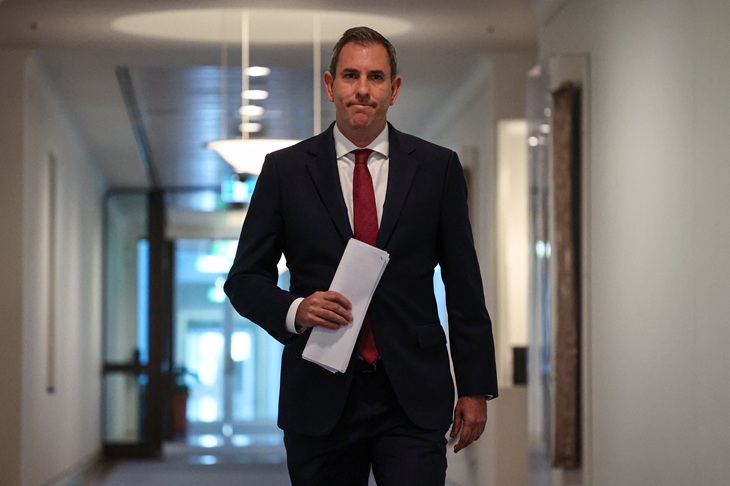
Treasurer Jim Chalmers calls it values-based capitalism. The phrase is sweet enough to belong on a decorative tea towel. But let us be honest. What the country is getting looks far less like capitalism and far more like values-based Peronism. This is government deciding what is good for you, who receives what, and how enthusiastically you should applaud.
Australia’s economic momentum, once the pride of the developed world, now feels like a car rolling downhill while a committee debates whether the handbrake should be up or down. Productivity is stuck in place. Real wages are quietly eaten by inflation. Investment confidence is acting like a shy wombat staring into a bright light. Yet the government continues to insist that its plan is working, which is impressive considering the plan is simply central planning with a friendly accent.
Australians were promised transformation, prosperity, resilience, sustainability, inclusivity, and every other warm word that fits neatly into a press conference. What we have actually received is a growing pile of debt, a mountain of bureaucratic intervention, expensive ideological tinkering, and an ambitious reinvention of the economy that no one requested and everyone must fund.
Values-based Peronism offers pleasant slogans but terrible receipts.
The government’s approach appears guided by emotional aesthetics rather than measurable results.
Regulation is treated as a mood. Public spending becomes a gentle conversation. Industry policy becomes a way to make sure the right groups feel validated.
Unfortunately, emotional economics does not pay mortgages. It does not reduce grocery bills. It does not build the energy infrastructure Australia actually needs. It only builds announcements about infrastructure, which are much easier.
Solzhenitsyn warned that people accept political distortions because it feels more comfortable than acknowledging painful truths. He was not writing about Australia, but he may as well have been. Voters often reward the very tricks that undermine their own economic wellbeing. We nod politely when told that cost-of-living pressures are temporary. We applaud transformative policies that transform very little beyond the size of the deficit. We accept reforms that reform nothing except the number of bureaucrats needed to administer them.
Australia’s economic decline is not accidental. It is the entirely predictable outcome of a government convinced it can plan prosperity from a conference room while calling the system capitalism and trusting that the label alone will calm the public.
Values-based capitalism is not what we have. What we have is values-based Peronism, a system that assumes government is wiser than markets, voters, or basic arithmetic.
Solzhenitsyn urged people not to live by lies. A sensible first step in Australia would be to stop pretending this is capitalism at all.
This first appeared on Substack