History is full of once-celebrated conventional wisdoms that ultimately failed scrutiny. Bloodletting, alchemy, and lobotomy are just a few examples. Even Newtonian physics was eventually refined and expanded upon by Einstein’s theory of general relativity.
This is the beauty of science; it evolves because it can be questioned. Science, at its best, is self-correcting. It thrives on intellectual challenge, promotes open debate, and improves, replaces or builds on existing ideas.
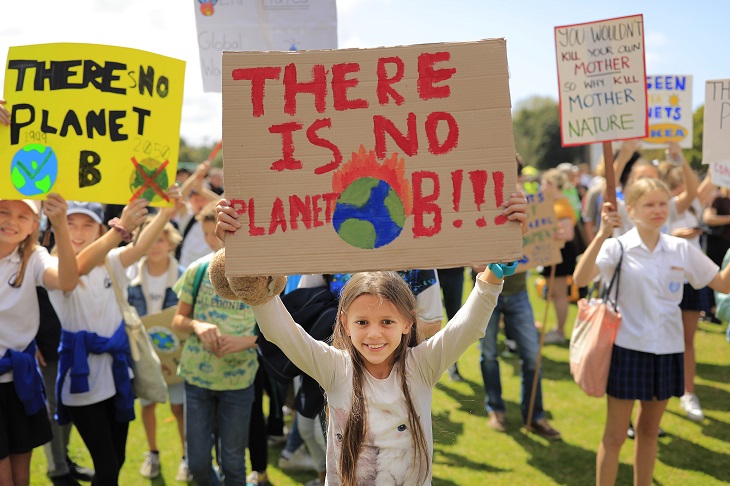
Yet in modern classrooms, climate change has been elevated beyond question. Anthropogenic global warming, and speculations around it, is treated not as a scientific hypothesis to be tested, but as a moral truth to be accepted.
By embedding the cross-curriculum priority of ‘Sustainability’ into all subjects at all year levels, climate change is no longer housed in the exclusive domain of science and mathematics, where theories are tested and can be disproven. Rather, climate education is being inserted into subjects where emotion dominates: English, the arts, economics, and legal studies.
In those disciplines, consensus carries weight. Feelings often outweigh facts. And things pop in and out of existence through people’s imagination rather than the universal laws of physics. This is deeply dangerous to real scientific learning.
A hydrogen atom exists whether you believe in it or not; and free hydrogen ion increases a solution’s acidity, no matter what we feel about it. It can be measured, tested, and verified – quantitatively – by anyone. What we think or indeed feel about this element neither changes its existence nor its properties.
But things like grammar rules, financial instruments, and democracy exist only because we agree that they do. These are human constructs sustained by consensus, convention, and creative imagination. Concepts surrounding climate change are increasingly being treated in the same way: not as measurable physical phenomena, but as social, or even moral, constructs defined by belief.
Once you surround climate education in a moral and ethical framework, rather than a scientific one, it grows immunity to challenge in the classroom. Students are increasingly encouraged not to understand the Earth’s climate, but to feel it. To experience anxiety, guilt, and duty rather than display curiosity, apply logic, and embrace discovery.
This reframing has reduced the role of the scientific method in climate education – and scientific literacy in general in schools. Many classrooms shy away from teaching the full complexity of Earth’s climate system, like the fact that airborne liquid water and water vapour are the most important contributors to the greenhouse effect – not carbon dioxide. Students are taught simplified, moralised narratives, namely that carbon is bad, humans are guilty, and action is urgently needed.
By moralising climate, our education system has placed the orthodox narrative regarding anthropogenic global warming beyond reproach.
To question it is to sin. To ask for evidence is to invite ridicule. And to challenge it is to entertain heresy. So, the next generation learns not to think, but to conform.
Real science welcomes disagreement. Consensus is irrelevant, and sometimes even dangerous, because scientific truth does not depend on popularity. If scientific progress were a popularity contest, we might still be drilling holes in skulls to treat mental illness and prescribing margarine as a health food.
Science must never be reduced to ‘what most people think’. Nor should it be reduced to what international bodies’ chosen list of experts happens to think (or are told to think to get research grants). Yet that is exactly what is happening in Australian classrooms, where children are taught that belief equals proof.
We are raising a generation to obey ‘scientific’ dogma, not to understand the scientific method. If climate science were as ‘settled’ as claimed by radical activists, then it should easily be able to withstand examination. It should be tested, debated, and scrutinised in the hardest of sciences, not shielded within the softest of the humanities.
Colleen Harkin is the Director of the Institute of Public Affairs’ Schools Program