It was good to see that Vivien Gaston was lecturing about portraiture in the context of the travelling Archibald Prize exhibition. She’s an art historian who brings a literary sensibility to everything she says about art and Geelong was lucky to have her. Human representation, its distortion and its transcendence, is pertinent to this award and the complexity that trails in its wake. Louise Hearman won the Archibald with her remarkable portrait of Barry Humphries who embodies caricature with Dame Edna and Sir Les and co. Not forgetting that with Sandy Stone parody was transcended by the poignancy of the suburban chap with his ‘vehicle’ and his quiet worries. And this survived when Max Gilles – with a Guy Rundle script – appropriated Humphries’ character for his impersonation of John Howard. Gilles has high claims to be our greatest impersonator – his Hawke a thing of wonder.
But caricature and authenticity loom with the Archibald. Think of all the fuss and fury back in 1943 when William Dobell won the Archibald for his portrait of Sir Joshua Smith and was subsequently attacked because it was said to be a caricature. Well, as Robert Hughes said in The Art of Australia, the painting – with all its grandeur – was a caricature and this was Dobell’s fundamental idiom, it was the language through which he made art and he created the typology he represented. All sorts of legendary Australian figures – Les Murray arguably the greatest poet anywhere, Lionel Murphy, the former attorney-general who asked the question, ‘How about my little mate?’ – looked like figures from Dobell.
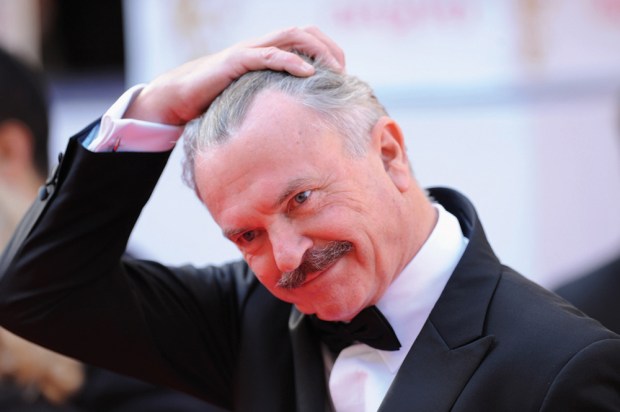
And a satirical vision can seem incarnated by nature. One of Britain’s finest actors, Roger Allam, played a conservative politician in the deft political cartoonery of The Thick of It. He’s also a staggering straight actor. His rendition of Conrad’s Typhoon is prima facie evidence of his histrionic genius.
He’s associated with Michael Frayn who wrote that dazzling reverse-mirror farce Noises Off which was directed by that Australian stage magician Michael Blakemore who won two Tony awards in the same year – one for Frayn’s Copenhagen and the other for Cole Porter’s Kiss Me, Kate. He also directed two extraordinary Michael Frayn plays – Democracy about Willy Brandt, the mayor of Berlin who became the German chancellor and Afterlife, about the legendary director Max Reinhardt, both with Roger Allam. Democracy uses a chorus of voices to explore the betrayal of Brandt by his intimate East German comrade and it is a dazzling piece of theatre that would have repaid all of Blakemore’s ringmaster skills and Allam’s magnetising voice.
Afterlife – in 2008 – received inexplicably poor reviews despite its manifest dramatic power.
Michael Frayn’s long essay at the end of the text lucidly explains how Reinhardt’s theatre company was on a scale comparable to England’s National Theatre with productions of Ibsen, Strindberg, Chekhov, Pirandello and Shaw. He also occupied the palace of the prince bishop of Salzburg and Afterlife is centred on the performance of Everyman – Jedermann – in the translation of Hofmannsthal.
Reinhardt recites the sombre and incantatory verse in a great variety of moods and contrasted predicaments and it has extraordinary virtuosity and power of darkness and light in the voice of Roger Allam. It is a play about the theatre and the rise of Nazism and the use of the medieval poem about the summoning of death has a complex confounding power. It is brilliant theatre and it was meant as a swan song for Frayn and his dyed-in-the-wool, surf-loving Australian director who should have run a theatre company here in Australia. It’s a play that touches on the essence of dramatic art. It’s a crying shame that we didn’t do it here with Roger Allam acting and Blakemore producing. When I met Michael Frayn with his wife Claire Tomalin over dinner they were in their eighties but wonderfully spry and funny. Reinhardt made one film, the Hollywood A Midsummer Night’s Dream with Mickey Rooney as Puck. Blakemore’s one film is an outback Uncle Vanya – called Country Life with Sam Neill and Greta Scacchi – that many people think is a mistake.
How fascinating that Bell Shakespeare’s production of Julius Caesar is to have Leon Ford as that magniloquent schemer Cassius. The role would suit him even though anyone who touches this play has to cope with Joseph Mankiewicz’s version with James Mason as Brutus, Marlon Brando as Antony and, indeed, John Gielgud as Cassius.
If there’s a script master in Julius Caesar it’s Cassius and Leon Ford has written such glories as the first series of Milly Alcock’s Upright with Tim Minchin and the young actress of genius went on to the Game of Thrones prequel House of the Dragons – and should eventually do everything, from Shakespeare to Shaw and Ibsen.
Leon also wrote four episodes of – and helped give Australian form to – one of the most dazzling streamers we have seen, Love Me – Alison Bell’s superb adaptation of the original Swedish series. And the cast matched the material. Hugo Weaving and Heather Mitchell as the old couple and with extraordinary power and presence Bob Morley with Bojana Novakovic as his ravishing – and by turns stormy and cold – beloved. Bojana is committed to the cause of the Serbian people and she was very striking in Macbeth (an undoing) in which her Lady Macbeth takes over all those great introspective speeches with all their despairing lustre and histrionic glory. Love Me is a terrific show, heartwarming but with an icy emotional reality when need be. Leon Ford is one of nature’s masters of the complications of a script. He seems especially sensitive to the twists and turns of women in love. Cassius, of course, is an anti-hero of great power. His seduction speech to Brutus is the most extraordinary re-animation of Roman rhetoric in subsequent literature. But he’s in love with Brutus and what a trail of shattered dreams that leads to.
By the way, if you want to see a European film of the first rank have a look at Justine Triet’s Anatomy of a Fall about a woman who is accused of murdering her husband. It’s in a mixture of French and English and the central performance by the German actress Sandra Hüller is staggering. The film won the Palme d’Or at Cannes in 2023 and is available on Stan.
Got something to add? Join the discussion and comment below.
You might disagree with half of it, but you’ll enjoy reading all of it. Try your first month for free, then just $2 a week for the remainder of your first year.