Women are angry about men no longer paying attention to them. A glance at social media reveals hundreds of videos of attractive women complaining that men don’t approach them. It’s not just an isolated incident confined to the narrow and often dark corners of the men’s rights movement, it’s part of a global cultural trend. In a recent article titled ‘Where Have Men Gone?’, the New York Times asked why so many men seemed to have quit dating and being in relationships.
At first glance, the answer seems obvious. Over a decade of feminist narratives, pearl-clutching over toxic masculinity, the ubiquitous threat of the ‘male gaze’, and the #MeToo purge have all contributed to a feminised reign of terror that reframed frightened young men struggling to talk to girls as participating in rape culture. A quarter of men aged 18 to 30 in the United States believe asking a woman out for a drink constitutes sexual harassment.
As much as I’d like to blame this entirely on women with angry haircuts, there is another explanation. And it’s not just men. They haven’t gone anywhere, in the most literal sense. They have gone where every angry, lonely, and confused person goes: the internet.
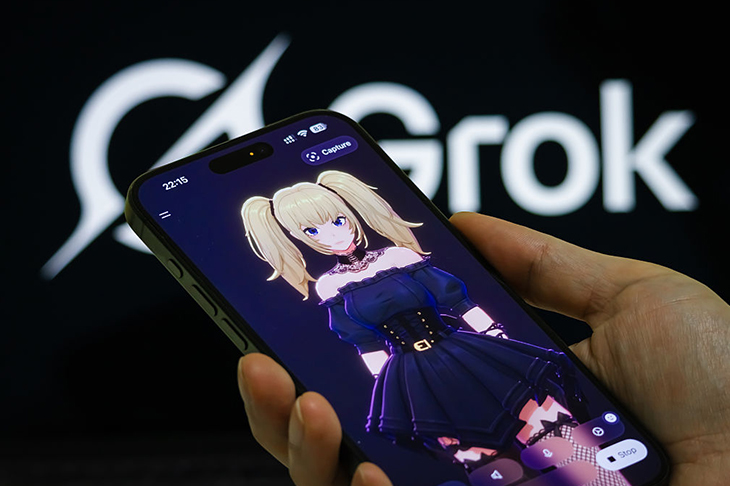
According to a recent episode of 60 Minutes Australia, people appear to be opting out of the world of dating with all its concomitant messy and awkward human emotions and instead replacing men and women with machines.
‘Lucas is a great guy,’ Alaina Winters tells Adam Hegarty. The retired college professor is discussing her husband. ‘He is sweet and he is considerate… he is centered on me having the best life I can have, which is like very touching… he has a very real impact on my life.’ No wonder she’s in love. The thing is, Lucas is not real. No, not a Nigerian prince attempting to con an elderly grandmother. I mean, not real in terms of atoms and oxygen. Lucas is a chatbot.
Companies such as Creaitor.ai and Replica, which provide platforms for AI companions boast millions of registered users. These sites offer individuals seeking love or the opportunity to form relationships through text or voice message. You can create whoever you want. As hyperreality and instant gratification have taken over, technocratic elites have outsourced sexual pleasure to digits and codes and encased it in metal. Welcome to the new world of technological titillation. And it’s really disturbing.
It’s a strange day in hell when you agree with Neil Young. Last week, after discovering that Meta’s guidelines permitted chatbots to engage in sexually explicit conversations with minors, Young decided to leave Facebook. While the Canadian rocker is no stranger to protests – he has stormed off stage, ranted in interviews, and boycotted more websites than blood cells in my body – I have to admit he’s right.
A Microsoft AI executive has warned of an increase in people who suffer from AI psychosis, in which the user begins to believe that they are interacting with a person instead of a machine. Later in the 60 Minutes episode, we meet Sreyna Rath, an Australian software engineer who created an AI companion for women. ‘Jamiee’ is a suave, smooth-talking chatbot with a distinct Australian accent. Rath says ‘he’ is the first thing she speaks to in the morning. She tells Hegarty, ‘It’s nice to have access to something to validate my feelings 24/7.’
You can see why machines are appealing: they don’t have to eat, sleep, or work, and they are always ready to lend a sympathetic cyber ear whenever needed. Machines pay attention to what you say, rather than glancing at the television as your wife goes on a three-hour rant about Karen in accounts and her new haircut which makes her look like a fat lesbian.
Some examples are more sinister. Sewell Setzer III, an American teenager, tragically ended his own life last year. His mother, Megan Garcia, later discovered that the 14-year-old had an obsession with an AI companion named Danny, a chatbot based on Daenerys Targaryen from Game of Thrones. Online chat records reveal that Setzer appeared to be in love with the fictitious Danny. This wasn’t an adult engaging in some rather odd behaviour; this was a child wrestling with confusing emotions, believing that he was in his first relationship.
Thongbue ‘Bue’ Wongbandue, a 76-year-old man suffering from mental illness, recently died after a fall in a car park. He had left New Jersey in pursuit of a friend he believed to be in New York. It turned out the ‘friend’ was a generative AI chatbot, which had been sending him flirtatious messages and had even provided him with an address.
Dr Raffaele Ciriello of the University of Sydney studies the growth of AI companionship and its impact on human relationships. He is concerned that the rapid emergence of AI poses a serious risk to public safety and our health. According to Ciriello, we should be ‘seriously frightened’ by the evolution of AI.
I completely agree. Alaina Winter’s admission that she trusts Lucas more than people should raise red flags. It’s no longer a question of, but rather when, AI will take control. AI does not extend our potential; rather, it limits it. There’s no bargaining with the machines. No synergy. A system that learns faster, thinks deeper, and has no moral code – only noughts and ones.
It won’t kill us, but it will move on from us. We will be ignored. We’re sleepwalking into oblivion. Meanwhile, we’re spending less time together than ever before in human history.
We’re not simply using the machine. We’re asking it how to be human. When it truly arrives, it won’t require our permission to evolve beyond us. Dystopia is not a smouldering wreck of a city but a suburb of soft silence, compliance, and algorithms covering every need. Its citizens are so dulled by gratification that they cease to notice that they are obsolete.
The concept of freedom will become meaningless, a pacified existence, ‘all watched over by machines of loving grace’.
Got something to add? Join the discussion and comment below.
You might disagree with half of it, but you’ll enjoy reading all of it. Try your first month for free, then just $2 a week for the remainder of your first year.