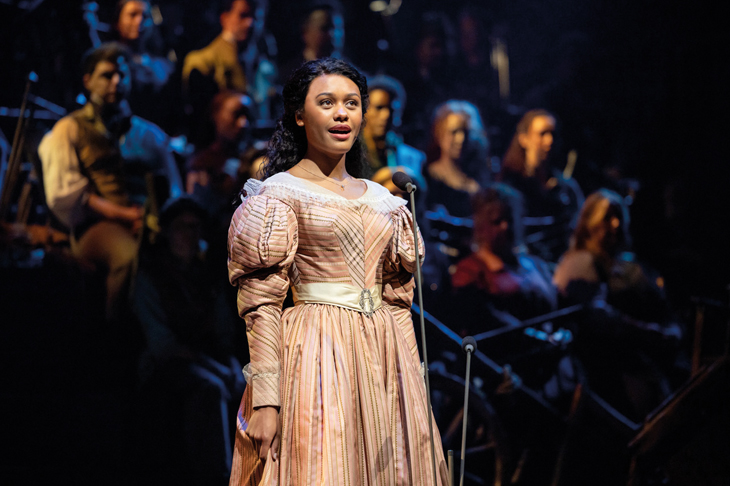
Who would have thought? The arena concert version of Les Miserables, Claude Michel Schönberg and Alain Boublil’s sung-through extravaganza is no mere spectacle – it is a spectacular achievement. The sound quality is impeccable, every word is utterly comprehensible and at the same time we get massive close-up screens of the actor-singers. And what an ensemble they are. We knew that Michael Ball had the reputation of being the greatest Sweeney Todd and that his Javert had a special professional relationship with his Jean Valjean Alfie Boe but Michael Ball does not give the performance of a mere singer who can act a bit. This is the Javert of a great actor with dazzling vocal gifts who is also able to bring the role of the implacable detective absolutely alive: he is grave, he is grand, every note is perfect and the characterisation has a sweeping authority. His baritonal darkness of tone is overheard and it never looks like a piece of histrionic artifice. Alfie Boe as Jean Valjean was very moving. He is billed as Britain’s favourite tenor and Boe hits the high notes with ravishing effect so that when he sings ‘Bring Him Home’ the audience is stunned at the beauty.
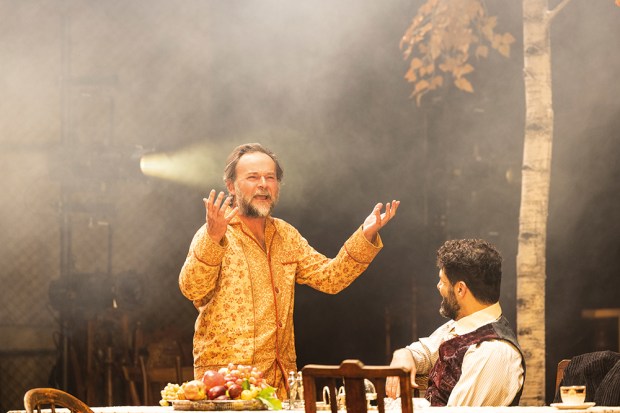
Another standout in a show without weak points was James D. Gish as Enjolras. He can really act so the music for the barricade song in a dramatic wash of red looks like the natural outpouring of his soul. This is the role the young Anthony Warlow had in the original Australian production in 1987. In the Rod Laver Arena version the red which envelops the stage and the red vest Gish wears are tokens of the glamorous panache of the rousing voice of revolutionary vehemence.
Matt Lucas is totally disciplined, totally fun-making. When Monsieur Thénardier belts out ‘Master of the ’Ouse’ you are in no doubt that this is an actor who could give the greatest Fagins in Oliver! – Barry Humphries, Jonathan Pryce, Ron Moody – a run for their money. And Richard Harris’s Guenevere in Camelot forty years ago, Marina Prior comes out on stage to show-stopping applause and, of course, she looks marvellously like the hag she’s playing, Madame Thénardier.
Fantine in this production was Rachelle Ann Go and her ‘I Dreamed A Dream’ could hardly be bettered.
The two young leads were superb. Jac Yarrow – who had been nominated for an Olivier for playing the title role in Joseph and His Amazing Technicolour Dreamcoat – was Marius, the love interest of Valjean’s adoptive daughter Cosette who was played beautifully by Beatrice Penny-Touré.
On opening night the cheeky street urchin Gavroche was Christopher Joseph and he was a delight.
Staged by James Powell and Jean-Pierre van der Spuy, Les Mis was brilliant and soaring, grand and exciting.
How does this compare with upper-level musicals? The original London production of the revamped Julian Fellowes Mary Poppins directed by Richard Eyre with Laura Michelle Kelly comes to mind.
Is Ian McKellen in Strindberg’s Dance of Death as good as straight theatre gets or his King Lear?
If this Les Mis wasn’t quite a musical, not quite theatre, it was nevertheless marvellous.
Henry V is certainly theatre of a spectacular kind. If you had the world to choose from you might bet on Chris Hemsworth to play Henry V. He has the authority, the effortless charisma and his work with Ken Branagh has put Standard English effortlessly within his grasp. JK Kazzi is a Nida graduate who was educated at an international school in Vietnam and also speaks French. His vowels could do with polishing though he has an electric intensity as the warrior king and perhaps the roughness of the Western Sydney voice deserves homage at a time when an unpredictably triumphant government could treat one of its own, Ed Husic, with brutality.
JK Kazzi looks set to be some kind of star whether on stage or screen.
But Marion Potts cuts the greatest speech in the play, Mistress Quickly’s narration of Falstaff’s – off-stage – deathbed which stands in contrast to the barbarous beauties of Henry’s songs of war – ‘Once more unto the breach’, the Crispin’s day speech, pre-Agincourt (‘We few, we happy few, we band of brothers’ – and she gives a somewhat muffled account of the action, especially Henry’s background – as Prince Hal – in Henry IV.
Well, as Peter Brook used to say, the text is not burned. It’s a bit weird – particularly in a play which has two scenes with Katharine of France (one learning English in anticipation of Henry and the other when they meet) that Marion Potts has decided to have most of the French characters speak in French which is then surtitled for the audience’s benefit. Weirder still that most of this is not actually Shakespeare’s language but a translation of the translation. This seems a needless complication in a distorting mirror and its worth mentioning that the dialogue of the French among themselves has an astringent dryness. ‘Self-love, my liege is not so vile a sin / As self-neglecting’ is just one example of what we lose.’
You can hardly complain that Henry and co. refer to the savagely elegant prince who says this as the ‘Doe Fan’ where ‘Dorfen’ is the usual pronunciation of Dauphin.
Although there were slabs of Henry V that were thrown away the audience seemed to warm to the attempt and especially the forceful performance of JK Kazzi (vaunted ockerisms aside). Ava Madon’s Katharine of France seemed to be having a #MeToo moment when Henry kisses her on the lips with the words, ‘Nice manners curtsy to great kings’ but this was against the manifest tenor of the scene, if arrestingly.
But the general response of the audience seemed warm and that extended to the tee-shirted costumes and sludge and dreck that betokened the battlefield set, both designed by the much-praised Anna Tregloan.
There was also a palpable wave of sympathy when the speeches were being made for the presence of just yesterday’s attorney-general, Mark Dreyfus, the only silk in parliament. In Shakespeare monarchy has its own divinity. In a liberal democracy the majesty of the Law – for which the attorney stands, not just his party – is not mocked with impunity.
Whether or not we live in a post Judeo-Christian time, Mark Dreyfus was the attorney-general in a country whose first Australian-born governor-general was Sir Isaac Isaacs: and one of the great statesmen of nineteenth-century Britain was Benjamin Disraeli.
Got something to add? Join the discussion and comment below.
You might disagree with half of it, but you’ll enjoy reading all of it. Try your first month for free, then just $2 a week for the remainder of your first year.