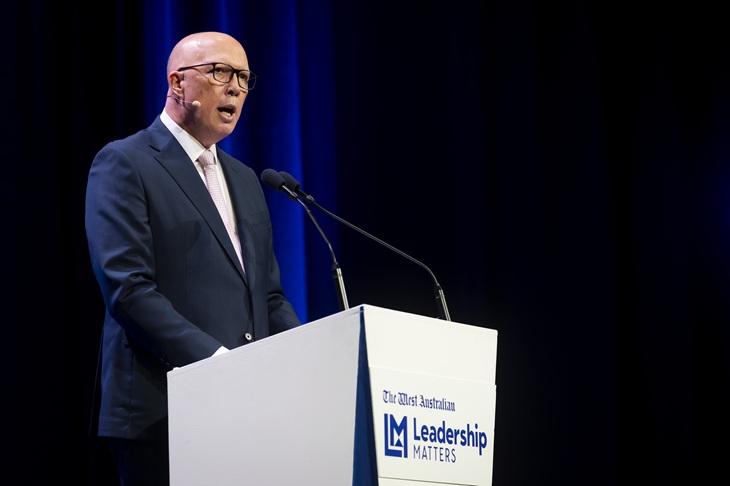
Like many conservatives, I have been waiting for something original from the Coalition that will differentiate them from the socialists. Labor has proven time and again that socialist approaches to housing affordability do not work. Today, I am pleased to report that Peter Dutton has announced an Australian first: First homebuyers will be eligible for tax deductions on their mortgage interest for new builds for the first five years of their mortgage.
This is great news, and the policy echoes my argument in the Speccie from this time last year: How about tax deductions for your home loan interest?
The policy is very clever. Its impact on housing prices will not be like Labor’s flawed policy that enables the CFMEU to rent-seek on government-funded builds. By placing the eligibility on new builds only, demand is likely to stimulate competition in the construction sector, a move that is always good for the economy.
The difference in the Coalition’s policy is that first homebuyers get to choose where they build and who builds their new home. Albo’s plan is like all of Labor’s direct market interventions – when the government builds houses (which it has repeatedly failed to do), it leads to higher prices, less choice, higher government spending, and therefore higher inflation.
Stimulating the construction sector indirectly without limiting consumer choice is a great move. The policy is innovative in an Australian context, and, if coupled with sensible reform of the construction sector, will be good for Australia and for young Australians wanting to buy their first home.
Another major reform that is needed is to remove bracket creep, particularly for those earning under $150,000. Mr Dutton has announced a one-off tax offset of $1,200 for those earning between $48,000 and $104,000. The one-off cost-of-living relief lump sum will be paid at tax time next year.
The Coalition typically provides means-tested, temporary measures in such circumstances, so there are no surprises in the approach. However, it does not tackle the underlying problem of entrenched bracket creep.
At a recent National Press Club address, one senior journalist suggested people in Western Sydney (I was born in Penrith) may not understand bracket creep. Bracket creep occurs when your income rises over time, pushing you into a higher tax bracket, so you pay more tax – even if your actual buying power hasn’t improved.
The last time the tax brackets were changed was in July 2024. But the Albanese government did not implement the changes in full. This means that Labor has embedded bracket creep in the tax system until 2030.
However, the Coalition’s announcement of the tax offset, along with the reduction in the fuel excise, will have an immediate impact on household budgets. This is significantly better than the ‘cuppa a week’ savings from July next year under Jim Chalmers’ budget. It also gives the Coalition the opportunity to address bracket creep after July 2026, something that Labor has failed to do.
As for home affordability, tax-deductible interest for first homebuyers on new builds will provide a net positive for all Australians. The policy announcement this morning clearly differentiates the Coalition from Labor and will achieve a major policy aim without driving up housing prices and inflation. Sir Robert would be pleased.
Dr Michael de Percy FRSA FCILT MRSN @FlaneurPolitiq is a political scientist and political commentator. He is a member of the Federal Parliamentary Press Gallery, Editor-in-Chief of the Journal of Telecommunications and the Digital Economy, Chairman of the ACT and Southern NSW Chapter of the Chartered Institute of Logistics and Transport, and a member of the Australian Nuclear Association. Michael is a graduate of the Royal Military College, Duntroon and was appointed to the College of Experts at the Australian Research Council in 2022. All opinions in this article are the author’s own.
Dr Michael de Percy FRSA FCILT MRSN @FlaneurPolitiq is a political scientist and political commentator. He is a member of the Federal Parliamentary Press Gallery, Editor-in-Chief of the Journal of Telecommunications and the Digital Economy, Chairman of the ACT and Southern NSW Chapter of the Chartered Institute of Logistics and Transport, and a member of the Australian Nuclear Association. Michael is a graduate of the Royal Military College, Duntroon and was appointed to the College of Experts at the Australian Research Council in 2022. All opinions in this article are the author’s own.