When ruthless and sociopathic individuals gain power, the outcome is similar to what the Polish psychologist Andrzej Lobaczewski referred to as a pathocracy: a system of government in which a small pathological minority seizes control over society. The end result is a totalitarian state characterised by a government that has turned against its own people. Writing in the twentieth century, he based his theory on a regime he had witnessed in his life, the Soviet Union.
A fortnight or so ago, the United Kingdom saw a populist backlash against such a pathocracy. Thousands of British farmers descended on Whitehall on a Tuesday to protest Labour Chancellor Rachel Reeves’ planned changes to farm inheritance tax (IHT). Beginning April 2026, a twenty-per-cent tax will be levied on all inherited agricultural assets worth more than one million pounds. The Treasury estimates that it will only impact 28 per cent of farms. However, both Defra and the National Farmers Union predict that up to 70,000 farms (66 per cent of estates) will be affected. If this is the case, farmers, some of whom have been working the same land for generations, face passing on an exorbitant bill to their children when they die. Many will simply sell up when this happens.
The claims that this is a ‘communist land grab’ are not right-wing hyperbole. Stephen Kotkin’s epic three-volume biography of Stalin goes into great detail about how the kulaks, supposedly ‘wealthy’ peasant farmers, were dekulakised – the forced expulsion of millions to work on collectivised farms and redistribution of farmland. But there was a problem: the politburo couldn’t agree on a definition. As Kotkin writes, ‘Who precisely was a Kulak – an owner of three cows? Four cows?’
In the UK today, even the smallest of farms requires significant investment. A combine harvester alone costs around £400,000; once you factor in livestock and additional machinery, you’ve probably exceeded the £1 million mark. Farming, an asset-rich, but cash-poor industry, generates little profit. Britain’s Country and Land Business Association (CLA) estimates that an average (200-acre) farm owned by one individual will generate a profit of around £27,000 and incur an inheritance tax bill of £435,000. Because IHT payments can be spread out over a decade, the CLA estimates that an average farm would need to set aside 159 per cent of its profits to cover the cost. The rest simply lack the necessary liquidity to pay. There is one way to avoid the tax: leave the land to your children as long as you live for another seven years.
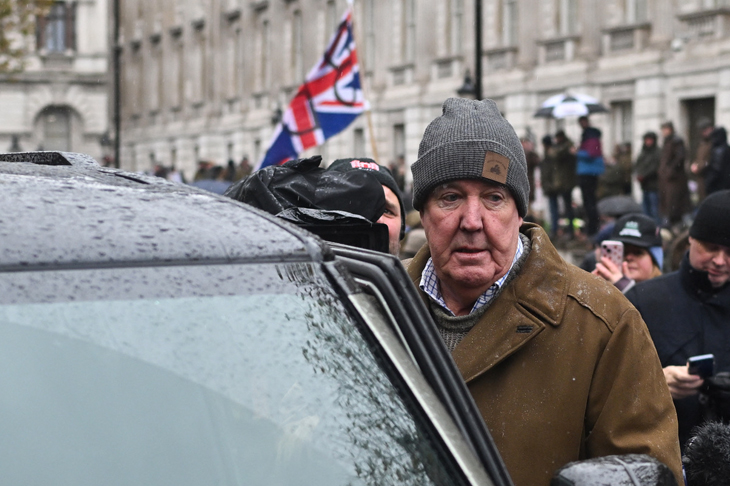
After marching through London that day, the farmers rallied outside Downing Street. A number of politicians spoke in support of them. While the sight of new Tory leader Kemi Badenoch and, surprisingly, Liberal Democrat leader Ed Davey did little to motivate the crowd, the true star of the show was Jeremy Clarkson.
Clarkson, not your typical celebrity seeking attention, has skin in the game. The Top Gear star is himself a farmer. In 2018, he bought a thousand acres of land in Oxfordshire and named the farm ‘Diddly Squat’ in honour of his numerous failed attempts to turn a loss-making venture into a profitable business. Despite Clarkson working seven days a week, the farm earned only £114 in its first year. His subsequent troubles are documented in Clarkson’s Farm, an Amazon documentary-style TV show. With season four on its way, it is already one of the most popular shows on the platform in the United Kingdom.
The show brought to the attention of the nation the problems and petty bureaucracy that come with working on farms. Clarkson and his tight-knit group of strange but lovable locals form the foundation of Edmund Burke’s little platoons; Clarkson’s Farm depicts him assisting others in the farming community. The show humanised the man’s image. I can’t think of anyone who is even remotely as popular. The left regards Stephen Fry as a national treasure.
But as a relatable figure, Clarkson has always inferred that he is on our side. The man has a long history of disagreements with the Labour party. His online feuds with London Mayor Sadiq Khan are legendary.
I’ve heard some commentators urge him to run for parliament. I disagree. The allure of populism is to be ‘anti-politics’ or outside the system. If you become involved in the political machinations of Westminster, you have to conduct yourself like a politician. You lose authenticity and become vulnerable to lobbyists’ influence. Clarkson is far more effective from the outside. I could quote Lyndon Johnson, but I’m sure you’ve all heard the tent metaphor.
As the French and Dutch protests showed, you don’t mess with farmers. This is a group of people who have means to inflict serious damage on the government. When Mark Rutte imposed strict net-zero policies on Dutch farmers, they took to their tractors, blocked the highway, and won over the public. Rutte is no longer in office, and the BBB, also known as the Farmer-Citizen party, is now a member of the Netherlands’ ruling coalition.
If I were being cynical, I would say this is part of a long-standing campaign – a ‘five-year-plan’, if you will – the dekulakisation of modern farming. As a result of the government’s obsession with net zero, Labour is pursuing policies that will take thousands of acres of high-quality agricultural land out of production. Farming is being destroyed in Britain. First by multinational retailers such as Tesco, who use mass economies of scale to crush the famers’ profits. And now there’s a punishing death tax. Farmers are the lifeblood of our community, producing the majority of the food we eat. Food security is critical in a volatile world; however, it has declined in Britain from 75 per cent to 60 per cent since the mid-1980s. Unless we want to rely on the mercy of the foreign market, we must protect farmers.
A few solutions have been proposed to get around IHT, including delaying it until 2031 and allowing farmers to gift assets. The simplest option is to completely scrap it. If not, it’ll be, in the words of Clarkson, ‘the end’ of farming. Politicians have repeatedly demonstrated an inability to relate to the average man, let alone the rural community. We need a new leader who is untainted by Westminster. ‘One day a king will come, and a sword will rise again.’ Well, Jeremy, the crown is in the gutter; perhaps it’s time to pick it up.
Got something to add? Join the discussion and comment below.
You might disagree with half of it, but you’ll enjoy reading all of it. Try your first month for free, then just $2 a week for the remainder of your first year.