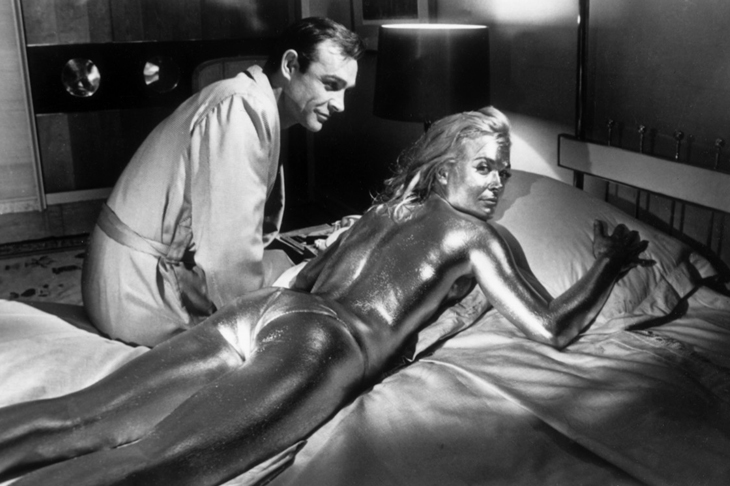
In a first for me, I am breaking some news from the world of entertainment. The daughter of Shirley Bassey has apparently agreed to re-record one of her mother’s giant hits, but this time only for an Australian audience. Of course, a few changes to the lyrics were necessary to make the famous James Bond song more relevant for contemporary audiences down under. And yes, Speccie readers, I have managed to get my hands on those new lyrics. Confidentially, I can even reveal that there is talk of a movie remake with Tanya Plibersek in the famous villain’s role. Whether that eventuates or not, in this world exclusive here are the new lyrics to that famous song:
Goldstopper, she’s the girl
The girl with the Adam Bandt touch
A blocker’s touch
Such a mine stopper
Beckons you to enter her web of clout
You won’t come out
Golden ores she’ll promise in your ear
But these vows can’t disguise what you fear
For this golden girl knows that she’s got a letter
It’s the kiss of death from Madame Goldstopper
Naive miners, beware that this heart hates gold
This heart is cold
Golden words she will pour in your ear
But her vows can’t disguise what you fear
For this golden girl knows when she’s got a letter
It’s the kiss of death from Madame Goldstopper
Naive miners, beware that this heart hates gold
This heart is cold
She knows you’ll fold
You will fold
She does not love gold
Never gold
And speaking of rivers of gold, what about Bill Shorten’s new job? How does he love the new vice-chancellor of the University of Canberra job? Let him count the 1.78 million ways. Because that will be what he now makes annually, 1.78 million dollars. If that seems a lot to you that’s because it is. Nor is this some incredible outlier in the realm of vice-chancellor salaries in this country. We have many vice-chancellors making more than one million dollars a year and plenty on over a million and a half. I was back in Canada for a few weeks this past June and a study was reported there on the pay of university top executives around the anglosphere. Australia was noted as being the highest-paying country, and that included the US (a much wealthier country than we are). In fact, Canadians saw Australia as outliers becaue we pay our top university administrators so much. Now full disclosure, cards on the table and all that: soon after I arrived here back in 2005 I wrote in a newspaper piece that I thought all the talk of these top uni executives running billion-dollar businesses was mostly bunk. The biggest cost is salaries and they are pretty much locked-in as an outgoing item. Meanwhile the biggest revenue item is student fees, most coming from government (aka we taxpayers) and the rest from the students. That’s locked in too. Yes, these days there’s also a lot of money from overseas students but that market (of which Australia incredibly has about 12 per cent of the world total) comes in large part because of ‘you can stay in Australia when you’re done’ visas handed out by government to these students. End such visas and the overseas student market will shrink massively. That is the reality of ‘this successful export industry’. Whatever you think of that situation – and I think it’s a flat-out Ponzi scheme – it’s hardly worthy of a massive pay cheque. So why do we pay our vice-chancellors comparatively so much?
I recall ending that newspaper piece of mine almost two decades ago by saying something along the lines of ‘a moderately numerate Year 11 student could do the job as well as, probably better than, most of this country’s top university administrators’. The main expenses are locked in. The main revenue streams are locked in or dependent on government policy. Unlike the private sector, no university will be allowed to go bankrupt and so big rewards aren’t linked to the possibility of big failure. A Year 11 student would probably be less politically correct, less keen to have two-thirds of employees being administrators not lecturers or researchers, and less in thrall to the DEI group identitarians.
Some try to justify this massive pay to vice-chancellors by pointing to international league tables of unis. But all those world rankings tables are garbage – think pandemic modelling and you’ll have the idea. Most of them make the numbers of overseas students an explicit rating factor, on the assumption that if students come it must be because of quality (not, say, to get a visa to stay in the country for life). Or go out and hire a winner of the Nobel Prize and put him or her up in a top hotel for a year without seeing a single student ever. Then watch what that does to your university’s world rankings.
And worse again, and as with all universities around the Anglosphere (if not the entire democratic world), the administrators are at least as left-wing politically as the faculty of universities, often more so. A law professor from Notre Dame law school in the US recently went through five years of data on donations by all US law professors to the Democrats and Republicans – this is public information in the US – and found that US law professors donate at a ratio of 36:1 to the Democrats versus the Republicans. There is no viewpoint diversity on campus, just reproductive organs diversity. I suspect it’s about the same huge left-leaning imbalance here in Australia and that suspicion is backed up by the fact that only three or four law professors in the entire country came out last year against the Voice proposal. You could count them on one machine operator’s hand.
So as a top Labor man Bill Shorten will fit right in as a university vice-chancellor. (Side query: does anyone believe these job offers would go to conservative politicians?)In fact, I’d guess his political worldview would be to the right of most of this country’s other vice-chancellors. And I’m not joking about that. Remember, two-thirds of unis officially supported Yes and none supported No in the Voice vote.
Given all that you might think Coalition governments would try to do something about this state of affairs. You’d be wrong.
Got something to add? Join the discussion and comment below.
You might disagree with half of it, but you’ll enjoy reading all of it. Try your first month for free, then just $2 a week for the remainder of your first year.