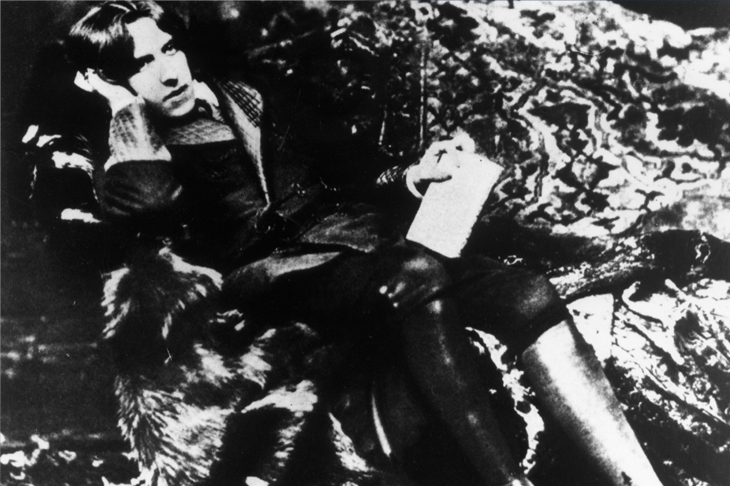
The fact that Kip Williams is leaving the Sydney Theatre Company to stage The Picture of Dorian Gray with Sarah Snook in New York is inevitably a reminder of Oscar Wilde who is the subject of the Australian Ballet’s new show Oscar.
It’s extraordinary to reflect on the dramatic brilliance of every aspect of Wilde’s life – which managed to encompass tragedy as his imprisonment and the grave and terrible letter to his intimate Bosie, Lord Alfred Douglas, testify: De Profundis is an extraordinary expression of pain and desolation. And Wilde was a virtuoso who lives for his work in the greatest range of genres: Dorian Gray is a popular and sophisticated horror story of unforgettable power. The Importance of Being Earnest is the greatest facetious comedy in the language. There may be more humane and morally shaded comedies of the Shakespearean kind but if you want great one-liners and truly ridiculous contrivances (‘a handbag!’) then this is one kind of zenith of comic art and will live forever because of such incarnations of Lady Bracknell as Edith Evans and Maggie Smith. Salome (which Bosie translated from Wilde’s French) is the most powerful modern dramatisation of the Bible story and provides a riveting libretto to Richard Strauss’s opera when he was at his most modernist. The Ballad of Reading Gaol is a great narrative poem, soaringly communicative with its impassioned humane force and its recurrent line, ‘For each man kills the thing he loves’. And isn’t it uncanny that in Wilde’s lifetime and with his brazen collaboration we have a stage show, a comic opera by the great satirical duo, Gilbert and Sullivan, which led Richard D’Oyly Carte – the Cameron Mackintosh of his day – to pay for Wilde’s tour of America. He arrived saying he had nothing to declare except his genius and he was an absolute star even though the object of the tour was to highlight himself as a figure of aesthetic ridicule.
He is the model for the poet Bunthorne who sings in Gilbert & Sullivan Sprechgesang ‘Am I alone and unobserved? I am. Then let me own I’m an aesthetic sham.’
He goes on to sing with lilting self-mockery about, ‘If you walk down Piccadilly with a poppy or a lily in your medieval hand. / And ev’ryone will say, / As you walk your flow’ry way, / “If he’s content with a vegetable love which would certainly not suit me, / Why, what a most particularly pure young man / this pure young man must be!”’
It’s wonderful idotic stuff and you can see the line that connects it with Monty Python and Pete and Dud, with Blackadder and Little Britain and beyond. You can also see why a great director such as Mike Leigh could view this strand of musical tosh as deeply connected with the culture of the folk, with an absolute and besottedly zany streak of British humour (to which Leigh doffed his cap in his Gilbert & Sullivan masterpiece Topsy-Turvy) so different to his tragicomedies of working class life yet somehow congruent with them. Babyboomers who first heard the Grossmith Topsy-Turvy role of Bunthorne sung by Martyn Green on the old Decca recording would also have heard the great Darrell Fancourt – the greatest of Mikados and Pirate Kings – sing ‘If you want a receipt for that popular mystery, / Known to the world as a Heavy Dragoon… Take all the remarkable people in history, / Rattle them off to a popular tune.’ And so he does: ‘Wit of Macaulay, who wrote of Queen Anne’ and ‘Grace of an Odalisque on a divan’ are just two examples.
It’s also interesting to see that Matthew Warchus’s version of The Lord of the Rings is to be staged in Sydney in January. Warchus is one of the great magicians of the theatre and the news of his adaptation of the great Tolkien saga coincides with a further development of the TV version.
It’s weird that this tale of Gollums and Frodos should be so central to our culture.
You can wonder what Merle Thornton who died just last week would have thought of Wilde and indeed of Gilbert & Sullivan. The woman who chained herself with Rosalie Bogner to the public bar at Brisbane’s Regatta Hotel in 1965 would certainly have appreciated the sense of drama. She was taken by John Anderson, the libertarian and apostle to the Push, until she saw him close down a discussion out of masculine lordship.
For a time she was going to do a research thesis on Ben Jonson, Shakespeare’s rival, with the poet professor A.D. Hope: she liked the way he looked at the trees outside the window rather than into his students’ eyes. But she was instrumental in having the law changed which disallowed women from being employed if they were married and she did this with the help of that improbable Ipswich policeman Bill Hayden, the man who said a drover’s dog could have won the election for which he was replaced by Bob Hawke.
Merle Thornton made her way with her beloved husband Neil to University College London which the eminent literary critic Frank Kermode intimated was the least bad academic institution he had encountered and it put a spring in Merle Thornton’s step and in Neil’s to have dealings with the likes of Kermode. All of which was less fun for her daughter Sigrid (the actress to be) who was left behind. But Merle listened keenly to the lectures Iris Murdoch gave when, each month, she came down from Oxford: she argued that you had to master the theory of moral philosophy before it could be any good in practice. Merle Thornton was always an intensely dramatic voice on behalf of the truth as she saw it. She had an unmistakable piping voice. Merle lived the life of the mind, she lived the life of the soul. The thought of her makes you ashamed of how she sang like a bird of all that was terrible and all that was beautiful in human life. We hardly deserved her.
Oscar you suspect would have cottoned on to her variety of feminism. When she was kicking 90 she wrote, ‘If something doesn’t look right, if something doesn’t feel right, take a moment. Stop. Don’t let it pass. Call it out. Keep fighting!’
Got something to add? Join the discussion and comment below.
You might disagree with half of it, but you’ll enjoy reading all of it. Try your first month for free, then just $2 a week for the remainder of your first year.