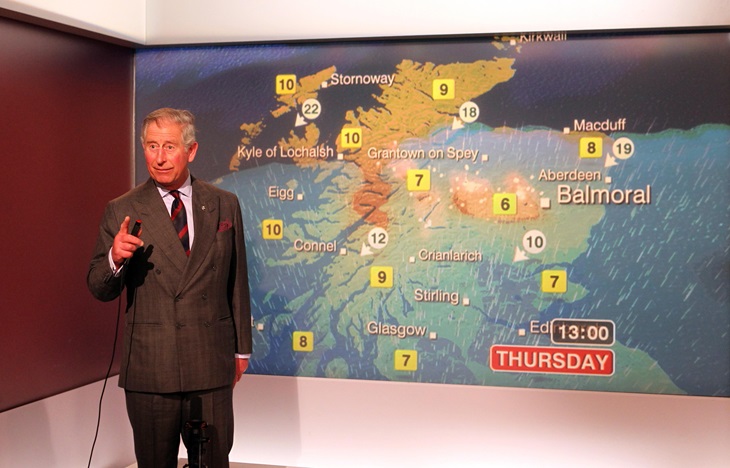
Is it only the political movement of Climate Change in which we need to be wary of King Charles III, or does his disposition to the left-wing run deeper?
This was the uncomfortable question I asked myself after hearing the annual Christmas message issued from Buckingham Palace.
Admittedly, my frame of mind when I heard it was very much skewed by artistic works – one a movie and the second a novel.
The film was the World’s Fastest Indian, the classic New Zealand-made sporting movie, although it stars a British actor Anthony Hopkins. It portrays the life ambition of legendary New Zealand motorcycle racer, Burt Munro, who broke a world land speed record in 1967 when he accelerated his modified 1920 Indian Scout motorcycle to a top speed of 295.453 km per hour. At the time, he was 68 years of age.
Munro lived in freezing Invercargill, the southernmost town on New Zealand’s South Island. The film reveals the sacrifices and idiosyncratic choices he made to achieve his singular personal dream.
He’d wake at 5am and, shortly after, start work for the day by revving his motorcycle engine. His house was depicted as a mechanic’s garage, with his single bed set amongst all the grease, tools, benches, and metals. The lawn around his garage was never mowed. He’d hand-make many of the metal parts needed to improve the speed of his bike.
Next door lived a young boy who was like a grandson to Munro. They’d talk world records, eat biscuits, and drink tea. In one scene, the kid says: ‘Mum wants to know what you’re doing for Christmas, Burt…’
Anthony Hopkins does a convincing response revealing Munro’s surprise at the question. Evidently, he’d not considered taking time off and doing something at Christmas.
The portrayal of Munro reminded me of the fictional characters depicted in the novels of Ayn Rand, especially Howard Roark, the single-minded architect who is the protagonist in The Fountainhead. I went to my bookcase and read some paragraphs to remind myself of details.
Roark pursues his dream of designing buildings in his own modern style, absorbing high personal and professional costs in staying faithful to this vision.
Ayn Rand as a cultural figure in New York was despised by the left including their leading thinkers, such as Gore Vidal, Noam Chomsky, and Christopher Hitchens. Even the conservative US writer William F. Buckley viewed her ideas as unrealistic and criticised her atheism.
Rand was particularly savage on the role of government, the ultimate symbol of collectivism and its insidious disposition for absorbing power and, in doing so, destroying true creativity and ambition individuals.
She died in 1982, yet her books and thoughts still inspire people in each generation. One fan is the tech billionaire Peter Thiel who, with Elon Musk, founded PayPal.
It was against the Burt Munro movie and thinking about Ayn Rand’s legacy, that I read King Charles III’ 2023 Christmas message.
Remember that Rand assigns highest status and morality to those individuals serving their own personal interests, this is what the King had to say:
‘…we remember those … whose work of caring for others continues…’
‘… my heart has been warmed by countless examples of the imaginative ways in which people are caring for one another…’
‘… selfless army of people – volunteers who serve their communities in so many ways … they are an essential backbone of our society.’
‘… the meaning of coronation itself: above all, a call to us all to serve one another…’
‘Service also lies at the heart of the Christmas story…’
‘…service to others is but one way of honouring the whole of creation…’
‘…on this Christmas Day, my heart and my thanks go to all who are serving one another…’
In fairness to the King, he does not define ‘service’. If he means to include those engaged in real commerce, that of offering products and services for sale in the hope of making profit, then I think most could get on board.
But I suspect that’s not what he means, he’s got in mind those who volunteer their own time to work for others, in hospitals, on beach patrols, do natural disaster recovery, and man crisis phone lines. They do these things without payment or formal contracts.
These people are afforded much glory in modern society and yet would be considered poorly in a world envisioned by Ayn Rand. Rand viewed self-sacrifice as disgraceful – a betrayal of self.
I think a fair criticism of Rand is that she was just too idealistic, that she painted heroic figures that couldn’t exist in the real world. None of her main heroes, for example, provide practical guidance on how to raise children. Even so, her ideas persist and provide a beacon to many.
To the extent that individuals depended on others, Rand advocated that services provided needed to be properly transacted, meaning nothing is provided for free. The good or service transfer is settled cleanly by payment of money, not leaving a hazy grey situation of implicit debts and control.
Ironically, those who are most sympathetic to Rand’s ideas are probably also likely to be the strongest supporters of the British Monarch remaining the head of Australia’s government.
You wonder how long it is before the leftist ideas in his head, start to erode support for the Monarchy amongst the right. While it is easy to intellectually justify support for the Monarchy as an entity – blind to the person at the top – at some point there is likely to be a reckoning.
And how long before the left turn on the King? If he moderates his position on Climate Change, for example, perhaps in sympathy for UK citizens paying exorbitant energy prices, they’ll go after him like vicious hyenas.
If that happens, the only people willing to publicly stand in his corner will be the sorts of people sympathetic to the ideas of Ayn Rand.
And the longer he retains these soft left dispositions, the less heart they’ll have for the fight. So, he’s in something of a bind.
Nick Hossack is a public policy consultant. He is former policy director at the Australian Bankers’ Association and former adviser to Prime Minister John Howard.