Europe is waking up.
There have been small military scuffles over the years since the close of the second world war, and the engagement of distant proxy wars in the Middle East – but in recent weeks we have seen signs that the machine of regional war is preparing for something more serious.
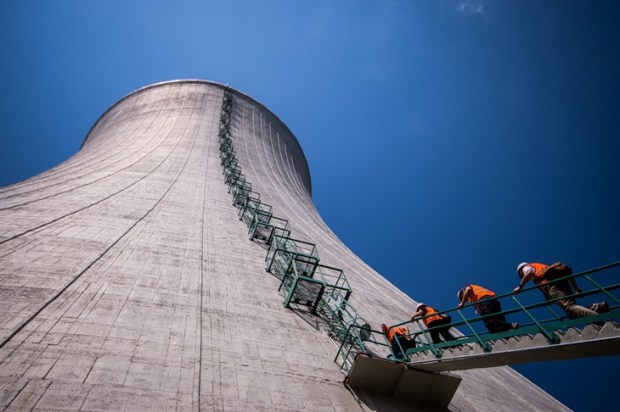
Aside from heightened security around European energy stations, regular joint military operations with America, and the fast-tracking of democratic nations into the Nato family, hot-war drills have begun in civilian areas.
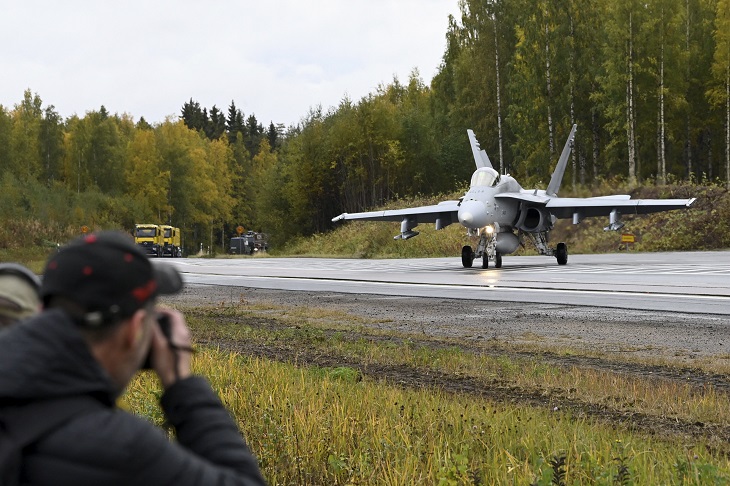
Late last week, Finland closed a major motorway so that it could give its fleet of fighter jets room to practise take-offs and landings on a 2km stretch. Utilising public roads is something that happens when military bases come under attack and the nation’s forces have to get creative with their defence.
Just quietly, it’s also the reason Australians were furious with the government for allowing Chinese entities to lease rural airports and engage in pilot training. These airstrips are meant to sit in reserve as strategic assets. Regardless of how peaceful you believe your neighbourly communist dictatorship to be, you shouldn’t let them practice in your airspace. (This is still going on.)
Finland is not as foolish as Australia, although it has been decades since it conducted this sort of road-based exercise because it requires significant disruption to traffic. It is a sign that the government is genuinely concerned about Russia’s war of aggression in Ukraine spilling out into the rest of Europe as Putin goes on the march to recapture escaped territories and – who knows – maybe pick up a few new ones on the way through.
It took several days for Finnish authorities to clear the road in Joutsa. The work was completed last Wednesday with photographs released over the weekend showing citizens watching the incredible sight of jets shooting down the highway. Over 200 people were involved in the operation with F/A-18 Hornets and Hawk Mk 51 planes joining an assortment of other aircraft.
There are a dozen or so of these ‘reserve’ runways in Finland. No doubt we will see more of them tested in the weeks to come.
‘Mainly I imagine all of the highway bases are in fairly good situation so simply taken into the operations in a few days,’ said Colonel Vesa Mantyla, head of the Finnish Air Force. He added, ‘The menace from Russia or the actions from Russia with the cruise missiles and ballistic missiles proves that the idea of dispersed operations is true.’
The Finns have been warned that they should be prepared for the countryside to be rapidly turned into both a launching pad and training ground for the military at short notice. These things take space and so, for the moment at least, the globalists can thank the few remaining country-folk for preserving the land. At the same time, the Finnish navy is running joint drills continuously.
It seems the UK got out of the mess early, with the ‘open borders’ dream of the European Union crumbling at the first signs of territorial aggression. Tens of thousands of Russians are running away from Putin’s war, with the bulk of them fleeing into Georgia and Mongolia. Others are rushing to sneak through Finland’s border, which is in the process of shutting to Russians entirely, including tourists. The British Ministry of Defence said that those fleeing Russia at the moment are overwhelmingly from the educated middle class. Dying on the streets of Ukraine is not high up on their list of things to do.
The post-war years have made nations lazy about their security. Finland is guilty of this, with most of its borders comprised of cattle fences or natural rivers – designed for stopping livestock, not armies. Finnish authorities are making plans to build 80 km of emergency fencing.
In the meantime, both Finland and Sweden are clawing to join Nato with the deputy Secretary Mircea Geoană addressing the Helsinki Security Forum last week (whose theme was ‘Northern European Security Redone’) saying that, ‘Having allies on all sides of the Baltic Sea will change the strategic environment in the region and make the defence of the Baltic countries easier.’ He later said, ‘Finland and Sweden will make our alliance stronger, more resilient, and more integrated in the world around us.
Turkey, the nuisance of Nato, has threatened to block their application. Turkey and Hungary are the only two nations in question for the required unanimous vote, although it is likely both will agree if a few military sweeteners are tossed in by America.
While Nato never had any designs on Russia, existing primarily as a defensive network for nervous European nations frightened of Russia’s habit of violently annexing neighbouring territories, it is set to grow into a genuine anti-Russian force entirely of Putin’s paranoid making. Living like an anointed Tsar with communist characteristics in his palace, Putin has forgotten that liberated USSR nations don’t want to ‘come home’ and the world – terrified of another second-world-war-Russian-predator (this time on the arm of China instead of Germany) – is prepared to defend the Ukraine line in the sand. As for the ‘elections’ held in occupied territories, the UN is unlikely to accept the result of votes conducted at gunpoint in regions whose populations have deserted or been left as murdered bodies on the streets.
By in large, European nations are perplexed and angry with pro-Russian sentiment coming out of distant Western democracies such as Australia and America who see the ex-KGB operative as some kind of defender of the conservative faith or figurehead for the anti-Woke movement. The nostalgic fiction of Russia is nothing like the violent aggressor that keeps Europe awake at night. It’s the same kind of thinking that allows our UK counterparts to view China as a passive economic entity rather than the dangerous Pacific coloniser that it really is.
Those who live in the shadow of tyrants see them more clearly than foreign apologists.
Eventually, everyone will be given a good look at the leadership of Russia and China – just as the press and celebrity class last century eventually realised that their obsession with Hitler and Lenin was severely misguided.
Whether Europe descends into a local war depends entirely on Putin’s desire for ‘rebuilding the empire’. If he persists, and European forces get serious, Putin could end up losing not only Ukraine, but occupied Crimea as well. This is partly because Western leaders have always known that they will have to fend off both Russian and Chinese aspirations. As to whether or not nuclear war is on the table, Putin would have to be an idiot to destroy Ukraine’s food-growing areas and mineral reserves – which are the primary reasons (as well as the strategic seaport) for invading.
There are significant implications for Australia.
Aside from the insanity of our politicians giving Ukraine our limited military assets (which Australia requires for domestic defence), it has long been acknowledged that our most powerful ally, America, can only win one war – either against a full-strength Russia or China. To this equation, Putin has offered an unintended answer. Defeating Russia in Ukraine and weakening its army strips China of its military bedfellow and pushes India up in the league of regional forces. This makes it increasingly dangerous for Xi Jinping to launch a Pacific war in search of Taiwan.
European wars may be a long way from Australia, but the fate of the Pacific likely rests on Putin’s defeat. A Russia left to lick its wounds is the only way Australia and its Pacific neighbours can stay out of Xi’s clutches.