Come breeding time, around 10 million Adélie penguins swarm the Antarctic shoreline. They ensconce themselves along the rocky beaches and low cliffs like a civilisation of misshapen dominoes that topple over repeatedly as they waddle and hop across the landscape, taking in good humour the cruel hand of evolution.
Watching these lardy birds scale the violent cliffs as the tides smash them off into the swell teaches humanity a thing or two about perseverance.
An Adélie’s chief concern is nest-building. It is something they create out of the black and grey pebbles that make up Antarctica’s gravel beaches. Even though there are millions of penguins, there are plenty of pebbles to go around. An industrious penguin need only mine the nearest square foot for the hundred stones he needs for the task.
It should be easy, but Adélie penguins are enthusiastic thieves.
They waste an enormous amount of time pilfering choice pebbles from nests across the colony. Each penguin burglar races back to their home with a stone clutched in its beak – flippers flapping madly. While they were away, their nests have been similarly raided leading to a colony-wide arms race and ridiculous pebble-redistribution effort that only ends when the eggs drop.
Scientists have tried painting a single nest and discovered those coloured stones appearing across the whole colony, such is the extent of the pebble problem.
If you think stone-thievery is a ludicrous quirk confined to frosty Southern birds, you’d be wrong.
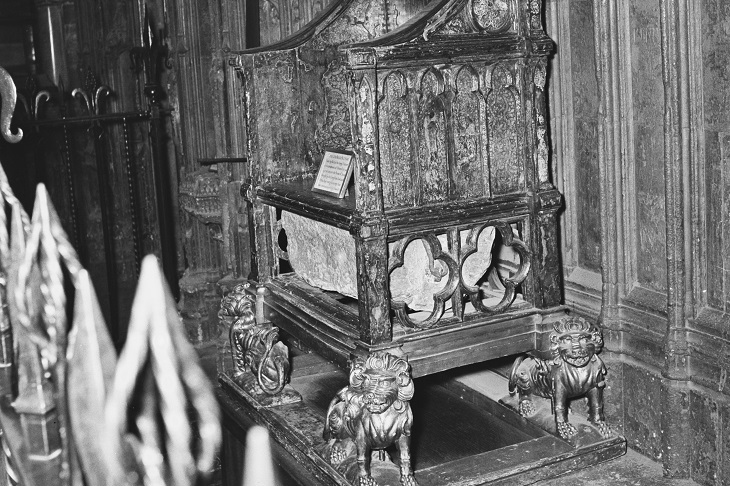
The Coronation Stone – upon which King Charles III will be officially crowned – has been ferried around lots of European nests by kings, conquerors, sweaty uni students, and outraged bureaucracies.
Also known as ‘The Stone of Destiny’ or ‘The Stone of Scone’, it is a 152 kg roughly-shaped oblong lump of red sandstone that is placed beneath the monarch’s chair upon coronation as part of a tradition dating back nearly a thousand years.
The stone’s early history is a contradictory mix of mystery, myth, and guesswork.
Scotland had used the stone in the crowning of its ancient monarchs for many centuries until the rock was nicked from its Scottish nest in 1296 during the First Scottish War of Independence by King Edward I (Longshanks) of England. He then commissioned a throne to sit in Westminster with the stone – using the sacred artefact to lend weight to the coronation. The stone remained there, crowning kings and queens, until Christmas Day in 1950 when some brazen student rock thieves broke in and dragged it to Arbroath Abbey before being eventually recovered.
England gifted The Stone of Destiny to Scotland in 1996 on the proviso it be allowed to make the odd trip back to Westminster when there’s a king or queen that needs crowning. This will happen for King Charles III.
This stone is probably not a Scottish native, but rather pilfered from other nests much farther abroad.
Legend has it that the sacred stone was brought from Spain or Egypt. The Biblical version names it as the Stone of Jacob from the Old Testament while another account says that it was taken from (the much closer) Ireland in 500 AD by Fergus, son of Erc – the first King of the Scots. As the story goes, the stone was brought to Argyll where he was crowned upon it, thus beginning the tradition of stonely-coronation. These legends sometimes name the stone as Lia Fáil which is Irish for – no prizes for guessing – ‘stone of destiny’ named after Ireland’s old name Inis Fáil or ‘The Island of Destiny’. In this story, it was the Irish who began the tradition of crowning their High Kings of Ireland upon it – and the Scots who are the thieves.
However, the stone is geologically linked to the area of Scone meaning that either many of the romantic stories about the stone are fabrications – or that there is more than one stone being dragged around. Perhaps a bit of both?
In the hundreds of years since its arrival in England, the stone has been hidden repeatedly including famously during the second world war to keep it out of the thieving paws of the Nazis. It’s one thing for England, Ireland, and Scotland to pilfer from each other’s nests, but no one invited the Germans!
For a while, it sat in a dank vault under Abbot Islip’s Chapel, concealed among the lead coffins as a grim secret known only by a few trusted people with a series of maps sent in sealed envelopes to Canada in case those men should die and the precious stone become a Holy Grail quest.
Even in war, any suggestion that the stone should be sent to Scotland for ‘safe keeping’ created a bit of friction…
‘I trust the Office of Works will not lend itself to this attempt by the Scotch to get hold of the Stone by a side wind.
‘You cannot be so simple as not to know that this acquisitive nation have ever since the time of Edward I been attempting by fair means or foul, to get possession of the Stone, and during my time at Westminster we have received warnings from the Police that Scottish emissaries were loose in London, intending to steal the Stone and we had better lock up Confessor’s Chapel, where it is normally kept.’
Given all this prior effort to cement the rules of ‘finders keepers’, it seems extraordinary that the stone was later thieved by a pack of students. Mind you, those idiot students – far from being patriotic – broke the stone in half during the theft, desecrating the sacred object.
It was Her Majesty Queen Elizabeth II who formally returned the stone to Scotland in 1996, 700 years after Edward I. The Scots offered no challenge to it being returned for the coronation of the Queen’s son.
At the end of the day, there is no shortage of red sandstone – nor does the Stone of Destiny hold any special powers. Why does a lump of rock make humans act like brooding Adélie penguins? Why do humans and birds alike fight over bits of rock on a planet made of stone? That this stone many not be the original is immaterial. All that matters is how we feel about it. Our attachment to inanimate objects is as inexplicable as our love for distant figureheads – but it endures, nonetheless.