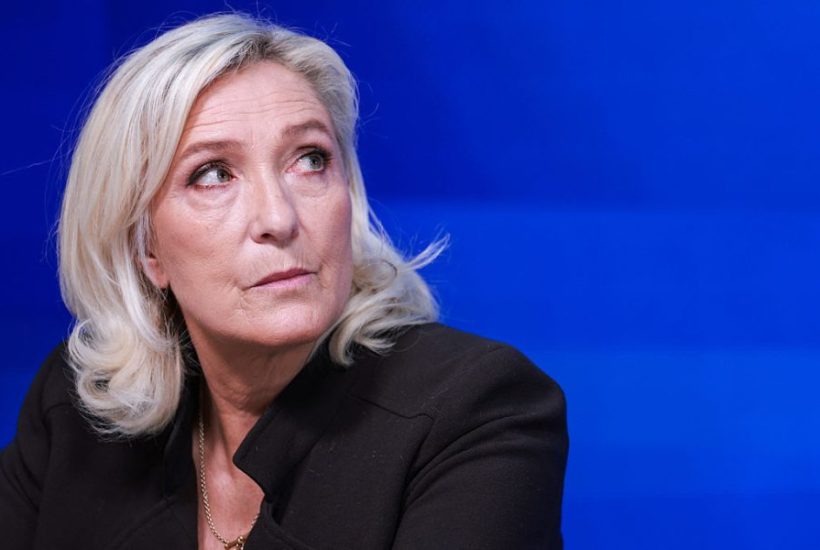
It’s been a difficult week for Marine Le Pen. Two opinion polls found that she has dropped a couple of percentage points, and that was before a series of minor scandals rocked her National Rally party.
She remains the frontrunner in the presidential polls but picking up the pace behind her is David Lisnard, the man I described last month as the closest the French have to a Tory. This week, the conservative Le Figaro went even further, hailing Lisnard as ‘Thatcher in a suit’.
He probably liked that description, as did many of his growing number of supporters, social conservatives and economic liberals who are terrified at the prospect of a second round run off between Le Pen and the far-left’s Jean-Luc Melenchon; when it comes to economics, they’re as left-wing as each other.
The ascension of Lisnard from rank outsider to genuine contender isn’t the only reason for Le Pen’s furrowed brow. This week charges of anti-Semitism have been levelled against Le Pen’s No. 2, Jordan Bardella, and Laure Lavalette, one of her senior lieutenants. It’s not the first time Bardella has been accused of the world’s oldest hatred this autumn and he continues to plead not guilty.
If Le Pen is laid back about Lisnard, why has she unleashed the attack dogs?
Not so Lavalette, who admitted to being the chair of a student union in the 1990s whose magazine ran anti-Semitic articles. Saying that she ‘wouldn’t do the same thing now’, Lavalette tried to close down the story by telling reporters that ‘I’m not going to justify what happened 30 years ago in a climate that was completely different’.
Le Pen is standing by Lavalette but there was no mistaking her irritation at being dragged into another controversy. ‘When you’re young and foolish, the important thing is to be less so when you’re older,’ said Le Pen.
The third scandal involves the opening of an investigation into allegations that a senior civil servant leaked confidential information to the National Rally when he worked at the Ministry of the Interior. Le Pen denies any knowledge of such a leak and the civil servant has described the allegations as a ‘politically motivated operation’.
Le Pen made a similar claim in the spring of 2025 after her conviction for misusing EU funds. It was a ‘witch-hunt’, she told supporters, and a ‘political decision’ and she vowed never to stop fighting.
Le Pen will have been braced for a ferocious presidential campaign but what’s clearly taken her by surprise is the emergence of Lisnard. They may have nothing in common economically – Le Pen has savaged Lisnard’s promise to put France’s 3,000-page Labour Code ‘through the shredder’ – but they do when it comes to dealing with the crises of uncontrolled immigration and galloping insecurity.
Le Pen feels threatened by Lisnard. During a television interview on Wednesday evening, she spent several minutes attacking Lisnard’s economic liberalism, prompting the host to suggest he had got under her skin. Le Pen didn’t appreciate the remark. ‘I feel no anxiety about any of the presidential candidates,’ she retorted. ‘It’s the journalists who are getting all worked up today…we love a bit of novelty when we’re journalists.’
But if Le Pen is laid back about Lisnard why has she unleashed the attack dogs? One after another this week, her senior lieutenants have taken to the airwaves to denounce Lisnard as a ‘closet Macronist’ and ‘the Macron of the Croisette’. The latter phrase was apparently coined by Bardella and refers to the Boulevard de la Croisette, the main seaside promenade in Cannes, where Lisnard is mayor.
Macron is political Kryptonite in 2026. Even his two former prime ministers who are running for the presidency have gone to great lengths to distance themselves from the man in the Elysée. But it’s too late: Édouard Philippe and Gabriel Attal are floundering in the polls because they are seen as Macron’s men.
Lisnard never served Macron in any capacity. He has admitted that they were in regular contact a decade ago when Macron launched his party, En Marche, but Lisnard chose to become the 2017 presidential campaign spokesman for the conservative candidate Francois Fillon.
Lisnard this week summarised his election manifesto as ‘the revolution of common sense’. He wants voters to ‘play their part in the nation’s recovery’ by unleashing their potential. Hitherto this has been impossible because the state keeps ‘stifling them with taxes and regulations’. He promises to reduce France’s 5.8 million civil servants by half a million and raise the age of retirement from 62 to 65.
For the moment everything is going swimmingly for Lisnard; he’s on the cover of magazines and on the front pages of newspapers, and he’s forever cropping up on television and on the radio. As Le Pen said, journalists do enjoy a novelty.
That may change if Lisnard’s ascent continues into the new year. The left-wing media in France is powerful; the moment they feel Lisnard has passed from being a novelty to a presidential threat it will be their attack dogs let off the leash.