Small boys have always had big parts in fables – putting fingers in dykes, crying wolf, climbing beanstalks and so on. But none has had a more enduring influence that the one who drew public attention to the sartorial shortcomings of his head of state. I think of this boy whenever I visit Sydney’s Museum of Contemporary Art. Or rather, I think of my own boy, aged 11, after I’d taken him round New York’s equivalent institution and tried to convince him that Mark Rothko’s colour field canvases couldn’t have been painted by the guy who’d just done our kitchen, and that Jackson Pollock’s action paintings couldn’t have been done by a chimpanzee. Suffice it to say that asked later what he thought of MOMA my son told me, with the gravitas of a clinician giving me the results of a biopsy, that M-O-M-A stands for Museum Of My Ass.
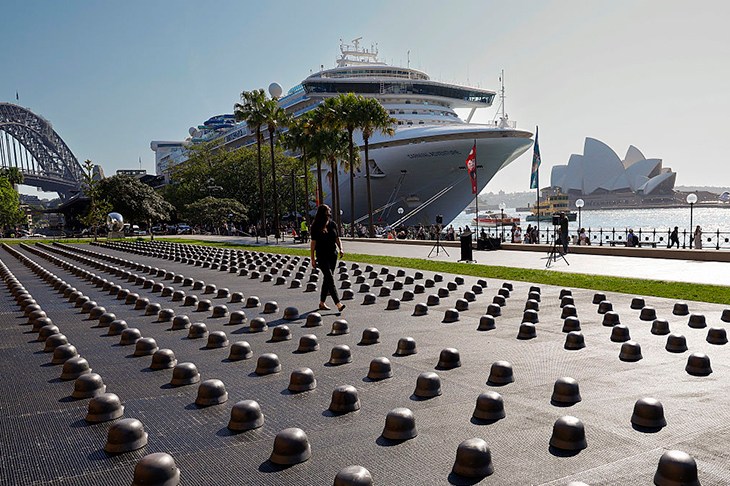
Since he still lives in the US, I don’t know what my son would think of the 500 faux Wehrmacht helmets currently despoiling the lawn in front of the MCA. Google won’t tell you what the Balnaves Foundation paid Chinese artist Ai Weiwei for ‘Mushrooms’, or what it cost taxpayers to have it installed at Circular Quay. But we can assume that MCA management didn’t canvass public opinion before the project was green-lighted. And even if they had – if the Sydney Morning Herald had published an AI preview and thousands of readers had registered their outrage – it’s doubtful whether anyone at the MCA would have paid much attention. This is, after all, the gallery whose inaugural foray into public art was putting Jeff Koons’ monstrous topiary eyesore ‘Puppy’ on the same spot.
We shouldn’t judge the MCA’s inaugural curator too harshly for that. After all, Koons had already pulled the wool over the eyes of most major European and American galleries. And in 1995 more discerning Australian pundits could still explain ‘Puppy’ the way their predecessors had criticised the Whitlam government’s purchase of ‘Blue Poles’; as evidence that the cultural cringe was still a thing. But no such excuses could be given for the MCA’s decision, twenty-five years later, to display the work of Vincent Namatjira, a man whose lack of artistic talent is as conspicuous as the genius of his great-grandfather. The only possible mitigation being that when tartan-Doc-Marten curator-in-chief Elizabeth McGregor invited Namatjira minor to besmirch the MCA’s walls, he’d already won that year’s Archibald Prize with the kind of daub in which only a primary school teacher would ordinarily see merit. Depressing proof that the Art Gallery of NSW was by then no less in thrall than the younger gallery to the DEI agenda of the progressive left.
Ai Weiwei says he likes Australia, and it’s easy to see why. While many Western art establishments have grown weary of his monumental virtue-signalling, most Australian reviewers have been remarkably restrained about ‘Mushrooms’. The artist must also have a particularly soft spot for Sydney, since this is not the first stunt he’s foisted on the city. Readers may remember, with embarrassment, ‘law of the journey’, the supersized, overloaded inflatable dinghy which was his contribution to the 2020 Biennale. Neither ‘law of the journey’ nor ‘Mushrooms’ would have impressed any contemporary selection panel, of course, if it wasn’t the MO of their creator to tell anyone who’ll listen what his sculptures are supposed to represent; in these cases, the plights of, respectively, North African refugees and war-ravaged Ukrainians. The two pieces also exemplify, between them, a post-modernist principle to which Weiwei is by no means the only modern artist to owe his reputation: that objects of no intrinsic interest or aesthetic value can be invested with both if they are duplicated either on a grand enough scale or in great enough numbers. This maxim might go some way to explaining the enduring popularity of the giant roadside fruit, vegetables and animals which cheer up the outskirts of some of our regional towns, and perhaps also the continuing popularity of patterned wallpaper in our homes. But whether such anodyne exercises in magnification and multiplication deserve the same kind of attention we give to the work of real artists like Arthur Streeton, Albert Namatjira and Margaret Olley is surely a question worth asking. To answer it, I suggest you make a point of visiting Circular Quay yourself. And if possible, take a small boy with you, show him ‘Mushrooms’ and then ask him what he thinks the letters M-C-A stand for. I’m pretty sure my 11-year-old son would have said Museum of Con Artists.
Got something to add? Join the discussion and comment below.
You might disagree with half of it, but you’ll enjoy reading all of it. Try your first month for free, then just $2 a week for the remainder of your first year.