Hello, what’s this I see before me? A blank page; and a pen unencumbered by the heavy weight of BBC News impartiality. I still present University Challenge, it’s true; but having left the Today programme, perhaps I can now asseverate opinions that a fortnight ago would have got me sacked. This feels good! Here goes…
Dominic Cummings was right. I’m referring, obviously, to a speech he gave to the IPPR in 2014. It’s on YouTube and, being something of a weirdo and misfit, I have watched it a dozen times at least. His peroration can be distilled to three propositions: first, the trouble with Britain is that whoever is elected, the system (aka the civil service) always wins; second, the system is utterly, hopelessly unequal to the demands of our era; third, the people who do get things done are entrepreneurs and scientists, with their bias toward action, rather than members of the system, with their bias toward process. Is he wrong? Andy Burnham’s cabinet seem to agree. Perhaps they suddenly descry what, in a different context, the editor of this publication called the Blob.
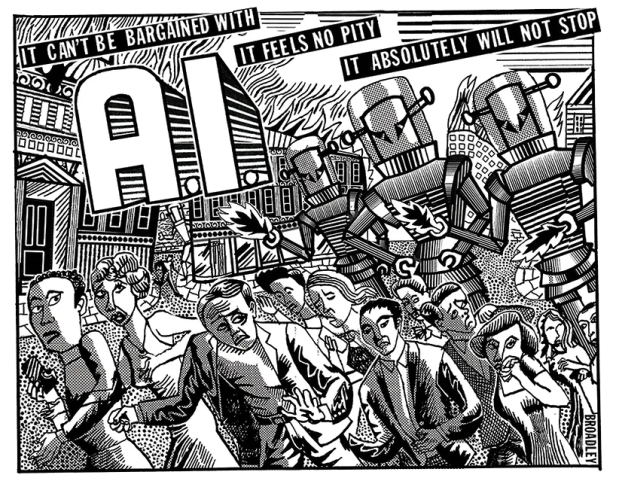
The central challenge of our age is the gap between what the people need and what politics delivers. We really have replaced the rule of law with the rule of lawyers. Many of the big projects that threaten to emancipate us from the vortex of decline – HS2, the Lower Thames Gateway – become bywords for incompetence. We haven’t built a city for 60 years or a reservoir for 35. Pre-Budget chatter – ‘limited fiscal headroom’, ‘tough choices’ – is farcically myopic. On Today, for years I’ve been screaming inside, wanting to say: ‘Guys! We are about to get a century of change in a decade. Our country has been stagnant for 20 years. The post-1945 order has collapsed. AI offers thrilling promise, and peril. Get real!’ Now that I’m on YouTube, I guess I can say it, and will.
OK, what else? Ah yes, here’s another bias: I confess I have tried very hard for years to raise the alarm on our national debt. Most of the country’s emergencies, such as a million young Neets, are chronic. This is acute. It is – how can I put this? – suboptimal for a nation’s second biggest item of expenditure to be servicing its debt. I remember when our debt crossed a trillion (it is now £3 trillion). Whenever I bemoaned our debt on air, learned professors protested, arguing debt only matters if you’re not growing. I pointed out Britain’s unique exposure, in part because of our high proportion of index-linked debt, known as ‘linkers’ (Word of the Year 2027, I predict). Yet in my view, debt should be recast as a moral monstrosity. Why should our children get the bill for our fiscal incontinence and profligacy?
You will have noted that all these strong opinions are simply common sense. I have never struggled with impartiality, being rather heterodox in my views. But my politics has evolved in two directions. I now give much greater weight to leadership, and to contingency; or, if you like, to having a character that meets the moment. I can’t see that character in Westminster – yet.
In politics, all ‘-ism’s’ should be considered guilty until proven innocent. Yet I have long lamented that ‘capitalism’ and ‘socialism’ are taken, because I am a capital-ist and social-ist. On the former, Gary Becker’s theory of human capital is underdeployed; and when it comes to the economic variety, obviously we need to spread ownership. (By the way, Andy Burnham is our first PM to represent the Co-Operative party). On the latter, we are living through a crisis of community and connection. The essay which inspired Robert Putnam’s seminal Bowling Alone is three decades old. All the trends he highlighted have accelerated. An update is needed. Scrolling Alone? I might write it.
I have a theory about ex-BBC staff, which is that the degree to which they slag off the Corporation that gave them their career, pension, panjandrum status etc is determined by the manner of their departure, and whether they achieved the position they dreamed of. On both scores I have zero regrets, so perhaps readers will indulge me for a moment. In the press, a common narrative about Today is that it is losing listeners because of the BBC’s cultural biases. This betokens the dire state of media analysis. Today is no den of wokeness, trust me. And the real story is not how many listeners it’s lost, but how many it’s kept: 5.7 million in an era of almost infinite choice. Contrary to most ‘formers’, I hope I’m still championing the BBC a decade from now – and that there is a BBC to champion. How’s that for impartial?
Got something to add? Join the discussion and comment below.
You might disagree with half of it, but you’ll enjoy reading all of it. Try your first month for free, then just $2 a week for the remainder of your first year.