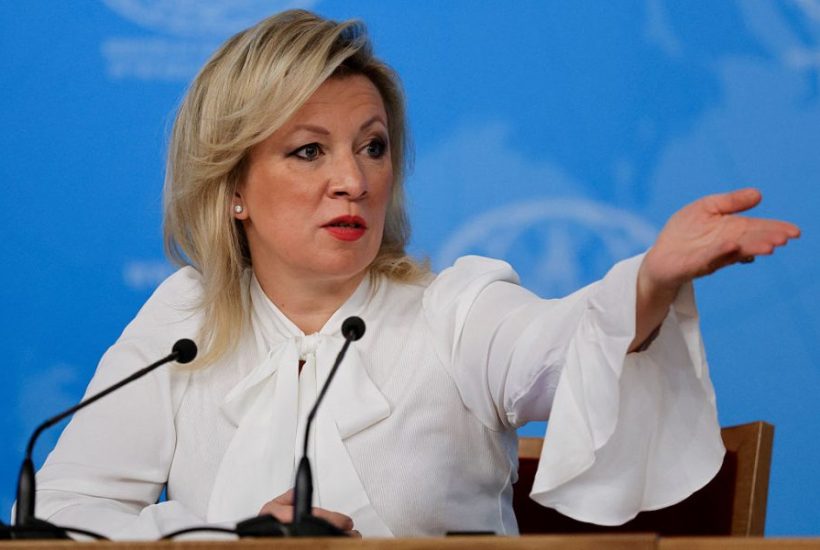
The latest statement from Maria Zakharova, the reliably acerbic spokeswoman of the Russian Foreign Ministry, has generated considerable interest and concern amongst the British chattering classes. And that was no doubt the idea. In the course of one of her regular press briefings, she delivered a characteristically robust warning:
We call on all residents of the United Kingdom to consider the inevitable catastrophic consequences of their own government’s hostile actions. We urge the British leadership to once again thoroughly analyse the situation and immediately and decisively abandon its hostile, aggressive policy, which can only prolong the agony of the Kyiv neo-Nazi regime and create the risk of escalating the conflict to a fundamentally new level… We have repeatedly warned that the response to Ukrainian strikes using British weapons on Russian territory could be against any British military facilities and equipment in Ukraine and beyond.
Given the context, coming as it did in a week in which Andrei Fedorov, who had been a deputy foreign minister of Russia, warned that he could not ‘100 per cent exclude’ the possibility of ‘semi-military’ operations against targets in Britain, it was perhaps inevitable that this led to alarm from some quarters and bluster from others.
We have heard it all before, many times since 2022
Cutting through the familiar rhetoric about ‘the Kyiv neo-Nazi regime’, though, there is much less to Zakharova’s statement than meets the eye. It offers, instead, a masterclass in repacking old talking points in a dramatic way, not as a precursor to some kinetic attack, but rather as an alternative: rhetoric as an instrument of war.
First of all, we have heard it all before, many times since 2022. Britain arming Ukraine at the outset, providing it with Challenger 2 tanks, then Storm Shadow missiles. All of these were presented as crossing some fearsome Kremlin red line, and each time serious but conveniently unspecified consequences were threatened.
Of course, since then the UK, like other European countries, has experienced a growing campaign of ‘hybrid war’ incidents, from arson attacks to online hacks. The country has also experienced a huge number of incidents which had nothing to do with Russia but which were quickly assumed to be part of a nefarious Muscovite plot. Remember the drones that shut down multiple European airports last autumn? Most turned out to be false alarms or unconnected with Russia. Or the fire at an electrical substation last March that shut Heathrow down? Commentators and politicians rushed to blame Moscow, but it turned out to down to delayed maintenance.
This is not to deny that the Russians are launching increasingly aggressive ‘sub-threshold’ attacks on countries that they regard, not unreasonably, as indirect participants in the Ukraine war. Instead, it is to highlight the way that it is in the Kremlin’s interests to talk up the threat. The more we see Putin’s hand in everything that goes wrong, the more we, in effect, elevate his status and amplify his coercion.
The Russians have long warned that any Nato troops deployed directly into Ukraine would be considered legitimate military targets (and this is one of the reasons why the much-vaunted ‘Coalition of the Willing’ is so often the ‘Coalition of the Cautious’). By vaguely suggesting that this could be extended into the UK – ‘could’ is doing a lot of work there – Zakharova is out to make us take notice and be afraid.
Just as with the periodic hints that Russia could – again with the ‘coulds’ – use nuclear weapons, Moscow wants to intimidate, to convince at least part of European society that this is a conflict which could spiral out of control, and lead to all-out war and Armageddon. The hope is that they will in turn bring pressure to bear on their governments either to disengage from Kyiv or try to lean on it to end the war on Russian terms.
Likewise, the rhetoric used by Zakharova and the rest of the Russian spokesphere is always about presenting Moscow as responding to Ukrainian or Western aggression. Aggression becomes reframed as consequence, terror attacks launched more in sorrow than in anger.
Despite the wild speculation around CIA director John Ratcliffe’s unexpected and unexplained visit to Moscow, there is no concrete evidence that Putin is preparing for some imminent direct attack on the West, even though his shadow campaign of subversion and sabotage will undoubtedly continue.
There may be scope for more pointed responses in kind, such as cyberattacks on Russian targets, but this is much less easy than the more gung-ho pundits believe. In the main, though, Europe must up its game in both resilience and counter-intelligence but also keep calm and carry on. Putin wants us to be scared – we can choose whether to give him what he wants.