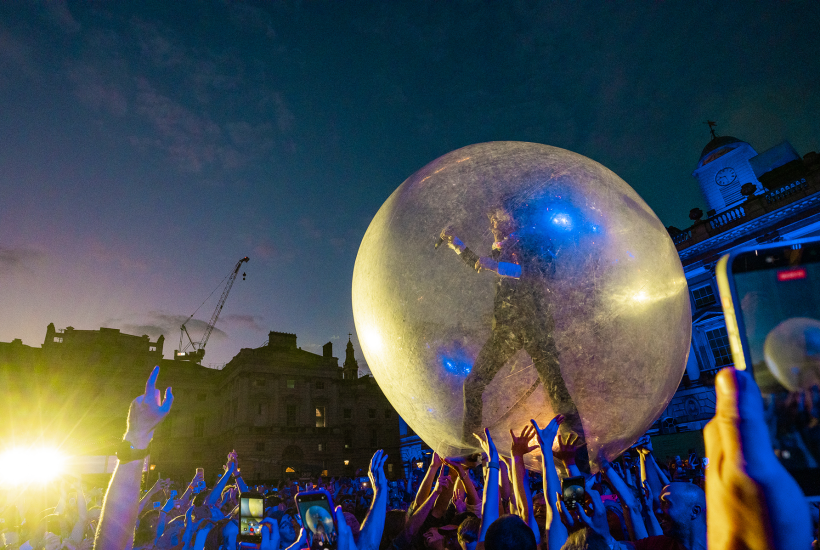
It would be difficult to do certain shows in the courtyard of Somerset House. One can’t really host anything too confrontational in a Georgian quadrangle: the clash of surroundings and sound would be too jarring. So instead the annual Summer Series tends to gravitate towards the feelgood or the inspiring, which is perfectly fine. However, if you go to more than one of the shows, it can feel as though you are watching some variant of the same performance.
Flaming Lips and Black Country, New Road are very different bands at a surface level. The former – a psychedelic band formed in the early 1980s in Oklahoma City who, somehow, after nearly 20 years, catapulted to success at the end of the 1990s – come from outside the pop industry. The latter started a little before the pandemic and were hailed from the very start, though they have become a rather different band now. What both have in common, though, is a gauziness – a dreaminess that seems largely unconnected to the real world.
Flaming Lips, playing two sets, took the approach that more is more, as they always do. Their stage was festooned with inflatables – balloons, beach balls – with costumes and digital screens: a feast for those who enjoy hallucinogens. BCNR didn’t bother with the fripperies, simply offering musicians on a bare stage. But at both there was a strong element of what the musician Will Sheff of the band Okkervil River once described to me as ‘the court music of the ruling class’: indie music.
The Lips became popular at a very different time – in a culture broadly suffused with optimism. That was reflected in much American alternative music back then, with scores of bands (many, like the Lips, produced by Dave Fridmann) writing music that appeared to suggest that any adversity was a minor hurdle; that all that remained in life was to dream. Collectively, they were like a musical Francis Fukuyama; and their end of history was music that only looked in on itself.
Projecting Wayne Coyne’s lyrics on to screens didn’t help, because he is simply not a very good lyricist. The words are fine as part of the noise, but presented as written text, they are doggerel: ‘Every time a dragonfly flies by, it’s you’, ‘If you could watch everybody work while you just lay on your back/ Would you do it?’ After a while it was as though someone were flashing up lines from a picture book for little kids – the kind with the Important Messages about being nice to everyone.
When they first appeared, BCNR sounded like a southern, middle-class version of the Fall playing some sort of hybrid country music. Their original singer departed after one album, and the strange apocalyptic element disappeared. Instead of one man, three women now share the vocals, with a marked softening effect. What intrigued me was that I was with a friend who loves this kind of music – gentle, folkish, melodic – so much so he puts on shows and releases records by not dissimilar bands, and he was bristling at it. He felt the way I did a couple of nights later at the Lips: all very pleasant, but dear God, the world is burning under a desert sun, and this is the best you’ve got?
Collectively, they were like a musical Francis Fukuyama
It’s of course wildly unfair to blame pop singers for not having much to say about the world, especially when what they have to say is usually so forgettable. Meaningless platitudes are, however, preferable to Graham Nash telling us about the plight of the whales: ‘It’s a shame you had to die/ To put the shadow on our eye’. But both these shows felt like opiates rather than stimulants, right down to BCNR opening with a cover of Wings’s ‘Band on the Run’, Paul McCartney being probably pop’s most notable purveyor of ‘don’t worry it’ll all be fine’ music.
Art always exists in a context. And I’m not sure the context of this benighted summer really suited either of these bands. Both are fine groups, and I’ve enjoyed them before, but both summon only one mood in me. Usually it’s a benevolent but not overwhelming admiration. In the oven of the London heat, it was mild irritation.
Got something to add? Join the discussion and comment below.
You might disagree with half of it, but you’ll enjoy reading all of it. Try your first month for free, then just $2 a week for the remainder of your first year.