How do you produce the type of person who cares deeply while seemingly not giving a damn? With great difficulty, it turns out. Plenty of people imagine that they can say what they think, but very few do. For most people, some real or imaginary social punishment lies on the horizon: a dinner they won’t be invited to; a club of which they fear they will never become a member.
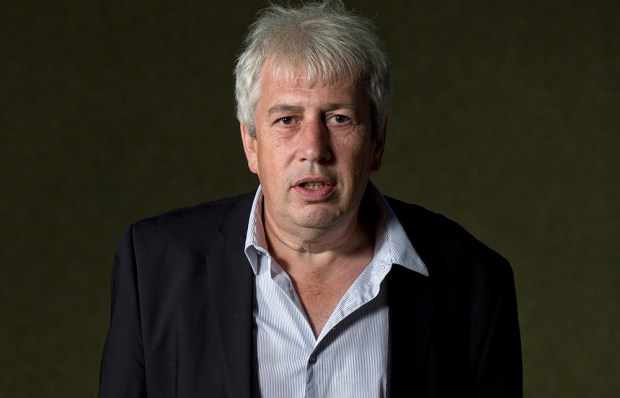
Rod Liddle was one of the happy few who was free. He was free to say what he thought. He was free to voice unpopular opinions and – often harder – he was free to voice popular opinions. When the whole world seemed to be falling on his head he had a perfectly contented attitude towards it. I remember a few years back when there was a Rod storm (always caused by people who don’t read The Spectator taking some line – usually a joke – out of context), I asked him how he was doing. If I remember rightly the evening news had actually done a segment in which an interviewer had read out portions of Rod’s latest column to people on the street, gauging their reactions. These were almost universally bewildered or appalled, because that is what the broadcaster wanted them to be.
In a society in which everyone is meant to say the same thing, the person who refuses to do so is at a premium
Anyway, Rod was fine, of course. Though he did tell me that his latest way of realising he had set off the banshees was that he would be happily sitting in his study and his wonderful wife, Alicia, would arrive in the doorway and give him a look that made it clear that whatever he had just written had become the main news story of the day.
It takes a considerable amount of composure, confidence and certainty in your cause to be unbothered by such hurricanes. But Rod was indeed unbothered by them. On occasion he seemed to enjoy them, as though the howling was a sort of refreshing breeze, reminding him of the insanities of his critics and reassuring himself that he was right.
The role of such a figure in a culture can hardly be overstated. In a society in which everyone is meant to say the same thing, the person who refuses to do so is at a premium. If that person is also driven not by a desire to shock, but by a desire to tell the truth, then they are even more valuable.
That was what drove Rod. Of course he enjoyed the occasional bomb that would shake his editor, copy-editor, lawyer or reader. He even developed a trick which he passed on, which was to plant some obvious firework into a column which would have to be removed, but leave a depth-charge in the hope that nobody noticed before it went off. It was a brilliant tactic.
Better still was the fact that his bomb-throwing was grounded in deep moral causes. He loved this country. He loved its people. He loved the working class who had become such an enemy of the sort of people who normally have columns in national newspapers. He loved Millwall. He loved his family. He loved his wider family of readers and colleagues.
When we last spoke he was in hospital but it looked like things were getting better. I was optimistic for his return, as was he. But he also had what he described to me as a zen-like attitude towards the possibility that everything was coming to an end for him. He told me that he had a slight attitude of ‘my work here is done’. We laughed at the idea of him as a do-gooder, but that is in fact partly what he was. He gave people the confidence to be more honest, ask more questions and put up with less cant.
I hope he knew how appreciated he was. A few years ago, The Spectator packed out the London Palladium for an ‘in conversation with Rod Liddle’. I was there and it was magnificent to see one of the capital’s largest theatres filled with readers wanting to see Rod. I popped backstage afterwards and there he was on his own, changing T-shirts and sizing up a bottle of wine he’d been given as a fee. ‘How was it, mate?’ he asked as I put my head round the door. ‘I have one thing to say,’ I told him. ‘I don’t think Yasmin Alibhai-Brown could have filled this place.’
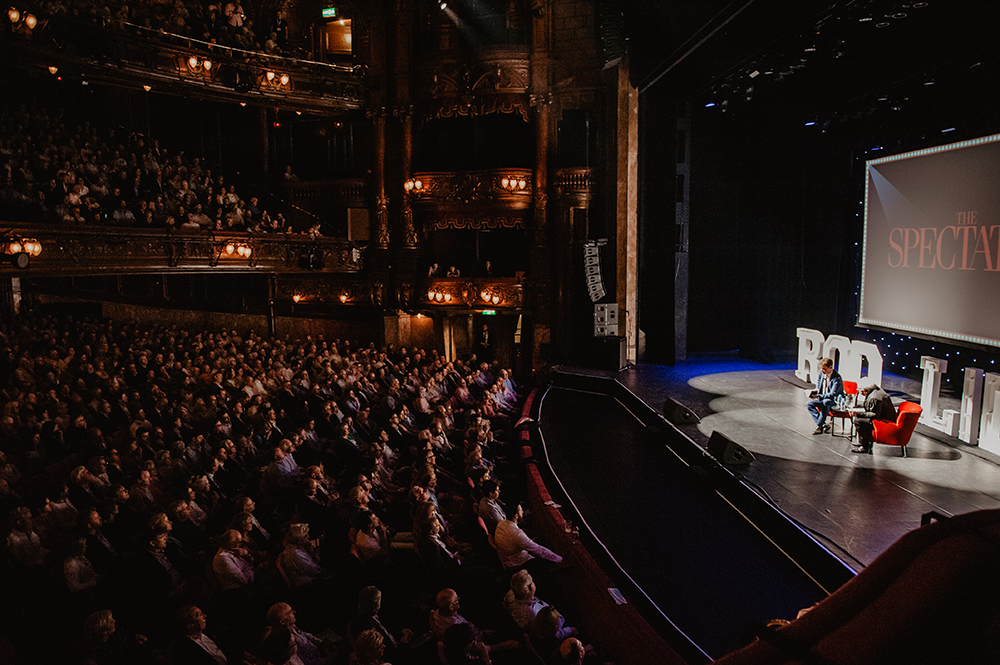 Rod Liddle with former editor Fraser Nelson at the London Palladium (Anne Schwarz)
Afterwards at the pub I asked a few young readers what had brought them out. I remember one of them saying to me: ‘I want to be around people who are saying things I’d like to say some day.’ It was deeply moving, because this instinct was right. Being around someone brave like Rod – or even reading him – had the effect of making other people braver too.
Very few writers have that effect. Christopher Hitchens did. Auberon Waugh perhaps. Like them, Rod had that caring yet devil-may-care attitude. Even as a colleague he freed up others. He and I used to joke when we got together that at least we always had Taki there to give cover. Later I used to joke to Rod that at least he was still there to take any flak that might be incoming.
It’s one of the more minor reasons to miss Rod, but I shall miss him more than I can say. The world just became a bit blander, significantly less amusing and palpably less honest. Somewhat morosely I remember the night he and I were tasked with removing Jeremy Clarke from a Spectator writers’ party. Jeremy was happily dancing on his own in front of a hedge when I arrived. There was no music.
‘Wotcha Douglas.’ ‘Wotcha Jeremy,’ I said. ‘You seem pretty happy.’ ‘I’ve done drugs,’ he replied. Shortly afterwards our Low Life columnist deposited the contents of his stomach on to The Spectator’s garden steps and fell into a bush.
I can’t remember why Rod and I ended up taking charge, but Rod did it far better than me. ‘Why should Jeremy be my responsibility?’ he said to me at one point, exasperated. And yet Rod assumed that responsibility nonetheless. I rarely loved him more than in that moment: harried, amused, exasperated and hoping nobody would notice how much he cared.
Got something to add? Join the discussion and comment below.
You might disagree with half of it, but you’ll enjoy reading all of it. Try your first month for free, then just $2 a week for the remainder of your first year.